DigiTalk Podcast EP44 Recap - Lowering Barriers for Web3 Beginners


分享到朋友或朋友圈
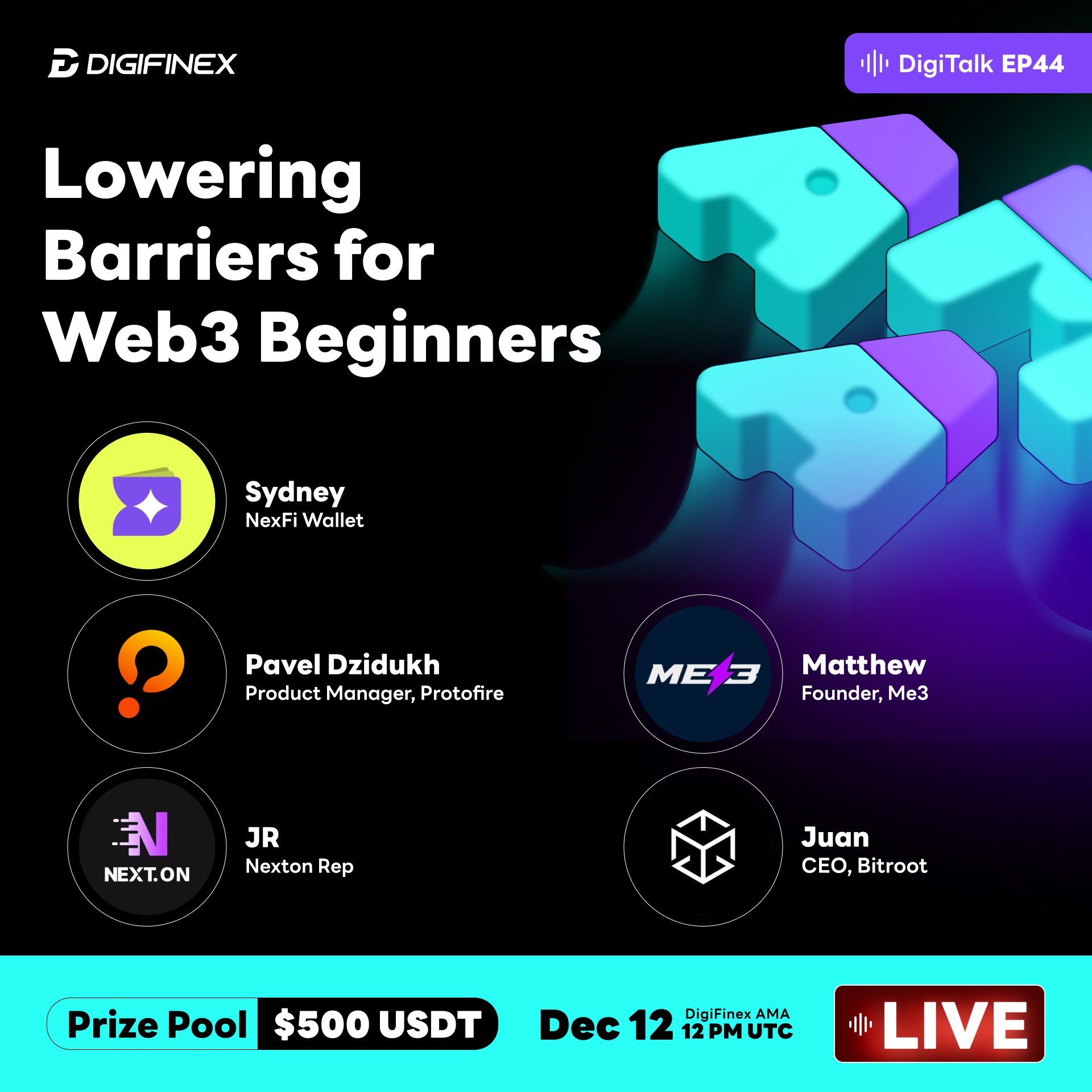
In DigiTalk Episode 44, “Lowering Barriers for Web3 Beginners,” top builders come together to share how Web3 can be made more accessible for newcomers.

Introduction
Protofire
Protofire is a well-established blockchain development studio and growth agency boasting over 7 years of deep expertise in the Web3 space, with a strong emphasis on DeFi product building. They collaborate with leading industry protocols such as Polygon, Balancer, Flare, and many others to deliver large-scale, production-ready solutions that push the boundaries of decentralized finance. Beyond client partnerships, Protofire actively incubates and develops their own internal DeFi projects, nurturing innovation from ideation through to deployment. For aspiring builders or projects seeking robust product strategy, technical development, or growth support, Protofire extends an open invitation to connect. Their team can handle everything from complex infrastructure to user-facing applications. Interested parties are encouraged to visit protofire.io, fill out the contact form, or reach out directly to explore potential collaborations and see how ideas can be transformed into impactful Web3 realities.
Bitroot
Bitroot is building a cutting-edge next-generation Layer 1 blockchain engineered from the ground up with native AI capabilities at its core. The chain incorporates a parallelized EVM for superior performance, high-throughput Byzantine Fault Tolerant (BFT) consensus, and a dedicated AI execution layer that elevates the blockchain beyond simple settlement into a full-fledged on-chain compute fabric. This architecture enables seamless running of AI models, large-scale data processing, and execution of intelligent smart applications entirely on-chain. Currently live on mainnet, Bitroot positions itself as foundational infrastructure for the exploding on-chain AI sector. The team emphasizes that as AI continues to boom, dedicated blockchain layers optimized for compute-intensive workloads will be essential, and Bitroot is leading that charge with scalable, decentralized solutions that maintain security and performance.
NexFi Wallet
NexFi Wallet is an innovative programmable multi-policy payment protocol designed to make cryptocurrency transfers feel as effortless as traditional digital payments—fast, low-cost, and without unnecessary product friction. Supporting more than 35 stablecoins and major cryptocurrencies, it allows users to send, receive, and convert assets in real time through automated smart contract layers, including advanced features like conditional payouts and recovery mechanisms. Security is prioritized with MPC-based non-custodial wallets (plus optional custodial modes for flexibility), while user experience is enhanced through automatic fiat-to-stablecoin conversions and full gas abstraction, removing common pain points. Everything remains on-chain for transparency. NexFi aims to position itself as the go-to wallet infrastructure for everyday users who want simplicity without sacrificing decentralization or control.
Nexton
Nexton addresses a core inefficiency in DeFi: most retail users are locked out of true, sustainable yield because advanced strategies like arbitrage, market-making, and cross-chain trading are too complex, capital-intensive, and time-consuming. By allowing users to simply stake assets, Nexton's AI-powered routing engine takes over—scanning opportunities across all major blockchain ecosystems, executing trades, optimizing liquidity, and managing strategies automatically to deliver institutional-grade returns. With over 60,000 users and a track record of consistently achieving 90% APYs (and strong ROI) over the past year, Nexton differentiates itself by building true multi-chain infrastructure rather than just another yield farm. Launched initially as a Telegram mini-app on TON for frictionless access, it is actively expanding to chains like Base, Solana, and Ethereum, combining ease-of-entry with sophisticated backend automation.
Me3
Me3 is an AI-powered engagement platform that rewards authentic, verifiable user participation across Web3 ecosystems through gamified campaigns and tasks. Since mainnet launch in October of the previous year, it has recorded over 200,000 activations and forged partnerships with more than 75 ecosystem players, including major Tier-1 exchanges for high-impact campaigns. The platform is now transitioning toward a more mature enterprise SaaS and B2C model, with an updated version featuring significantly enhanced AI-driven analytics, deeper data insights, and improved backend intelligence set to launch in the coming weeks. This evolution will be followed closely by the project's token generation event (TGE), signaling a busy and transformative period ahead for the team and community.
Q1: For Web2 users who are curious but hesitant, what usually stops them at the very first step — downloading a wallet, making a transfer, or simply understanding what they’re buying?
Protofire
The single largest obstacle for Web2 users is the sheer complexity embedded in the entire onboarding process. From the moment they arrive at a Web3 application, newcomers are inundated with an overwhelming amount of new information and decisions—selecting from hundreds of wallets, navigating seed phrase warnings, grasping how addresses and transaction flows work, and understanding basic security implications. This stands in stark contrast to the seamless, one- or two-click experiences they're accustomed to in Web2. Even as tools like MetaMask and Ethereum itself continue to iterate on smoother onboarding (through updates aimed at reducing friction), the cumulative cognitive load remains daunting. Protofire stresses that we must always design with newcomers in mind, providing guided, step-by-step flows and educational touchpoints to bridge this gap, rather than assuming professional-level knowledge from day one.
Bitroot
Web2 users are habituated to infrastructure that operates invisibly in the background—click a button, and everything magically works without needing to understand the mechanics. In Web3, suddenly confronting visible, user-managed elements like gas fees, private keys, chain IDs, and the irreversibility of transactions feels like being dropped into a foreign environment without a guide. The fear of making an irreversible mistake (e.g., typing one wrong character in an address and losing funds forever) is a powerful psychological deterrent. Bitroot is tackling this directly through AI-native onboarding designs where the blockchain itself functions as an intelligent assistant—proactively guiding users, explaining actions in plain language, and handling much of the decision-making. The goal is to shift the experience from feeling like operating a raw toolbox to interacting with a helpful, intuitive companion.
Nexton
Two intertwined issues dominate early hesitation: ecosystem fragmentation and perceived insurmountable complexity. A curious Web2 user might hear about an exciting opportunity, but attempting to act immediately confronts them with a dizzying array of choices—which wallet to install, which chain to select, how to bridge funds safely, what tokens actually represent, and basic security best practices. This forces them into the role of instant expert across multiple domains just to take the first step, which is fundamentally unreasonable. Nexton mitigates this by consolidating all necessary functionality into one streamlined interface (starting with their Telegram mini-app entry point). By automating cross-chain routing, security checks, and opportunity execution behind the scenes, users can participate meaningfully without ever grappling with the fragmented chaos that typically overwhelms newcomers.
NexFi Wallet
Many Web2 transplants perceive entering Web3 as stepping into a highly technical, unforgiving financial laboratory rather than a consumer-friendly product. The combination of hidden technical complexities, lack of intuitive guidance, and interfaces that offer little reassurance or error forgiveness creates strong psychological barriers that cause users to retreat early. NexFi Wallet counters this by deliberately hiding complexity under the hood while presenting clean, predictable, and forgiving user experiences. Features like gas abstraction and automated conversions are designed specifically to make first interactions feel safe and confidence-building, proving to users that Web3 can be approachable and reliable from the outset.
Q2: Beginners often say, “I want to try Web3, but I don’t want to lose money or mess up my wallet.” How should we address this fear more effectively?
Bitroot
The industry must normalize the concept of "training wheels" for Web3 adoption, mirroring how people learn complex skills in the real world—starting in controlled, low-risk environments rather than jumping straight into live traffic. Practical implementations include widespread use of testnets for risk-free practice, pre-transaction simulations that preview outcomes, AI-guided step-by-step assistance, and innovative wallet designs offering session-limited scopes or limited reversibility to instill confidence. While risks cannot be eliminated entirely and should be communicated honestly, superior design choices—such as deterministic execution environments and AI-explained transaction signing—can remove most ambiguity. When users understand exactly why they're signing something and can preview consequences, the majority of fear dissipates, transforming perceived danger into manageable learning.
Protofire
Approach early Web3 engagement like entering any sophisticated market or game: begin with minimal stakes and gradual progression to treat potential small losses as educational "tuition" rather than catastrophes. Avoid rushing into advanced instruments (futures, leveraged strategies, or exotic DeFi protocols) and instead focus on foundational understanding—starting with Bitcoin's basic mechanics, then moving to Ethereum's mature ecosystem with its abundant tools and scam-detection resources. Use only small amounts on well-established chains with strong infrastructure, and leverage emerging AI features judiciously for guidance while remaining cautious about over-reliance. This measured, educational mindset turns inevitable beginner mistakes into valuable lessons that build resilience and long-term confidence without devastating financial or emotional impact.
Q3: Most newcomers get overwhelmed by too many chains, tokens, tools, and narratives. If you had to choose one entry path for them, what would it be?
Protofire
For a reliable and educational starting point, direct newcomers toward Ethereum as the primary chain due to its battle-tested infrastructure, extensive ecosystem of wallets and tools, and relatively robust mechanisms for identifying and avoiding scams compared to newer alternatives. Complement this with a security-enhanced wallet like Rabby, which provides additional protective features beyond standard options like MetaMask. Critically, advise complete avoidance of narrative-chasing in the early stages—hype cycles often lead to losses for inexperienced users. Instead, emphasize sticking to well-known, established solutions on major chains to build solid foundational knowledge and habits before gradually exploring broader ecosystems.
Q4: Where do new users actually get their first pieces of information today — TikTok, Twitter, friends, communities — and how does that shape their understanding?
Nexton
Discovery overwhelmingly occurs through high-velocity social channels such as Twitter (X) and TikTok, supplemented by personal recommendations from friends and community referrals—these sources excel at sparking initial excitement and rapid awareness. However, the information delivered is frequently fragmented, heavily influenced by short-term hype, and lacking critical context, which can create unrealistic expectations about risk, reward, and mechanics. To counteract this distortion, newcomers should consciously prioritize transparent, data-verified research over emotional news cycles, maintaining disciplined skepticism toward viral content. Working with these channels rather than against them—using them for discovery while verifying elsewhere—helps harness their distribution power without falling into common misunderstanding traps.
Protofire
Social media platforms, particularly TikTok among younger audiences, combined with word-of-mouth from friends, colleagues, and family, serve as the dominant initial touchpoints—especially during bull markets when enthusiasm spreads organically. Unfortunately, much of this content severely distorts Web3 reality: TikTok is saturated with sensationalized promotions, outright scam endorsements, and exaggerated success stories designed purely for engagement rather than education. Twitter offers somewhat broader perspectives but remains noisy and polarized. Overall, while these channels are highly effective at driving mass awareness, they often shape an inflated, incomplete, or outright misleading understanding that requires significant personal verification to correct before safe participation.
Conclusion
This AMA provided valuable insights into the biggest hurdles facing Web3 adoption: complex onboarding, fear of irreversible mistakes, ecosystem fragmentation, and hype-distorted information from social media.
Speakers from Protofire, Bitroot, NexFi Wallet, Nexton, and Me3 agreed that the key to mass adoption lies in making Web3 feel familiar and forgiving for newcomers. Practical solutions include AI-guided assistance, simplified single-entry interfaces, testnet "training wheels," starting on mature chains like Ethereum, and prioritizing clean, confidence-building UX over feature overload.
As markets heat up again, the shared message was clear: builders must hide complexity, deliver early wins, and foster trust through thoughtful design. Projects like these are actively leading that shift, bringing seamless experiences that can turn curious Web2 users into confident, long-term participants.
By focusing on user-centric innovation and collaboration, Web3 is steadily moving closer to mainstream accessibility.