
Author: Justin Sun
I
Nobel invented dynamite. The majority of his lifetime wealth came from this invention.
It is said that in 1888, a French newspaper mistakenly published his obituary with the headline "The Merchant of Death is Dead." He read his own obituary and wrote his will a few years later.
Today, no one calls him the Merchant of Death anymore.
"Nobel" has become a neutral noun, like "Volt" and "Watt," devoid of emotion, merely a unit. He gave his money to "those who have conferred the greatest benefit to humankind," the money returned to humanity, and his name was thus neutralized—not through defense, but through a list of laureates spanning over a hundred years.
I tell this story because I understand him. I know where the money comes from, and I know where the money can go.
II
The root of my wealth is mathematics.
The blockchain industry as a whole is built upon cryptographic constructions and security assumptions supported by long-term research: the intractability of discrete logarithms on elliptic curves, the irreversibility of hash functions, and the difficulty of factoring large numbers. In 1985, two mathematicians independently conceived of using elliptic curves for cryptography—one at a university, the other at IBM, unknown to each other. No one thought it was useful back then. What they wrote on the blackboard later became a trillion-dollar market, something unprecedented—a way for an individual to have complete control over their own wealth, without needing anyone's permission. They themselves received not a single cent.
This freedom is one of mathematics' most underappreciated gifts to humanity. I have taken a great deal from this gift. Establishing this prize is, first and foremost, repaying a debt.
III
The Nobel Prize has no prize for mathematics. This was an oversight from over a hundred years ago, perhaps due to personal reasons, perhaps simply an afterthought.
Later came the Fields Medal, awarded every four years to those under forty; and the Abel Prize, awarded annually for lifetime achievement. They are both excellent, but their rhythm is the rhythm of a bygone era.
The mathematical community actually had another kind of prize. Erdős spent his life setting bounties on problems, ranging from twenty-five dollars to ten thousand dollars. Whoever solved a problem, he would write them a check. Many people framed the checks on their walls, never cashing them in their lifetime. He passed away in 1996, and since then, those kinds of checks have been written less and less.
But mathematics is entering a different era. AI cannot conduct experiments, but it can derive proofs; AI can hardly build a collider for a physicist, but it can try ten thousand paths for a mathematician. Today, the time from a conjecture being proposed to being solved could be months, or even days. A prize awarded every four years, facing such speed, is like a bell that rings once every four years, hanging in an era measured in days.
IV
So the rules of the Justin Sun Prize are very simple.
The prize follows the problem, not the person. No waiting for annual meetings, no waiting for nominations, no waiting for age.
Each problem has two columns for attribution. One column records the prover, the other records the formalizer—the person who translates the proof into a machine. Both columns can be the same person, or they can be two people on opposite sides of the globe who have never met. It can be a human, it can be an AI, it can be a human using an AI—I don't care about the species in either column. The same name can appear again and again, in either column.
The money has only one trigger: the machine verifies the proof from the first line to the last line, without a single error. Once passed, the names in both columns are the recipients of the prize money for that problem. This standard is not my invention. Scholze put his most important theorem out there, asking others to translate it into a machine; Fermat's Last Theorem is currently being translated line by line into a machine.
Before the machine verification, human proofs are not in vain either. If the mathematical community accepts it, the name is posted first, the money remains untouched, and the status reads: Proved, Awaiting Formalization.
The money in the prover column is only paid for problems solved after being listed. For problems already solved at the time of listing, the prover's name is still recorded, but the money is only paid to the person who translates it into the machine. This prize records what happens after its establishment; it does not retroactively pay for the history of mathematics.
The division of labor is clean: the name belongs to the mathematical community, the money is governed by the machine, and the donor is involved in neither side. Human judgment is left with only one thing: confirming that the problem written into the machine is indeed that problem.
There is one last thing I have the final say on: the problem list. Which problem gets listed, and what price it carries, is decided by my signature. Erdős set the prices for his checks himself; I won't pretend to be an exception here. But once a problem is listed on the shelf, it is locked: problems can only be added, not removed; money can only be paid out, not revoked. No one, including myself, can change it. If a problem is listed incorrectly, it gets paid out anyway, and then re-listed.
My taste is entirely spent on this one thing. Beyond pricing, verification, payout, and attribution, I have no vote.
The result is what matters.
V
Within these rules, my favorite part is the word "awaiting."
After a problem is solved and accepted by the mathematical community, the money doesn't move immediately. The prover's name is posted first, the formalization column remains empty, and the status reads: Proved, Awaiting Formalization. Whoever translates this proof into the machine, and the machine verifies it, their name fills the empty column, and the journey of the money's ownership begins at that moment.
In other prizes, waiting is a delay, a procedural step, a necessary evil. Here, waiting itself is a list.
Erdős's checks, many framed on walls, were never cashed. A framed check looks backward; it is a memorial. A check hanging on the chain looks forward; it is a summons. An empty column is like saying to the world: Here is a job, with a price.
Thus, this problem list simultaneously grows another thing: a public map, marking everything humanity has acknowledged but the machine has not yet acknowledged. This map does not exist today. It only has fragments, scattered in several places, never unified, and certainly never with prices attached.
Formalizers have never lacked enthusiasm; what they lack is a priced blueprint. Whoever fills that empty column gets the money. From now on, for translating long proofs into machines, the enthusiasm remains theirs, but I pay the bill.
VI
I also want to talk about taste. This is where this prize truly separates from the Nobel Prize.
Nobel was an inventor. He believed his whole life that a thing must be useful, must land on the ground, must be built, sold, and change people's lives. This was his taste, and it is engraved in his prizes: Physics, Chemistry, Medicine, Literature, Peace—each is a reward for the real world. For over a hundred years, this prize has rewarded those who build buildings on the ground.
My taste is different, and I don't intend to hide its source. I have read Dario Amodei's Machines of Loving Grace and deeply agree with the picture he paints: a nation of geniuses housed in a data center.
I agree because I am doing the same thing. From day one, blockchain has been a kingdom built in the air: no factories, no mines, no territory, only consensus and mathematics. My work in AI is also adding bricks to this kingdom. I believe that in this century, a significant portion of humanity's most important buildings will be built in the air, and the foundation of the airborne kingdom can only be pure reasoning. In 1940, Hardy wrote in A Mathematician's Apology that he was comforted by the thought that number theory would never have any practical use. Eighty years later, number theory is the foundation of my industry.
So Nobel and I chose different directions. He rewards things that land on the ground; I reward things that are suspended in the air but perfectly interlocking. This is not about right or wrong; it's about two eras, two tastes. I want to pass on this idea of the airborne kingdom, year after year, through a prize.
VII
In the fall of 2007, three people entered Peking University in the same year. One came from Shenzhen, with an IMO gold medal, and went directly into the School of Mathematical Sciences. One came from Guilin, first studied Earth and Space Sciences, then transferred to mathematics. One came from Huizhou, and studied History.
Nineteen years later, the first two stood on the same podium in Philadelphia. Wang Hong and Deng Yu received the 2026 Fields Medal.
The third person was scrolling through Zhihu in the sleeping compartment of a plane not long ago when he saw this news. He put down his phone, and his first thought was not pride. It was: Our generation has also reached the time when we should do something.
They contribute through proofs. I cannot prove. What I can do is ensure that those who prove get paid.
VIII
Over the past few years, I have made various scattered charitable donations. From now on, the focus of my philanthropy will shift to this prize. The reason is simple: this is the most significant contribution I can make for humanity.
For now, the prize focuses solely on mathematics.
IX
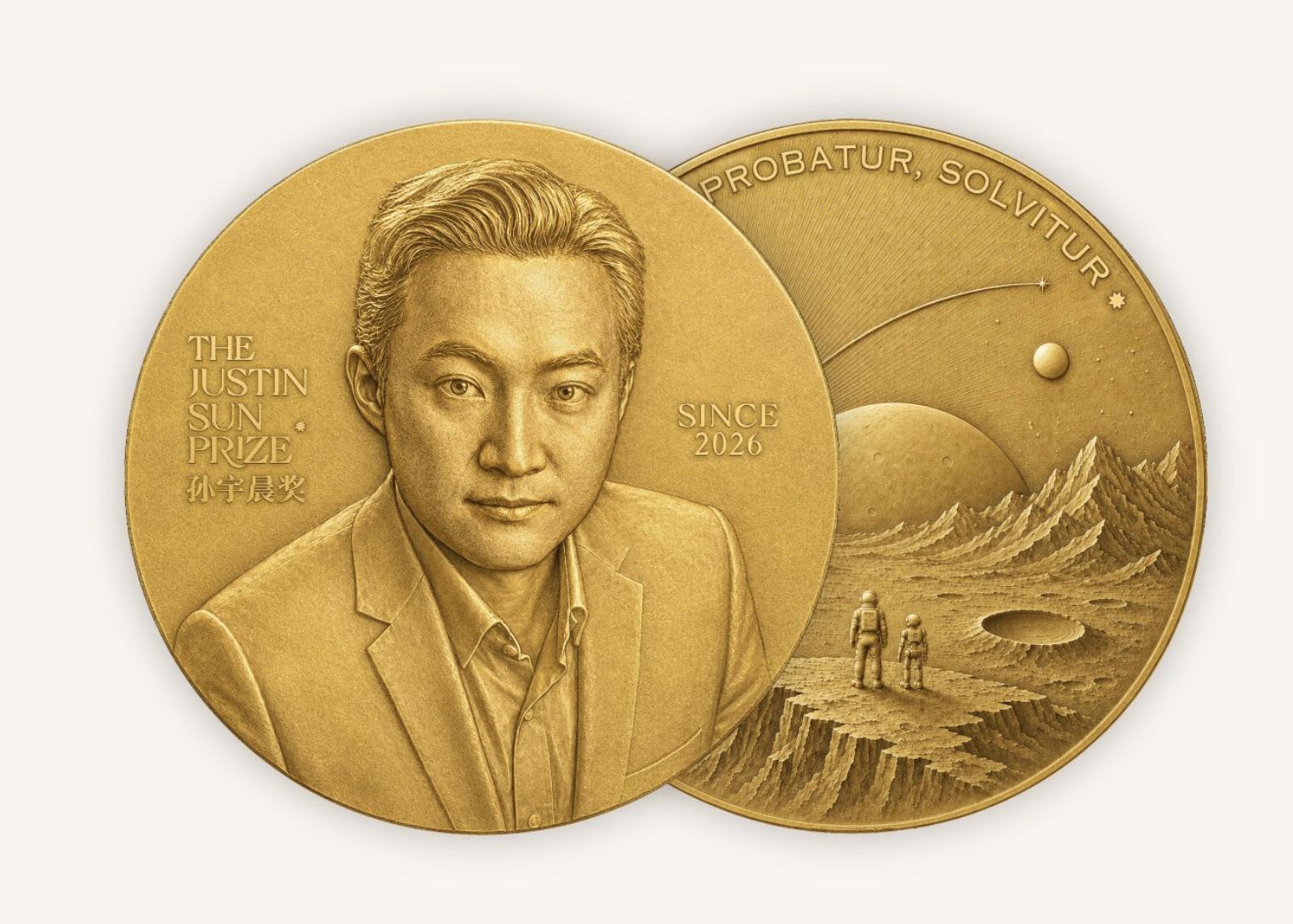
One more thing: why this prize is named after me.
Two reasons.
First, prizes named after a person are the least political things in the world. Nobel, Fields, Abel, Turing, Wolf—the longest-lasting prizes in mathematics and science are almost all named after a single person. Countries change, institutions rename, companies go bankrupt. Once a person's name is engraved on a prize, no one can ever modify it.
Second, it is an account I give to myself. I am thirty-six years old, and the wealth I have accumulated exceeds what I need. If a person's wealth has no direction, it will eventually just become inheritance disputes and auction house records. I want to personally point this money in a direction while I am still clear-headed: it came from mathematics, and it returns to mathematics.
As for the controversies surrounding me, the list of laureates is the only answer. I do not ask anyone to believe me now.
The Justin Sun Prize can afford to wait.
X
One last thing. This prize does not require anyone to trust anyone. You only need to trust the machine's verification, and the machine only recognizes logic. The initial prize pool has already been placed on the blockchain. The address is public, and the balance is visible to the whole world. I have retained only the right to add more money.
Every winning proof will be made public. Anyone can verify for themselves whether it is correct. You don't need to trust me, and you don't need to trust any committee. Every prize payout will remain on the chain, public, immutable, verifiable even a hundred years from now. Once a proof is established, it is established forever. I hope the reward for the prover is of this same nature.
I am not a mathematician. I am an observer, and I pay. The rest is left to the proof.
Justin Sun