
Binance remains crypto’s leading exchange, expanding from spot and derivatives into RWAs, payments, savings, yield, and broader financial services.


The role of centralized exchanges in digital assets dates back to Bitcoin’s earliest years, when there was no true market price and Bitcoin itself functioned less as a financial asset than as a technical experiment. In those early days, Bitcoin was mined, transferred, and debated within a small community of cryptographers, developers, and libertarian-minded early adopters, with its value driven more by ideology than by market demand. Exchanges fundamentally changed that dynamic by introducing the infrastructure needed for continuous trading and globally visible price discovery, transforming Bitcoin from a niche peer-to-peer network into a tradable financial asset. The evolution of centralized exchanges since that point has effectively mirrored the evolution of crypto market structure itself: a series of distinct phases, each organized around a different product and a different generation of trading venues.
The first of those phases was almost entirely Bitcoin-centric. Early services such as NewLibertyStandard used fixed exchange rates based on electricity costs and mining difficulty, tying Bitcoin’s value to production rather than market demand. True price discovery began with BitcoinMarket in 2010, which introduced a venue where buyers and sellers could trade directly. Bitcoin initially traded at roughly $0.003, though reliance on traditional payment rails proved fragile after PayPal withdrew support in 2011.
As liquidity concentrated, Mt. Gox rapidly became the center of global Bitcoin trading, at one point handling an estimated 70-80% of worldwide volume. Its dominance was driven less by technological superiority and more by the tendency for liquidity to concentrate on a single venue in an immature market. Beginning in late 2011, Bitcoin was steadily siphoned from Mt. Gox’s hot wallets for years without detection. By the time the breach became public, the exchange had likely been insolvent for nearly two years. Roughly 850,000 BTC, around 7% of Bitcoin’s total supply at the time, valued at approximately $473M, were lost.
In the years after Mt. Gox, the exchange landscape underwent two major reshufflings. The immediate post-Gox period was dominated by USD-based venues such as Bitstamp, Bitfinex, and BTC-e, which absorbed much of the displaced liquidity. But by 2015-2016, Chinese exchanges, primarily OKCoin, Huobi, and BTC China came to dominate global trading, with some studies estimating they accounted for over 90% of Bitcoin volume by 2016. Much of this activity was driven by zero-fee trading models that likely inflated volumes through wash trading, but Chinese demand nonetheless became central to the 2015-2017 market cycle. That leadership ended abruptly in September 2017, when China banned cryptocurrency exchanges and ICOs, forcing the country’s major platforms offshore almost overnight.
2017 marked one of the most important phases in crypto history as the market was shifting from a Bitcoin-centric structure toward a broader multi-asset ecosystem. The ICO boom of that year had produced an explosion of new tokens and trading demand was migrating from a single asset toward a long and rapidly growing tail of altcoins, and the venues positioned to capture that shift were those that could onboard new assets at the pace the market was creating them. Many platforms still struggled with slow interfaces, frequent downtime, and fragmented liquidity, a vacuum that left room for a venue built around execution quality, accessibility, and low fees to define what came next.
Binance launched in July 2017 with a focus on execution quality, accessibility, and low fees, further enhanced by BNB discounts. It rapidly listed emerging assets during the 2017 ICO cycle and helped make stablecoin quote markets, particularly USDT pairs, a central layer of global crypto liquidity. As traders and market makers gravitated to the platform, liquidity deepened, spreads tightened, and network effects reinforced Binance’s position as the default venue for diverse crypto trading activity. Within six months of launch, Binance became the leading exchange by spot volumes for the first time, reflecting how liquidity and fee structures influenced exchange competition during the early days.
What distinguishes Binance from earlier market leaders is the longevity of its position. While Mt. Gox led the market briefly before collapsing, Binance has remained the industry’s leading exchange through multiple market cycles, regulatory challenges, and shifting competitive dynamics. Its sustained presence across such a wide range of conditions mirrors how the broader crypto market structure has matured over time.
Derivatives took center stage in the next phase of crypto market evolution in 2021. While BitMEX pioneered the perpetual swap in 2016, the product remained relatively niche for several years. That changed in 2021, when derivatives volumes overtook spot volumes for the first time. Since then, derivatives have dominated activity, consistently exceeding 70% of total volumes since 2023 and peaking at 80.9% in September 2023.
FTX’s collapse in November 2022, then one of the largest derivatives venues, was a turning point for the industry. Beyond shifting flow toward surviving platforms, it reset expectations around transparency. Proof-of-Reserves attestations quickly moved from an occasional practice to a baseline requirement, as exchanges used verifiable reserve disclosures to prove customer assets were fully backed and rebuild market trust.
Meanwhile, decentralized exchanges continued to gain traction, with market share remaining in double digits throughout 2025 and reaching a record 18.9% in June. Rather than treating DEXs as a competing channel, major platforms began bringing on-chain trading into centralized interfaces - including Binance Alpha, Bybit’s Byreal and Coinbase’s DEX integration. The result was a growing convergence between CEX and DEX models, allowing users to access on-chain liquidity and token discovery from familiar centralized platforms, and gradually blurring a boundary that had long defined the market.
By late 2025, a new form of convergence had emerged between crypto exchanges and traditional financial venues. Leading exchanges began expanding beyond digital assets into equities, commodities, and tokenized real-world assets, while also building out consumer-finance features such as payments, savings, yield products, cards, and fiat rails. As a result, the centralized exchange has increasingly evolved into a financial super-app, combining trading, payments, savings, and access to both crypto and traditional markets within a single ecosystem.
Across the three principal product categories of crypto trading, the structure of competition has evolved meaningfully by segment, with Binance emerging as a significant participant in each. However, the broader exchange landscape has also become more fragmented and competitive over time. Binance’s early growth took place when centralized exchanges were the primary gateway into crypto, but that structure has changed as the market has matured.
Liquidity is now spread across a wider range of venues and formats. Offshore and regional CEXs compete more aggressively by product segment, decentralized exchanges such as Hyperliquid have captured meaningful on-chain trading activity, neobanks and fintech apps have expanded retail access, and traditional financial institutions are entering crypto through ETFs, tokenized assets, custody, and brokerage-like products. As a result, market leadership today is no longer defined by a single venue dominating every layer of activity. Instead, it increasingly depends on how exchanges adapt to a broader, more interconnected financial ecosystem, where competition is deeper, user entry points are more diverse, and trading activity is split across centralized, decentralized, and traditional finance rails.
Spot market competition has become more fragmented since the peak of centralized exchange concentration in 2023. Binance remained the largest venue in 2026, with 25.9% of global spot market share as of May and more than $10B in average daily volume, but this was well below its 67.0% peak in February 2023. Bybit, OKX, and Coinbase ranked as the next-largest spot CEXs based on monthly volumes in May with market shares of 5.98%, 4.92%, and 4.65% respectively.
The decline reflects a broader redistribution of activity across competing centralized venues, regional exchanges, decentralized liquidity, and new retail access points. Even so, concentration remains meaningful: Binance still processed nearly four times the spot volume of its nearest centralized competitor, and no other exchange has consistently maintained more than a 15% share of global spot trading volume since 2020.
Derivatives markets have followed a similar trend in becoming more distributed since Binance’s peak in late 2022. Binance remained the largest global derivatives venue in 2026, with 37.0% market share and more than $50B in average trading volume, but this was well below its 72.3% peak in December 2022. OKX, Bybit, Gate and Coinbase International rounded out the top 5 with a market share of 16.8%, 10.6%, 9.47% and 6.74% in 2026.
The decline reflects a broader redistribution of activity across competing centralized exchanges following the post-FTX reshaping of market structure. Even so, Binance’s lead remains substantial: the exchange continued to process roughly twice the derivatives volume as the nearest competitor.
Binance also leads all centralized exchanges in open interest across derivatives markets, accounting for 23.8% of total industry open interest at the end of May 2026. The scale of this positioning highlights the exchange’s central role in global crypto derivatives activity and reflects the depth of capital and activity flowing through the broader derivatives market. Institutional exchanges like CME followed with a market share of 12.2% in open interest.
Unlike the spot and futures market, where leadership has moved between venues across cycles, the options market has been dominated by a single venue for almost its entire history. Deribit has held an overwhelming majority of global BTC and ETH options volume continuously since 2018, built on an early-mover advantage, a product set tailored to sophisticated volatility traders, and the deep, resilient liquidity that options market-making requires.
This segment has also stayed disproportionately institutional, with activity concentrated among professional desks rather than the broad retail base that drives spot and perpetual volumes - a structural feature that has reinforced the incumbent’s position, since options liquidity tends to concentrate even more heavily on a single venue than linear products do. While Binance was late to options, the product is growing. In 2026, Binance averaged $22.2B in options trading volume, still a share of Deribit's dominance, but demonstrating a level of incremental momentum as Binance expands its overall derivatives offerings.
The most significant shift in Binance’s market share over the past five years occurred between mid-2022 and early 2023, when the exchange experienced a sharp acceleration in both spot and derivatives market share. Spot market share peaked at 67.0% in February 2023, while derivatives share reached 72.3% in December 2022. A major contributor to this expansion was Binance’s zero-fee BTC trading campaign, which materially increased trading activity and consolidated liquidity on the platform during that period.
Binance introduced zero trading fees across thirteen BTC spot pairs in July 2022 as part of its fifth anniversary promotion, covering markets including BTC-USDT, BTC-USDC, BTC-BUSD, and several fiat pairs. The broader promotion remained in place until March 2023 after which only selected pairs - particularly BTC-TUSD and later BTC-FDUSD - continued operating under zero-fee or promotional structures into 2024.
The promotion created a powerful liquidity flywheel where zero taker fees allowed market-makers to quote tighter spreads while still earning rebates and incentives. This attracted more taker flow and encouraged deeper quoting across the order book. Binance’s BTC-USDT spot volumes surged to multiples of their pre-promotion baseline, with much of the incremental activity driven by professional market-makers and high-frequency trading firms. Once fees were reinstated, however, a meaningful portion of that flow normalized, contributing to some correction in market share from the early 2023 peak.
Although fee promotions accelerated Binance’s growth during specific periods, they do not fully explain its sustained market leadership. A more durable factor is the scale and composition of the user base behind its order books, which extends across both developed and emerging markets. By the end of Q1 2026, Binance had accumulated more than 316M registered users, several times larger than any competing exchange and, on its own, a population larger than that of most G20 economies. As a result, the activity flowing through Binance’s matching engine reflects not only promotional trading activity but also participation from a large global user base. That scale matters because each additional participant contributes liquidity, order flow, and market depth, supporting the network effects that underpin Binance’s market position.
Headline trading volume alone does not provide a complete picture of exchange quality. What distinguishes leading exchanges from the rest is less the scale of their activity and more the quality of the liquidity supporting it. Metrics such as market depth, spreads, slippage, and liquidity resilience ultimately determine where traders can execute size most efficiently and at the lowest total cost. Over time, these factors matter far more than raw volume figures in defining the strength and durability of a trading venue.
Across major crypto assets, Binance consistently ranks among the deepest exchanges globally. In Q1 2026, the BTC-USDT pair on Binance recorded the highest average 1% market depth of any BTC trading pair worldwide, while BTC-USDC also ranked among the global top ten by the same measure.
Similarly, Binance’s ETH and SOL markets ranked among the two most liquid venues globally for their respective assets, underscoring the exchange’s dominance across the three most actively traded cryptocurrencies on centralized exchanges.
High market depth reduces the price impact associated with executing large trades, making it especially important for institutions, algorithmic traders, high-frequency firms, and OTC-style execution desks. Importantly, Binance's leadership is not limited to deeper order-book liquidity. Similar results are observed using top-of-book measures, with Binance achieving the highest Market Quality score in the CoinDesk Exchange Benchmark, which evaluates liquidity and execution quality near the prevailing market price. For sophisticated participants, however, liquidity is not just about how much depth exists during normal conditions, but whether that depth remains reliable during periods of stress and volatility.
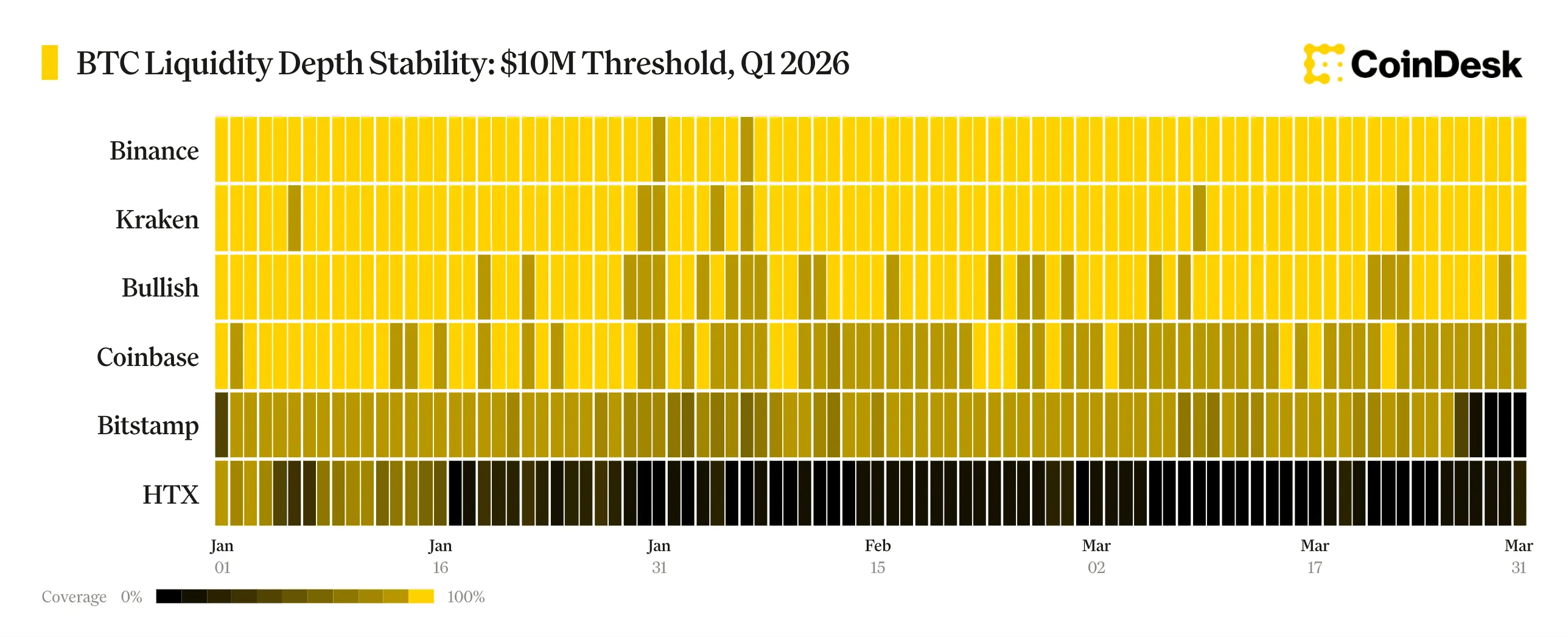
This is another area where Binance ranked highly relative to peers. Throughout Q1 2026, Binance maintained the most stable BTC market depth above the $10M threshold on all but two trading days, demonstrating a level of consistency that competing venues struggled to match. Importantly, this liquidity is broadly accessible to all market participants rather than being concentrated in specialized order types or conditional liquidity programs that may only be available to a subset of users. Liquidity that disappears during volatile periods offers limited value to professional traders managing large positions in real time; resilient liquidity, by contrast, becomes increasingly valuable precisely when markets are under pressure.
Spreads provide another important lens into execution quality. Tighter spreads lower implicit trading costs and improve overall trading efficiency, particularly for active participants operating at scale. Binance consistently demonstrates narrower spreads, stronger quote competition, and deeper market-maker participation than many peer exchanges.
Tighter spreads also signal healthier market structure. They typically reflect a more competitive quoting environment, where multiple liquidity providers are actively competing for order flow rather than relying on wider margins to manage risk. That competition improves pricing efficiency and reduces the cost of entering and exiting positions, particularly during volatile market conditions when spreads often widen sharply on weaker venues.
In Q1 2026, the average spread across Binance BTC trading pairs for a $10,000 order was just 0.031%, lower than every other major exchange in the comparison set. Combined with deep liquidity, these tighter spreads allow traders to execute with lower friction and greater pricing certainty, strengthening Binance’s position as a preferred venue for high-volume trading activity.
Importantly, Binance’s liquidity advantage is not limited to a handful of major markets. Across 427 listed assets, Binance ranked as the deepest venue for 275 of them based on 1% order book depth, representing 64.4% of all assets compared against other top-tier exchanges. The breadth of this is notable because it reflects how liquidity in crypto markets has deepened across asset classes over time, extending well beyond BTC and ETH into the wider altcoin ecosystem, where fragmented liquidity has historically been a challenge across the industry. Binance serves as one of the primary venues through which that depth is observable.
While market depth measures how much liquidity is available at incremental price levels from the mid-market price, spreads capture the immediate cost of crossing between the best bid and ask. Slippage reflects the realized execution cost of trading size against the resting order book. Together, these metrics determine the true cost of transacting on a centralized exchange.
In practice, trading costs consist of two distinct components: explicit fees charged by the exchange and implicit execution costs driven by liquidity conditions. The two are independent. Fees are administrative and can be adjusted by the venue, whereas slippage is structural, shaped by the depth and resilience of the underlying order book. An exchange that advertises low fees does not necessarily offer low execution costs if liquidity is shallow or spreads widen under stress. Ultimately, traders pay both on every transaction, making liquidity quality just as important as headline fee schedules.
Across standard order sizes, Binance consistently exhibits lower slippage than competing venues due to deeper books, greater liquidity concentration, and more active market-maker participation. When comparing BTC execution across $10,000, $100,000, and $1M order sizes during Q1 2026, Binance recorded the lowest average slippage among major centralized exchanges. This becomes particularly relevant for larger orders, where execution costs tend to increase non-linearly in less liquid markets.
Coupled with Binance’s highly competitive spot fee schedule, including substantial VIP rebates and discounted fees for users paying with BNB, the exchange’s advantage in all-in execution costs becomes even more pronounced. For active traders and institutions executing large volumes, fee differentials that may appear marginal on paper become increasingly significant over time, particularly when combined with superior execution quality.
What matters for professional traders is therefore not simply the posted fee, but the total cost of completing a transaction: the spread paid at execution, the slippage incurred while moving through the order book, and the exchange fee charged on the fill itself. Binance performs consistently well across all three dimensions. Tight spreads reduce immediate friction, deep liquidity minimizes market impact, and competitive fees keep explicit costs low even for large or highly active participants.
Together, these factors create a self-reinforcing liquidity ecosystem anchored by genuine user demand. High levels of organic trading activity attract market-makers seeking to capture flow, and competition among those market-makers improves spreads and order book depth. Better execution quality, in turn, helps retain existing users and attract additional trading activity. As a result, Binance is able to absorb large orders efficiently and at lower cost than most competing venues.
These advantages translate directly into lower execution costs for both retail and institutional participants, particularly for algorithmic and high-frequency traders where even small improvements compound meaningfully over time. In that sense, Binance’s liquidity profile creates a measurable economic advantage, positioning the platform not only as the largest exchange by activity, but also as one of the most efficient venues globally for trade execution.
Price discovery tends to concentrate on venues with the deepest liquidity and highest trading volumes, as informed traders can generally execute large orders there at lower cost. In USDT denominated crypto markets, Binance has increasingly served as one of the primary venues for price discovery. For example, between May 2025 and 2026, Binance recorded the smallest average deviation from the CoinDesk Composite Index (CCIX) BTC-USDT reference rate at 0.40 bps, suggesting a close alignment between prices on the exchange and the broader market reference rate. This is consistent with recent market structure research, which finds that Binance remains a leading venue for crypto price discovery, with price movements on the exchange tending to precede those observed on several competing trading venues despite the continued growth of alternative centralized and decentralized exchanges.
A key feature of Binance’s market structure is the close relationship between its spot and derivatives businesses. Derivatives market makers rely on spot liquidity to hedge positions efficiently, and Binance’s scale in both markets allows a significant share of these flows to occur within the same platform. Higher derivatives activity can generate additional spot hedging demand, creating a feedback loop that supports liquidity across the exchange and reinforces Binance’s overall market position.
The more consequential development in crypto market structure is not the scale of any single exchange, but the convergence of traditional and digital asset markets on shared infrastructure. For most of the past decade, crypto centralized exchanges and the traditional financial system operated as separate worlds, linked only at the fiat on-ramp. That separation is now dissolving from both directions: traditional assets are moving onto crypto-native rails, and crypto platforms are absorbing the product range of banks, brokerages, and payment networks.
The shift is visible along two distinct fronts. The first is the trading layer, where centralized exchanges are extending continuous, 24/7 trading to asset classes that have been bound by market hours - commodities, equities, and ETFs through perpetuals, direct spot-equity brokerage and synthetic wrappers. The second is the broader product layer, where exchanges have expanded beyond trading entirely into payments, savings and yield, card spending and more.
The Rise of Real-World Assets Trading on CEXs
Real-World Assets are becoming an increasingly contested frontier across the centralized and decentralized venue landscape, and the competitive question is increasingly which platform can build the deepest liquidity in tokenized traditional assets fastest. The major venues have approached the RWA opportunity from different angles. Hyperliquid moved early through its HIP-3 builder framework, which allowed third parties to deploy commodity and equity perpetuals. Coinbase has pursued tokenized assets through its regulated US footprint and its Base network. Others including OKX, Bybit and Bitget have all added access to traditional financial products to their users in different mechanisms.
Binance too has extended 24/7 trading to traditionally market-hour-bound assets through tokenized real-world asset perpetuals and its newly launched spot-equity brokerage. Together, these initiatives reposition these crypto exchanges into a broader financial marketplace built on crypto-native rails.
In 2026, crypto exchanges processed nearly $1T in year-to-date volume across RWA instruments, with Binance accounting for the majority of activity at 60.9% of total volumes.
The first leg of Binance’s expansion is the buildout of perpetual contracts linked to commodities, equities, and ETFs. The exchange’s 7-day average market share in these products rose from just 0.03% at the start of 2026 to near 10% by the end of May, driven by two key developments.
The first signal came in December, when Binance joined the growing market for gold (XAU) USDT perpetuals, later adding a silver (XAG) USDT perpetual in January amid a multi-month rally in precious metals. By enabling leveraged exposure to gold and silver using stablecoin collateral with 24/7 market access, the products introduced a compelling new use case for both retail and institutional traders. Demand was substantial: during Q1 2026, gold perpetuals averaged $1.06B in daily trading volume, while silver perpetuals averaged $1.41B.
A second growth wave emerged in March as escalating geopolitical tensions in the Middle East increased demand for continuous oil exposure. Hyperliquid initially benefited through its HIP-3 builder ecosystem, which enabled Brent and WTI crude perpetuals via the trade.xyz deployment. Binance only entered the market in April with its own oil perpetuals and quickly established a meaningful presence, capturing a significant share of oil-linked crypto derivatives within months of launch.
Commodities now dominate Binance’s RWA-linked derivatives market, accounting for 88.3% of total volume and nearly $400B in trading activity year-to-date. Equity-linked products are the second most popular category with a market share of 10.5% among RWA perpetual products on the exchange. Indices and the recently launched Pre-IPO category remain niche segments with only a marginal share of overall RWA trading.
Binance's pre-IPO perpetuals open access to a market that has historically been restricted to accredited investors through private-secondary platforms. By offering synthetic exposure to high profile companies such as SpaceX and OpenAI, Binance enables global retail participation in private-company valuations without requiring equity ownership. Early demand has been strong, with the SpaceX contract generating more than $500M in trading volume since its launch on May 21.
Overall, Binance has recorded nearly $450B in RWA perpetual trading volume in 2026 (as of May), leading all competing venues with a 59.4% market share. The figures reflect a broader shift in how investors are accessing traditional asset exposure, with crypto-native infrastructure increasingly serving as an alternative route to markets that have historically required traditional brokerage relationships. This reinforces Binance’s position as the primary liquidity venue among crypto exchanges across both native digital assets and emerging RWA instruments.
Part of the appeal stems from a structural difference between crypto and traditional financial markets. Crypto markets operate continuously, while traditional U.S. equity markets close from Friday afternoon until Monday morning. That creates persistent weekend price-discovery gaps whenever major macro events occur outside traditional trading hours. During those periods, tokenized assets traded on crypto venues become the only active market for pricing the underlying exposure. By the time traditional markets reopen on Monday, crypto markets may already have absorbed more than 60 hours of news flow.
That dynamic creates a meaningful arbitrage opportunity. Traders can establish positions in tokenized assets over the weekend and reprice them against comparatively stale traditional markets at Monday’s open. More broadly, the asymmetry between 24/7 crypto trading and limited traditional market hours gives crypto-native venues an increasingly important role in global price discovery as RWA liquidity continues scaling.
For example, recent weekend trading in oil markets highlights how crypto venues have increasingly become the primary source of real-time price discovery outside traditional market hours. While NYMEX remains closed from Friday through Sunday, Binance’s WTI perpetual contracts continue trading continuously, incorporating macro developments and geopolitical news in real time. Across six weekends year-to-date, Sunday night pricing on Binance’s WTI perpetuals explained roughly 86% of the eventual Monday opening gap in traditional oil markets and correctly anticipated the direction of the move every time. This trend suggests that crypto markets are increasingly serving as an early venue for market positioning and macroeconomic price discovery, incorporating new information and investor sentiment well before traditional markets reopen.
The second leg of Binance’s non-crypto expansion, announced on 1 June 2026, is its entry into traditional spot equity trading. The platform now offers access to more than 7,000 US stocks and ETFs for eligible non-US users, with fractional share purchases available from $5. Share purchases are arranged through the Binance broker-dealer entity Nest Trading, while custody, dividend processing, and corporate actions are handled by Alpaca.
The initiative targets a market that has historically been served through traditional brokerages. While US equities account for more than half of global stock-market capitalization, international investors often face foreign-exchange costs, local market restrictions, and varying levels of access depending on jurisdiction. Binance’s offering provides an alternative distribution channel for accessing these assets.
The launch of bStocks introduces a mechanism through which users can convert eligible equity positions into tokenized representations on BNB Chain. Tokenization is user-initiated, allowing investors to determine whether and when a position is moved on-chain. The resulting tokenized assets are intended to be backed one-to-one by the underlying securities.
The product connects traditional equity infrastructure with blockchain-based markets. Conventional equity positions remain subject to standard settlement processes and market-hour constraints, whereas tokenized representations can be transferred and utilized within on-chain applications. This potentially enables investors to deploy equity exposure within DeFi ecosystems while continuing to receive the economic benefits associated with the underlying shares, including dividends. The extent to which these capabilities drive user adoption remains an open question, but the launch reflects a broader effort to bring traditional financial assets into crypto-native environments.
Crypto Exchanges as Financial Super Apps
Crypto centralized exchanges are no longer best understood simply as venues for buying and selling digital assets. Leading platforms are evolving into broader financial ecosystems where trading sits alongside payments, savings, yield, lending, cards, and increasingly traditional assets. Major centralized exchanges have all moved toward the same financial-services surface from different starting points. For example, Coinbase has leaned on its regulated US footprint, adding derivatives, prediction markets, and stock-trading access through licensed entities and a USDC-centered payments and yield stack. Kraken has expanded along a similar-US path, pairing equity trading through a dedicated broker-dealer arm with consumer-facing products such as Krak Card and Kraken’s yield and staking offering. OKX and Bybit have also built out card programs, on-chain wallets, and earn products alongside their derivatives franchises.
Similarly, Binance’s product footprint now extends far beyond spot and derivatives trading. Alongside its core exchange business, the company has developed a broad suite of financial products spanning payments, savings, yield generation, token launches, stablecoins, and, increasingly, traditional financial assets. As a result, users can trade, hold, earn, transfer, and spend value within a single integrated ecosystem, with much of the underlying crypto infrastructure abstracted from the user experience. Tools such as Binance AI Pro further simplify platform navigation by helping users analyze opportunities, and manage portfolios more efficiently.
Beyond the core matching engine, Binance has built an expanding set of adjacent products - including Earn, savings, structured products, Pay, Launchpad, Alpha, Binance AI Pro, and a growing stablecoin ecosystem - that encourage users to engage with multiple services within the same platform. Users who hold balances on Binance for yield generation, payments, or ecosystem participation can move capital between products without relying on external transfers. As assets remain within the ecosystem, activity across these products becomes increasingly interconnected, supporting liquidity and broadening the platform’s role beyond that of a traditional trading venue.
Binance’s super app thesis to evolve from a trading venue into a fully integrated financial platform rests on three core pillars - pay, hold, and send - each of which had reached meaningful scale by the close of 2025.
The first pillar is payments, which focuses on facilitating transactions through crypto-native payment rails. Since launching in 2021, Binance Pay has processed more than $280B in cumulative transaction volume. In 2025 alone, its user base grew 30% year-over-year, while its merchant network expanded from roughly 12,000 to more than 20M. Stablecoins accounted for over 98% of business-to-consumer payment volume, highlighting their growing role in crypto-based payment activity.
Cross-border payments have become a meaningful component of that activity. Since 2021, Binance Pay has processed more than $87.4B in remittance and cross-border payment volume, serving over 34.2M users and generating an estimated $5B in fee savings relative to traditional remittance channels. The payments offering extends beyond peer-to-peer transfers. Binance Card is integrated with stablecoin balances and offers features such as cashback rewards, zero conversion fees, and fee-free foreign exchange on eligible USD stablecoin spending. Binance Pay has also integrated with local payment networks, including Brazil's Pix, allowing users to transact through existing payment infrastructure.
The second pillar is holding - supporting users who choose to hold assets on the platform for purposes beyond immediate trading activity. Through Binance Earn, Binance provides users with a range of options to generate returns on otherwise idle balances while maintaining exposure to their assets. The product suite spans savings, staking, tokenized Treasury exposure, structured yield products, and on-chain rewards, offering a broad range of risk, return, and liquidity profiles. This allows users with different investment horizons and risk preferences to derive value from holding assets on the platform, rather than using it solely as a venue for active trading.
Demand for these products accelerated materially throughout 2025. Binance Earn distributed approximately $1.2B in rewards, and at peak periods more than 30% of assets held on the exchange were allocated to Earn products. New offerings such as RWUSD, Plasma On-Chain Yields, BFUSD, Soft Staking, and Discount Buy further expanded the platform’s yield stack. Consequently, Binance’s yield offerings are sourced from a diverse range of underlying activities - including staking, on-chain protocols, tokenized real world assets, funding rate strategies, and other yield-generating mechanisms - providing users with exposure across multiple asset categories and risk return profiles. The trend suggests Binance is increasingly functioning not merely as a trading venue, but as a broader crypto-financial platform for payments, savings, and capital deployment.
Data from DeFiLlama and Binance’s Proof-of-Reserves system placed total user balances on the platform at approximately $145B as of Q1 2026, representing a 10.7% year-over-year increase in covered assets and highlighting the scale of assets held within the Binance ecosystem.
The third pillar is sending, which focuses on moving funds across borders and between counterparties through a combination of fiat and crypto payment infrastructure. In 2025, Binance's Fiat and P2P business grew transaction volume by 38% year-over-year, supported by an expanding network of licensed local payment providers across key jurisdictions, including Meda in Mexico, BPay Global in Bahrain, and Sim;paul Investimentos in Brazil.
This infrastructure is complemented by integrations with global payment providers such as Mastercard, PayPal, PayPay, and Trust Wallet, alongside connectivity to local payment rails including Blik in Poland, and Mobile Money services across several African markets. Rather than relying on a single payment standard, the platform's approach has increasingly focused on integration with local financial infrastructure. User behavior on these rails provides some indication of adoption. In 2025, 73% of active customers completed repeat transactions, suggesting that these services are being used for more than one-off transfers.
Consumer payment preferences vary significantly across regions, and access to local banking systems, payment methods, and regulatory frameworks often plays an important role in adoption. Binance's Fiat and P2P expansion reflects this approach, with growth increasingly supported by integration into regional payment ecosystems rather than a single global payments model.
Viewed through this lens, the boundaries of what a crypto exchange offers are shifting. Binance’s product footprint now encompasses payments, cards, savings products, foreign exchange, equity trading, and crypto-native financial services. With more than 316M registered users, Binance’s reported user base exceeds the combined total of Robinhood, eToro, Webull, and Revolut, placing it among the largest digitally native financial platforms globally.
Similarities with fintech platforms are visible across multiple layers of the business. Binance Pay facilitates peer-to-peer transfers, merchant payments, and stablecoin-based settlement, while Binance Card and related spending products provide functionality commonly associated with digital banking applications. Binance Earn offers savings, yield, and staking products, while Launchpad and token distribution services provide users with access to new digital asset offerings.
One notable difference is the degree of market infrastructure operated directly by the platform. Whereas many fintech applications rely on external trading venues, liquidity providers, and financial infrastructure, Binance operates its own exchange, derivatives platform, liquidity network, and an expanding tokenized-asset ecosystem. This creates closer links between the platform’s trading, payments, savings, and asset-management activities than is typically seen at standalone fintech applications.
This vertical integration was formalized in December 2025 when Abu Dhabi Global Market’s Financial Services Regulatory Authority granted Binance full authorization under its regulatory framework. The approval covers Binance.com through three separate entities: Nest Exchange (exchange operator), Nest Clearing and Custody (clearing house and custodian), and Nest Trading (broker-dealer). This structure brings traditional market safeguards - transparency, risk segregation, and supervisory clarity - to digital assets at scale. Binance is the first globally regulated digital-asset exchange operating under this model, and the same regulated broker-dealer entity facilitating OTC activity is also handling the platform’s US-equity transactions.
Recent additions, including tokenized equities, commodities, RWA-linked perpetuals, and access to US-listed stocks and ETFs, have broadened the range of assets available through crypto platforms. As a result, users can increasingly access a wider set of financial products within a single environment.
The competitive discussion around Binance and centralized exchanges is therefore evolving. While trading activity remains central to the business, the platform’s expansion into payments, savings, transfers, and traditional financial assets suggests that competition may increasingly extend beyond the boundaries of the crypto exchange sector alone.
The center of gravity in the centralized exchange landscape appears to be shifting from trading alone toward a broader suite of financial services. Future growth may be driven as much by fiat connectivity, localized financial products, and access to financial services as by improvements in trading infrastructure. The data through the first half of 2026 suggests that crypto-native infrastructure is increasingly capable of supporting that convergence, with Binance among the clearest examples of how that transition is taking shape.