Helmet provides investors in the cryptocurrency market with a wide variety of risk hedging options, and is based on Binance Smart Chain without the hassle of high handling fees.
Written by Wang Lujie
In 1666, the most serious fire in the history of the city of London not only caused huge losses to the subjects of Charles II, but also gave birth to the modern insurance system.
However, compared to the "fire" risk of the house, the risks that financial market participants who have huge amounts of money to play at all times need to bear are even worse, especially for the cryptocurrency market, which has long been known for its high volatility and does not have any weekend or holiday closures. Although the bull market is still thriving on the surface, no one can say that "3·12" will not happen again, and risk hedging is an unquestionable and necessary choice at the moment.
There are many ways to hedge. Contracts, options, insurance, etc. can provide different levels of protection, but each method has more or less problems. For the vast majority of investors, options are relatively complex, especially the operational complexity of hot decentralized options exchanges, which are beyond the scope of most investors’ understanding. Contracts, in the hands of most investors, are not hedging tools, but leveraged trading methods that amplify returns and risks.
At this time, insurance has become one of the few products that can truly play a role in risk control. Helmet, as an insurance deployed on the Binance Smart Chain, can provide investors with rich but simple and easy-to-understand risk hedging options.
Insurance mechanism
On the Helmet platform, you can purchase various types of insurance, and the names of many insurances are very intuitive, such as double insurance, halved insurance, etc. Becoming an insured party means that as long as you purchase these insurances, the insured party will receive corresponding compensation once these currencies double, halve, or break.
The insured party is the buyer of insurance, and the corresponding party is the seller of insurance, which is the underwriter.
As for the specific rates and prices of insurance, they are determined by the underwriter of the insurance. The underwriter can also decide the name of the insurance independently according to the actual situation. For example, the project owner sets up a "public offering failure insurance" for public offerings. If the price on the stock exchange within 24 hours is lower than the public offering price, the project party will pay a certain percentage of compensation. This insurance is very attractive to public offering participants, and the negative impact suffered by the project side will be much smaller.
This also means that what Helmet wants to do is not just an insurance provider, but an insurance platform. This C2C model is similar to Huize and Little Umbrella, and also gives the platform more flexibility and room for development.
Becoming an underwriter on the Helmet platform is also not a very complicated matter. In the early days, the Helmet team will be the first to release insurance for some of the more active assets on the chain; later, the platform will fully open the insurance portfolio tool to sellers, and anyone can customize and issue suitable insurance types based on the currency they hold.
Once the insurance policy is purchased by the policy holder, the premium will be immediately entered into the account of the policy holder; if the policy holder is not in danger during the validity period of the policy, the policy holder will be able to get back the mortgaged assets, and the premium will become income.
Token Economy
The policyholder will receive LONG Token after purchasing the policy. This LONG Token is somewhat similar to NFT in nature and contains the correct asset type, policy price, premium and policy quantity.
The purpose of LONG Token is to escape risks. If the compensation conditions are met, the wallet will automatically call LONG Token, deduct the insured assets, and send the pricing assets corresponding to the policy.
On the underwriting side, once the policy is successfully issued, SHORT Token will be obtained. Underwriters can obtain Helmet’s platform governance token: HELMET by staking SHORT Token.
It is worth noting that according to its official website, currently only SHORT Token can be used for mortgage mining, while LONG Token does not have this function. The project side’s tendency to encourage users to provide liquidity and issue insurance policies is very obvious.
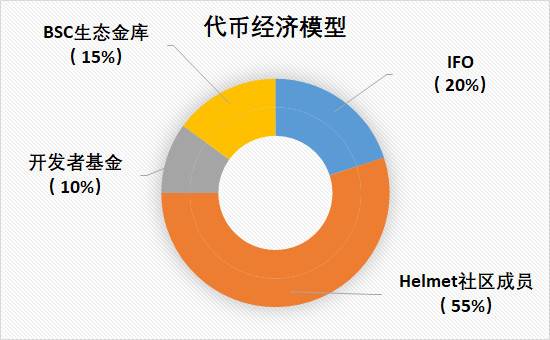
The total issuance of HELMET is 100 million, but in the first year after going online, the issuance limit of HELMET is 50 million, of which 10 million will be used for IFO; 27.5 million will be distributed to HELMET community members within one year to reward policy mortgages, LPT liquidity mining, and governance or proposals; 5 million will be dug out from the mine and used as developer funds; 750 Ten thousand coins will be used as the BSC ecological treasury and invested in the BSC ecological construction.
By holding HELMET, in addition to being able to purchase insurance policies on the platform as premium, you can also obtain insurance transaction fees through mortgage and participate in community governance and voting.
The insurance track has become a new hot spot in DeFi
As risk control tools, insurance products are easier to use than options/futures, so insurance has become a hot spot in DeFi.
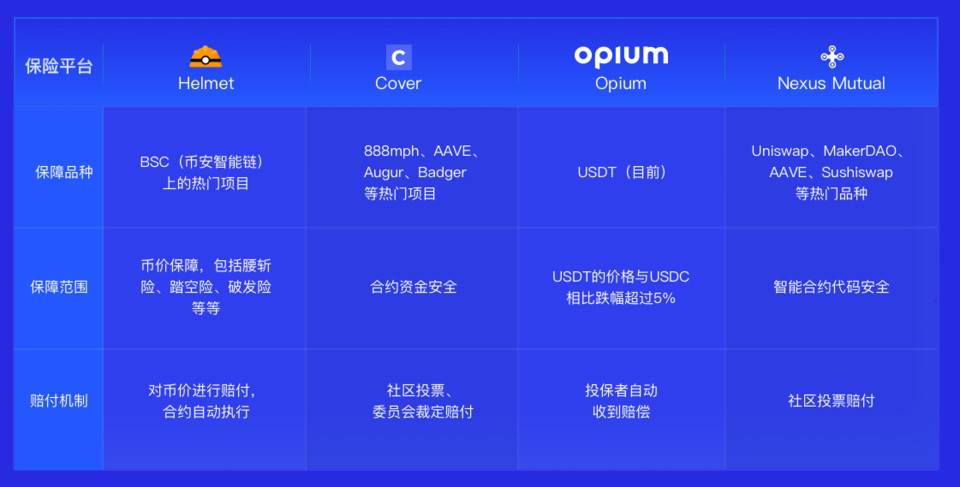
The most typical one is Opium, a decentralized derivatives exchange headquartered in the Netherlands that once featured diversified options products, especially CDS (credit default swaps/swaps) as an industry pioneer.
However, the insurance types currently provided by Opium are relatively single, mainly due to hacker attacks on DeFi contracts and the collapse of stable coins. Opium’s insurance page shows that its main coverage is USDT. If the price of USDT drops by more than 5% compared to USDC, users will be able to receive the full difference if insured.
Cover Protocol's insurance logic is somewhat similar to Helmet. By setting up two NFT tokens "CLAIM" and "NOCLAIM" that contain policy information, it provides pricing and trading mechanisms for the tokens, and supports multiple popular projects including 88mph, AAVE, SUSHI, and Badger. However, Cover itself had a contract vulnerability at the end of December last year, and the currency price was close to zero.
An even more "old" insurance is Nexus Mutual, which can be regarded as the pioneer of DeFi insurance and currently ranks first in the amount of locked positions in DeFi insurance projects. There are many similarities between Nexus Mutual and Cover. Both provide insurance for the security risks of smart contracts, and both require community voting to decide whether to compensate for the losses of a certain project. Although this fully reflects the mechanism of community governance, the efficiency is low.
Binance Smart Chain
Unlike many insurance peers, Helmet did not choose Ethereum as its main battlefield, but instead used Binance Smart Chain (BSC) as its position.
The current GAS fee on Ethereum is high, which is not very friendly to retail investors. Sometimes the premium is even not as high as the GAS fee. Choosing BSC as the main battlefield can largely avoid the trouble of GAS fees.
In addition, because of the support of Binance, BSC is also a public chain competitor that can still maintain vitality despite the current dominance of Ethereum. By choosing to deploy on BSC, Helmet will also be able to take advantage of synergies from BSC’s other projects.
On January 13, Helmet conducted a platform fundraising (Initial Farm Offering, IFO) on Pancake, the DEX platform with the largest trading volume on BSC. It planned to raise US$1 million, but a total of more than US$9 million participated in the IFO. Binance’s support also creates ample room for imagination for BSC’s outstanding projects. This is also one of the constraints of Helmet. After all, only Ethereum can currently create enough vitality and traffic for DeFi.
At present, Helmet has not announced team information and financing information; according to the team, the corresponding information is around the corner and will be announced soon.