
In a recent letter to investors, Pantera Capital expressed strong confidence in the Bitcoin market, believing that Bitcoin is expected to rise to $115,000 in August this year. At the same time, Pantera analyzed Ethereum’s fundamentals and history and believed that Ethereum is undervalued relative to Bitcoin.
Written by Joey Krug, Co-Chief Investment Officer of Pantera Capital
Translation: Perry Wang
Ethereum ETH is the leading asset in the cryptocurrency space for developers looking to write smart contracts and DeFi applications. It is the basic monetary collateral of the DeFi financial system. In the Ethereum network, the locked value of DeFi has grown from US$1 billion in January 2020 to US$16 billion in January 2021. The handling fees charged exceed that of the Bitcoin network, which is about 79 times based on the implied price-to-earnings ratio. The current market price has fallen 37% from the previous historical high. We believe that ETH is undervalued relative to Bitcoin BTC. In particular, BTC’s share of the overall cryptocurrency market exceeds 70%, which is close to the upper end of this share range in recent years.
When ETH was launched in 2015, it was easy to label it as an inflationary cryptocurrency with a worse economic model than BTC, thinking that its value might go to zero, but this was a misconception. The launch of the Ethereum network and ETH was a watershed moment in finance, enabling for the first time financial contracts that did not require the involvement of a trusted third party in financial transactions. Bitcoin’s market cap comes from its status as digital gold/store of wealth, but Ethereum’s value comes from its financial value. This new parallel system will be easier and cheaper to use globally in the long term, and will enable rapid experimentation with levels of Internet information consumption, but this time in financial markets. With Ethereum, anyone can participate and even create a new financial market with just a few clicks. If you wanted, you could get a loan at 3 a.m. on a Saturday night and pay it off the following Sunday. No exchange or OTC required, just use sites like 1inch and Matcha to swap from one asset to another and usually get a better price. You can send digital dollars to someone in 30 to 60 seconds 24x7, 365 days a year, and they can receive it anytime within that time frame.
As with most revolutionary new technologies, it is often difficult to use, seems complex, and many use cases feel like toy use cases. Will the future of finance really have the Sushi protocol as its core component? Maybe, maybe not, but does it really sound crazier than NASDAQ? Not really. Ethereum initially (2015-16) was almost only meaningful to its investors, then (2017-18) became a fun toy for members of the crypto community, and now Ethereum has actually entered an era of being very useful and found a product market. what does that mean? (2019-21) For those in the crypto space. I believe this growth trend will continue this year, and Ethereum will provide more value to crypto users as a platform for decentralized exchanges (DEX), loan protocols, synthetic asset trading protocols, etc.
This product-market fit is very real, with transaction volumes growing over 100x within the Ethereum network in the last year, as have loans. Ethereum itself now charges more daily transaction fees than the Bitcoin network. ETH, as an asset, is fully involved in all of these developments, as it will share in the transaction fee proceeds when staking ETH when it completes its migration to Ethereum 2.0. On top of that, ETH is used as collateral in many DeFi applications (for example, the issuance of USD-pegged stablecoin Dai required collateral).
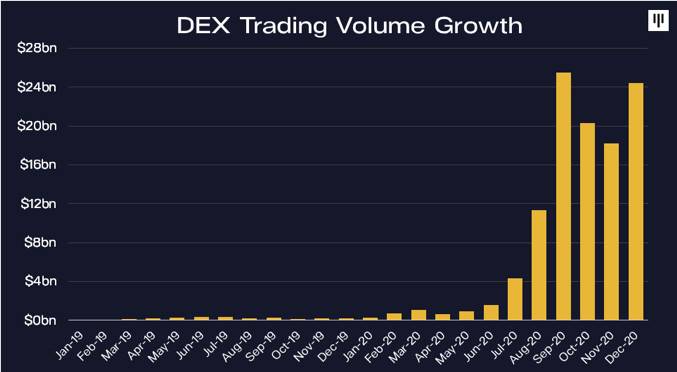
ETH is also used by users to pay transaction fees (there are plans to burn some of the transaction fees at some point). In the long term, ETH may even become a deflationary asset that can earn fee income, be used as collateral, and be used to pay fees. Any one of these features would be enough to make ETH a fascinating asset, but from an investment perspective, the combination of the above benefits makes ETH unlike any other asset on the market. The implied P/E multiple based on current transaction fees is around 79, which feels too low compared to assets in the stock market for an asset whose underlying usage is growing 25x (total locked value in DeFi) or 100x (DEX trading volume) annually.
ETH is currently down 37% from its all-time high and we believe ETH is undervalued relative to BTC (not that the two should be compared closely as digital gold and DeFi are ultimately two different things), but we remain very bullish on ETH. BTC’s total market cap market share in the crypto market has been above 70% recently, and in recent years it has tended to be at the upper end of that range, and as the bull market continues we think people will take some level of profit-taking on their BTC investments and put funds into ETH. In addition, once CME Group’s ETH futures are launched, it will legitimize ETH and become an asset that institutional investors can hold. It can actually serve as a fairly easy allocation container (suitable for the characteristics of disruptive technology assets for these institutions). As more and more ETH holders stake their ETH in Ethereum 2.0, meaning a large amount of ETH is locked, the market price will experience less selling pressure. These two things, combined with ETH fundamentals and historically low valuation relative to Bitcoin, should provide a strong tailwind for ETH price action in 2021, so we are very bullish on ETH.
Source link: panteracapital.medium.com