
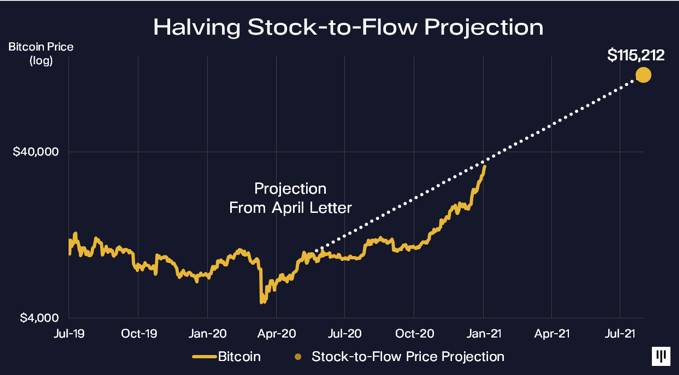
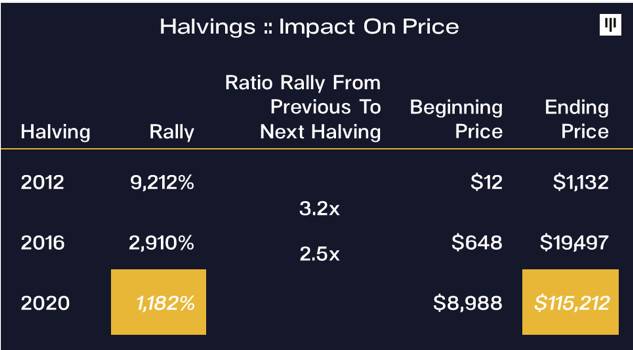
Pantera Capital estimates that if the history of the halving effect repeats itself, Bitcoin may reach a price peak of $115,212 in August this year.
Written by Dan Morehead and Joey Krug, the former is the co-chief investment officer and CEO of Pantera Capital; the latter is the co-chief investment officer of Pantera Capital
Compiled by: Lu Jiangfei
We explored the topic of Bitcoin halving in depth in our email to investors in May, shortly after Bitcoin’s block reward was cut in half. At that time, we wrote:
"Bitcoin price action has been largely uneventful over the past two weeks, with some comments suggesting that the Bitcoin block reward halving has already occurred, but no money has been made from it. Therefore, we emphasize that the Bitcoin block reward halving is a big event, and its impact may take several years to unfold. Generally speaking, the market may be undervalued in the 1.3 years before the block reward halving, and on average, the market peak may occur after the block reward halving occurs. About 1.2 years, such a complete cycle may take about two and a half years. "
Now, the “halving” effect is happening – exactly as we predicted.
Long story short,
The "halving" will have a huge impact - but it often takes a year or two to see what impact the halving has on the entire market.
In our letter to investors last April, we gave some forecasts, and it now appears that those forecasts are generally consistent with the actual situation. Our analysis is based on comparing Bitcoin’s supply/flow reduction trends relative to circulating supply, each time a block reward halving occurs, and also assessing the subsequent impact of halvings on Bitcoin’s price (full analysis below).
In our investor letter published in April last year, we predicted that if Bitcoin experienced a historic "stock-to-flow" impact, then every month thereafter, the price of Bitcoin would rebound along the following path:
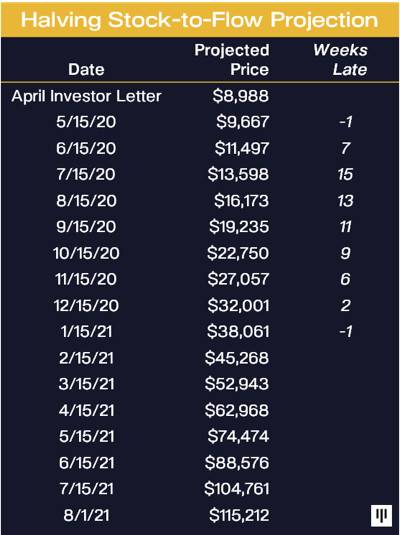
Although it has experienced slow changes for several months, the current price changes of Bitcoin are basically in line with expectations. So the question is: Will Bitcoin reach $115,212 before August 1, 2021?
I’m not betting my entire fortune on whether Bitcoin will hit $115,212 on August 1, 2021, but I think it’s really possible and we’re heading in the right direction.
— Dan Morehead, Co-Chief Investment Officer and CEO of Pantera Capital, speaking to Fox Business on January 8, 2021
When everyone is asking whether the effects of Bitcoin’s “halving” are fully priced in to current prices, I would remind them to remember this wonderful response from Jesse Powell, CEO of cryptocurrency exchange Kraken, during an investor call in May 2020:
Question: Has the Bitcoin halving effect been reflected in the price?
Answer: I don’t think Bitcoin will price itself.
— Jesse Powell, Bitcoin Halving Conference Call, May 12 2020
At least for now, Bitcoin’s price does not seem to reflect the imbalance between supply and demand. We currently remain below the 10-year exponential compound return trendline, and current Bitcoin prices are below our previous forecasts. The Federal Reserve is printing money like crazy, and Morgan Stanley bought 10% of the shares of business intelligence software giant MicroStrategy. It feels like the halving effect is not fully reflected in the Bitcoin price.
The background of Bitcoin halving
The money supply function of the Bitcoin protocol is exactly the opposite of quantitative easing. Now, 6.25 Bitcoins are produced approximately every 10 minutes. On Bitcoin, we cannot see "Greenspan put." (Lianwen Note: Greenspan put is a market slang term, which refers to the actions taken by former Federal Reserve Chairman Greenspan to prevent a sharp and continuous decline in the market, such as cutting interest rates to avoid investors' risk aversion and hindering U.S. economic growth.) Now, for Bitcoin, one thing that is unbeatable is: 6.25 Bitcoins are produced every 10 minutes.
Every four years, the Bitcoin block reward is halved – until 2140, when all 21 million Bitcoins have been mined.
Bitcoin supply and token distribution rules are based entirely on mathematical principles and are designed to be transparent and predictable.
"The total supply of Bitcoin is 21 million. When a block is generated, Bitcoin will be distributed to network nodes, and the Bitcoin block reward will be reduced by one side every four years. The first four years is 10,500,000; the second four years is 5,250,000; the third four years is 2,625,000; the fourth four years is 1,313,500 Pieces..."
— Satoshi Nakamoto, Crypto Mailing List, January 8, 2009.
The price impact of Bitcoin halving
If the Bitcoin block reward is halved, the price of the currency will soar. As we described in our recent letter to investors, it makes sense for the halving event to have an impact on the price of Bitcoin, because if the supply is cut in half (especially if market demand surges), there will be a shortage of supply and the price will inevitably rise sharply, thus incentivizing those who hold Bitcoin to sell.
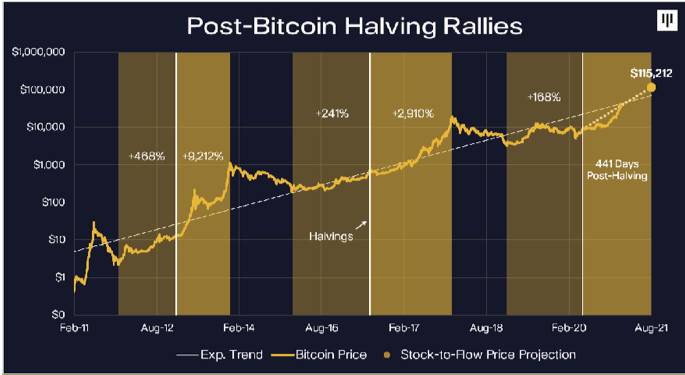
The chart below shows the price trend of Bitcoin before and after the previous three Bitcoin block reward halvings.
Judging from historical data, before the halving, the average time for the Bitcoin price to bottom out is 459 days, and then the price will gradually climb until the halving approaches, and then skyrocket. The average length of time between the halving and the start of the bull market is approximately 446 days.
In this cycle, the market trough before the halving will actually reach 514 days. We estimate and make a judgment based on this range: If history repeats itself, Bitcoin prices will peak in August 2021.
STOCK-TO-FLOW model prediction
Our framework for studying and analyzing the Bitcoin block reward halving is actually to study the changes in the "stock-to-flow" ratio of each halving, and then extend the research results to subsequent halving events. The first Bitcoin block reward halving, accounting for 15% of the total supply, will not only have a huge impact on supply, but also on price.
Subsequent Bitcoin block reward halvings are likely to have a gradually diminishing impact on price, as the ratio of the supply after the last block reward halving to the supply after the next block reward halving continues to decrease. The chart below shows the supply before each previous Bitcoin block reward halving, as well as the percentage change in supply after each Bitcoin block reward halving.
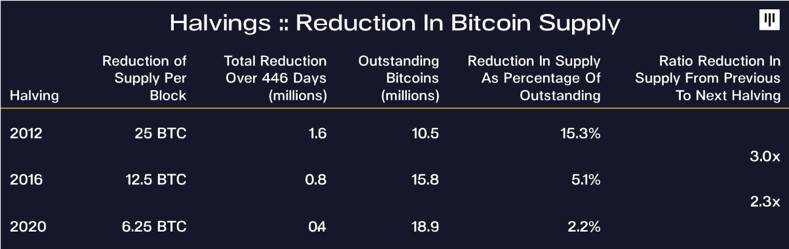
During the second Bitcoin block reward halving, the supply was only one-third of the first halving. This phenomenon is very interesting because the impact of this halving on the price increase is exactly one-third.
If we extrapolate this changing trend to the Bitcoin block reward halving event in 2020, then:
The reduction in Bitcoin supply this time is only 40% of what it was in 2016. If this relationship holds true, it would mean that Bitcoin’s price would also rise by 40% of its previous price – so we expect Bitcoin to reach a price peak of $115,212 in August 2021.
I realize that some people may find this price prediction ridiculous. But do you know? When we established the Pantera Bitcoin Fund, the price of Bitcoin was only $65. However, at that time we boldly predicted that the price of Bitcoin would reach $5,000. As a result, many people in the market thought this prediction was ridiculous.
Mark Twain once said: History does not repeat itself, but there are always striking similarities - we feel that the possibility of Bitcoin price rising is much greater than 50%, and the magnitude will be large.