
Author: Hu Tao, ChainCatcher
On November 17, Beijing time, the Q3 13F centralized disclosure was basically implemented, and the crypto positions of Wells Fargo, Goldman Sachs, Millennium and other institutions came into public view. On the evening of November 19th, Beijing time, Galaxy Research summarized that as of September 30th, 2,166 reporting institutions held a total of 356,491 BTC-equivalent U.S. spot Bitcoin ETPs, worth US$29.78 billion at the end of the quarter.
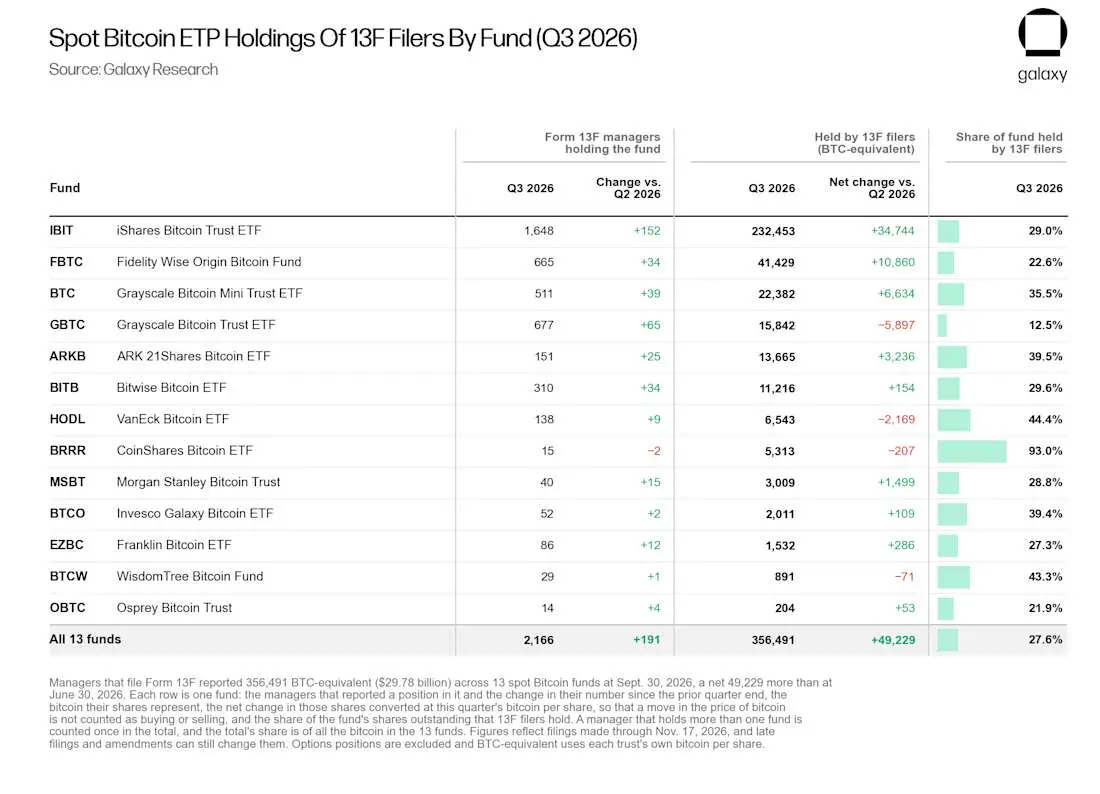
The net increase in holdings in Q3 was 49,229 BTC equivalent, approximately US$4.11 billion, which is the largest single-quarter increase since Q2 in 2025. On the surface, this is Wall Street buying again; but behind the total volume, the buyer structure and disclosure lag are more informative than the "new high" itself.
The same report shows that as of November 16, the total BTC holdings of related funds have decreased by 38,531 from the end of the quarter to 1,252,139, and the BTC price has dropped from approximately US$83,580 at the end of the quarter to US$64,943. The record quarter-end snapshot coexisted with redemptions and declines at the time of disclosure, essentially indicating that 13F is more suitable for observing institutional structures rather than looking for endorsement of current prices.
The total volume hits a new high, but the increase is uneven
What really keeps buying is not the most actively traded hedge funds, but investment advisors and wealth management platforms. Galaxy data shows that this category holds 144,307 BTC equivalents, accounting for 40.5% of all 13F declared positions, contributing about half of the net increase this quarter, and has been net buying for 9 consecutive quarters; its position size is currently approximately 3.3 times that of March 2024.
This set of data is more important than the total volume reaching a new high. Hedge funds' share of declared holdings has fallen to 19.0% from 50.6% at the end of 2024. This does not mean that trading funds are retreating across the board - Q3 macro funds, basis and relative value funds added a net 10,492 and 9,184 BTC equivalents respectively - but the source of stable increments is indeed shifting to client allocation accounts.
The increase is also highly concentrated. The top 50 largest holders had a total net increase of 59,578 coins, while the remaining institutions had a total net decrease of 10,349 coins; IBIT accounted for 65.2% of institutions’ declared holdings and received 34,744 of the net increases this quarter. The so-called "institutional increase in positions" is more of a concentration of a few large institutions, large platforms and leading issuers, rather than an even spread of risk preferences.
Rich country reaches the summit
Wells Fargo is at the heart of this ranking change. Its spot Bitcoin ETP holdings rose from about 15,900 BTC equivalent at the end of Q2 to 30,553 BTC, worth about $2.55 billion, becoming the largest 13F holder for the first time and surpassing Jane Street. Among them, IBIT’s share doubled from approximately 24.4 million to 49.58 million. Previously, from Q1 2024 to Q1 2026, the top spot had been occupied by Millennium.
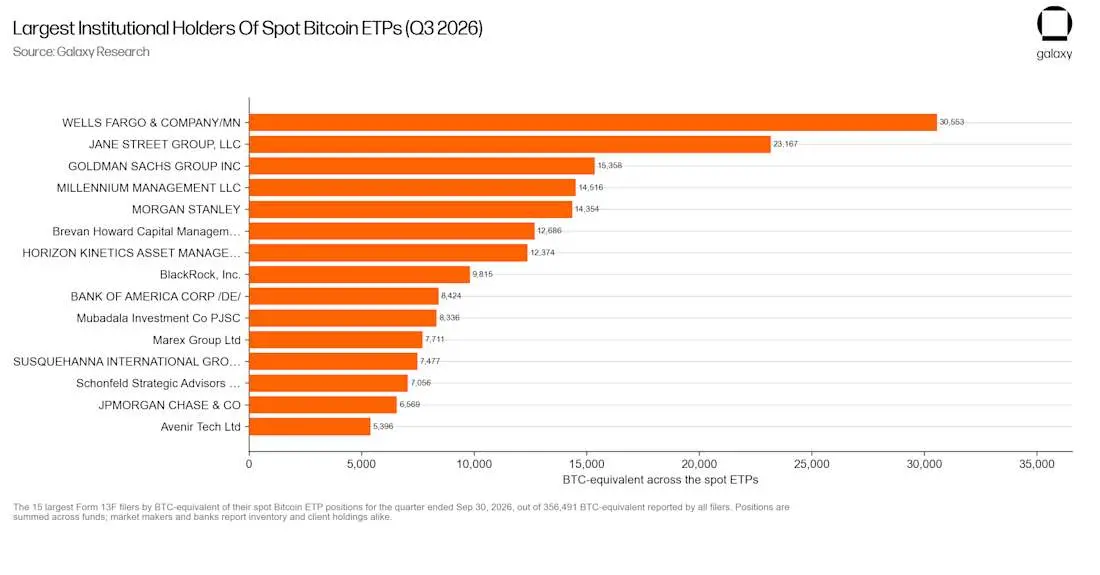
But the "largest holder" is not the same as the "largest self-operated buyer". Alex Thorn, director of Galaxy research, reminded on
Other banks are also expanding their balance sheets. The 13F filing showed that Bank of America's IBIT share jumped from about 1.72 million shares to 14.48 million shares, an increase of about 741%; Morgan Stanley increased by about 18% to 19.52 million shares, and JPMorgan Chase increased by about 9.6% to 11.41 million shares. Growth on the bank side is a fact, but 13F does not identify the ultimate beneficiary and writes all positions as "bank self-operated burst buying", which will exaggerate its directional meaning.
Goldman Sachs’ position doubled
Goldman Sachs’ declared position in spot Bitcoin ETFs increased from approximately US$580 million to US$1.283 billion, a 121% month-on-month increase. However, when broken down, its largest single position, IBIT, decreased by about 5% to 16.44 million shares, and its market value still rose to US$778.3 million, mainly because the quarterly price of IBIT rose from US$33.29 to US$47.34. The real increase came from FBTC: shares jumped from about 106,000 shares to 5.48 million shares, worth about $397.9 million.
This means that dollar market cap is a blend of price and share changes and cannot be directly equated to net buying. Goldman Sachs also opened a new MSBT position of approximately $47.9 million; its Ethereum ETP position rose from approximately $210 million to approximately $1.22 billion, and XRP and Solana fund positions rose to approximately $144 million and $180 million respectively. At the same time, it cut Strategy's long position by nearly 52% to about $422.6 million, more like adjusting the exposure structure than indiscriminately adding to positions in the entire sector.
The scale also needs to be calibrated. The above four types of funds total approximately US$2.8 billion, accounting for only approximately 0.25% of Goldman Sachs’ total 13F filings. For Goldman Sachs, this is still a small portfolio slice; for the crypto market, it means more about product adoption and distribution than a bank suddenly changing its asset allocation center.
Hedge funds cover, spot longs are just one leg of the trade
Millennium’s backfill is the most intuitive. The long market value of its spot Bitcoin ETF rose from about $434.9 million at the end of Q2 to about $1.21 billion, an increase of about 179%; IBIT share increased by 115% to 20.82 million shares, worth about $985.5 million. In the previous two quarters, it had successively cut IBIT from 34.33 million shares to 9.69 million shares at the end of 2025. This quarter is a clear rebuilding of the position.
Jane Street is more like rearranging inventory between products: IBIT's share decreased by 18.7% to 20.22 million shares, but FBTC increased by approximately 691% to 7.01 million shares, and ARKB increased from approximately 2.7 million shares to 11.69 million shares. If you only look at IBIT, you will come to the conclusion of underweighting; after merging multiple funds, its operation is closer to the position migration between issuers, rather than simply withdrawing Bitcoin ETP.
Options further weaken the certainty of the word "long". Millennium also declared call options corresponding to approximately 6.11 million shares of IBIT and put options to 2.75 million shares; Jane Street’s IBIT call and put options corresponded to approximately 34.97 million shares and 45.32 million shares respectively, both exceeding its spot holdings. Goldman Sachs also filed put options corresponding to approximately 7.51 million shares of IBIT.
13F only lists quarter-end long positions and some on-exchange options, and does not include short positions, futures and swaps, nor does it specify the option exercise price, term or trading purpose. For market makers and basis funds, ETF longs can be a fully hedged leg. The same document can tell completely opposite stories if the business attributes are ignored.
Record Snapshot, Already Lagging the Market
The document was fixed on September 30, and the market had already gone out of another period. According to RootData data, spot Bitcoin ETFs saw net outflows of approximately $3.63 billion in the latest month. The decline in fund holdings measured by Galaxy is consistent with the direction of capital flows, but these data cannot indicate that Wells Fargo, Goldman Sachs or Millennium have sold in Q4, nor can the two statistical calibers be directly subtracted.
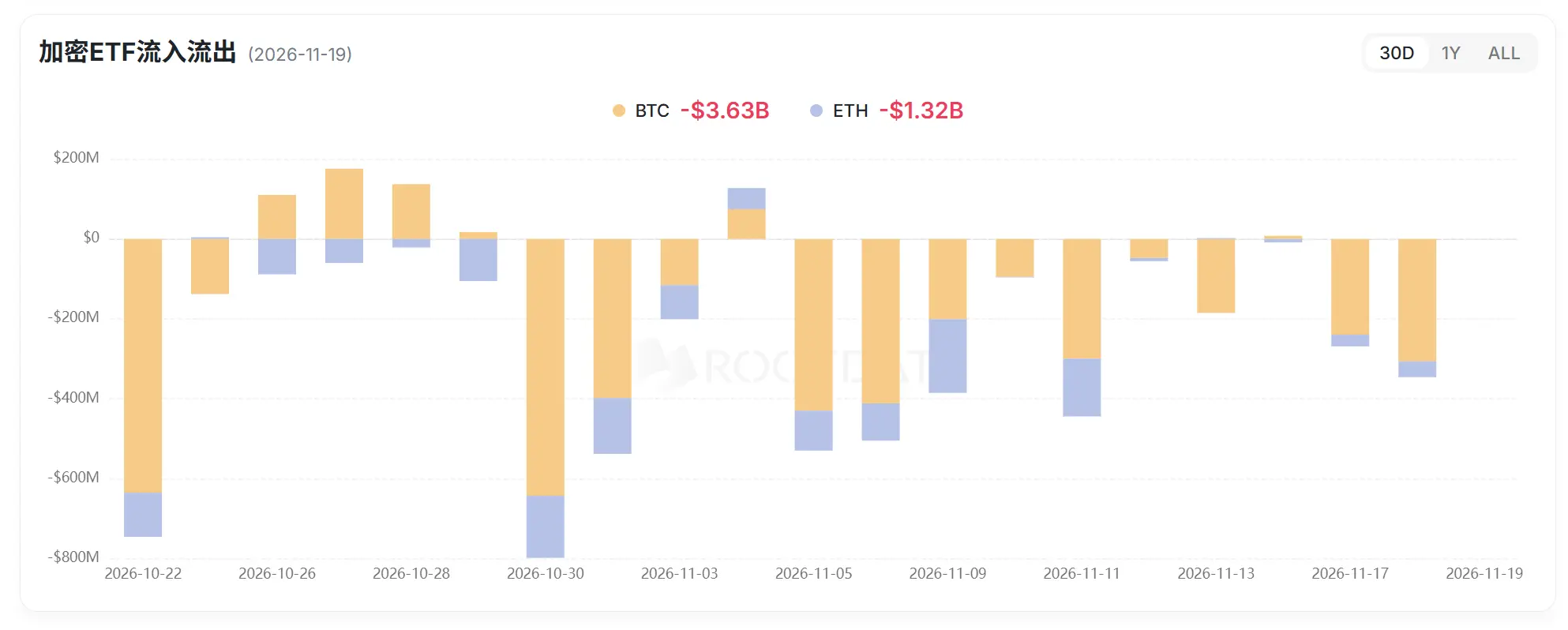
Therefore, the strongest conclusion that this 13F can support is not that "Wall Street has bought the bottom", but that Bitcoin ETP is entering deeper into wealth management and customer accounts: reporting institutions already hold 27.6% of BTC in the fund, higher than 24.8% at the end of Q2. This may bring about more persistent allocation needs, but whether wealth channels are really more stable than trading funds has not yet undergone a complete test in this round of Q4 redemptions. More data information will not be revealed until the next round of disclosures in mid-February 2027.