
Since its launch in March 2025, GasFree, the "Gas"-free transfer solution under JUST, the financial infrastructure on the TRON ecological chain, has continued to promote the rapid expansion of its business scale and grown into a benchmark project that has attracted much attention in the field of stablecoin payment with its breakthrough "transfer token direct payment of Gas" innovative mechanism.
Entering 2026, GasFree has experienced accelerated business development, achieving exponential strong growth in core indicators such as user size, capital flow volume, and number of transactions, demonstrating growth resilience far exceeding the industry average, and becoming a phenomenon-level dark horse project recognized on the stablecoin payment circuit. As of November 19, 2026, the cumulative stablecoin transfer scale of GasFree has exceeded US$173 billion, the cumulative number of transactions has exceeded 10 million, and the cumulative number of service users has exceeded 550,000. Real transaction data has fully verified the large-scale implementation results and subsequent growth space of the "Gas" transfer model on the TRON chain.
While its business scale is growing rapidly, GasFree has also simultaneously completed a number of product and ecological capability upgrades to further broaden its service boundaries. In terms of currency coverage, it has expanded from supporting USDT in the early stage to USDT and USDD, dual mainstream stablecoins; at the level of ecological access, GasFree has joined hands with Binance Web3 Wallet to launch a stablecoin gas payment function, exporting its capabilities to the world's largest encrypted user traffic portal; in terms of commercialization, GasFree's cumulative revenue has exceeded US$12 million since its launch, and business revenue has been included in the JST repurchase and destruction mechanism, further integrating the commercialization results into the value system of the JUST ecosystem.
From the initial single-point innovative tool that solved the pain points of on-chain transfer experience, to now becoming a stablecoin payment infrastructure with hundreds of billions of stablecoin transaction carrying capacity, serving hundreds of thousands of users, and contributing tens of millions of revenue, GasFree has embarked on a high-quality development path that drives large-scale applications through product mechanism innovation, and is accelerating its evolution into an indispensable underlying facility in the crypto payment track.
GasFree has delivered impressive results after being online for about 20 months: the stablecoin transfer volume exceeded 173 billion US dollars, the number of users exceeded 550,000, and the cumulative transactions exceeded 10 million
In the past 20 months since its launch, GasFree has completed a rare all-dimensional leap in the stablecoin payment industry: from scratch to large-scale implementation, the cumulative transfer scale has exceeded 173 billion US dollars, the number of service users has climbed to 550,000, and the cumulative number of transactions processed has exceeded 10 million. Structural growth has been achieved simultaneously in the three core dimensions of user coverage breadth, user transaction frequency and capital flow volume.
This eye-catching report card, which is composed entirely of real transactions, not only intuitively demonstrates GasFree’s current mature and large-scale application results, but also verifies its innovative “Gas”-free transfer model from the bottom up. It accurately hits the core experience pain points that have long existed in the stablecoin payment scenario, and has extremely strong market rigid demand and sustainable long-term growth potential.
GasFree will be officially launched at the end of March 2025. It mainly solves the pain point of traditional blockchain transfers that require holding the corresponding network native tokens in advance as Gas handling fees. Through the innovative model of "transfer tokens to pay gas directly", the handling fee can be automatically deducted directly from the transferred assets, allowing users to complete the transfer without holding any network native tokens such as TRX, truly realizing a "Gas" friction-free experience of "what you transfer is what you pay".
In the early days of its launch, GasFree mainly supported "Gas"-free transfers of USDT stablecoins, and was the first to be implemented relying on TronLink, the official TRON wallet. About half a year after its launch, GasFree's cumulative stablecoin transfer scale reached US$15.8 billion in September 2025, and the cumulative number of transactions exceeded 750,000. This initially verified the actual market demand for this product mechanism and laid the foundation for subsequent user growth and ecological expansion.
Entering 2026, GasFree is ushering in a period of accelerated business growth. The cumulative transfer scale has jumped from tens of billions of dollars to hundreds of billions of dollars, and the cumulative number of transactions has simultaneously moved from millions to tens of millions, and continues to leap to higher levels. Specifically, in January 2026, the cumulative transfer scale exceeded US$46.3 billion, and the cumulative number of transactions exceeded 2.5 million; in April, it further exceeded US$81.6 billion, with 4.66 million transactions; in July, it reached US$114.3 billion, with 6.61 million transactions; in October, it exceeded US$157.1 billion, with 9.14 million transactions. According to statistics on November 17, the cumulative transfer scale further exceeded US$171.8 billion, and the cumulative number of transactions was close to 10 million.
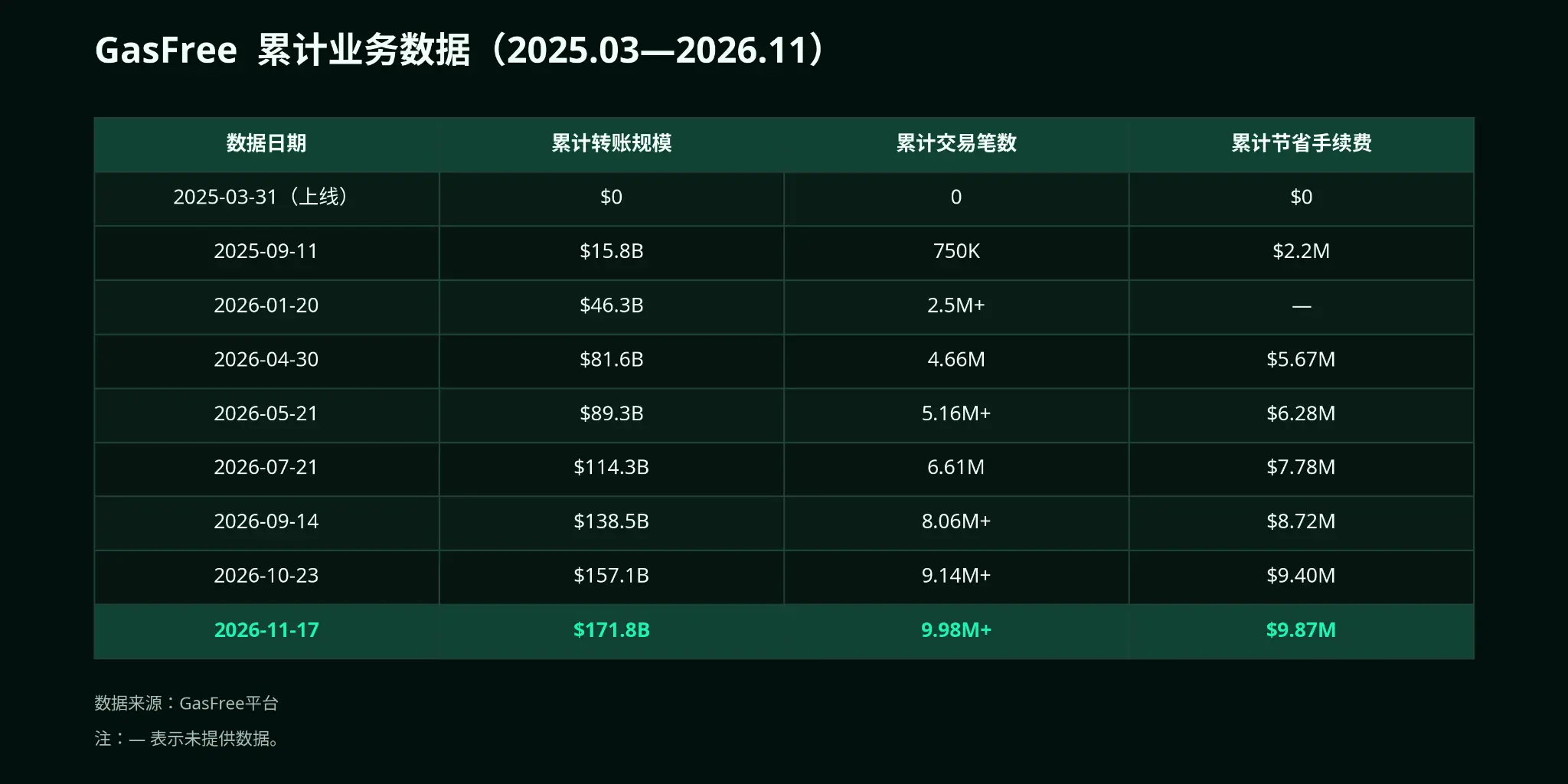
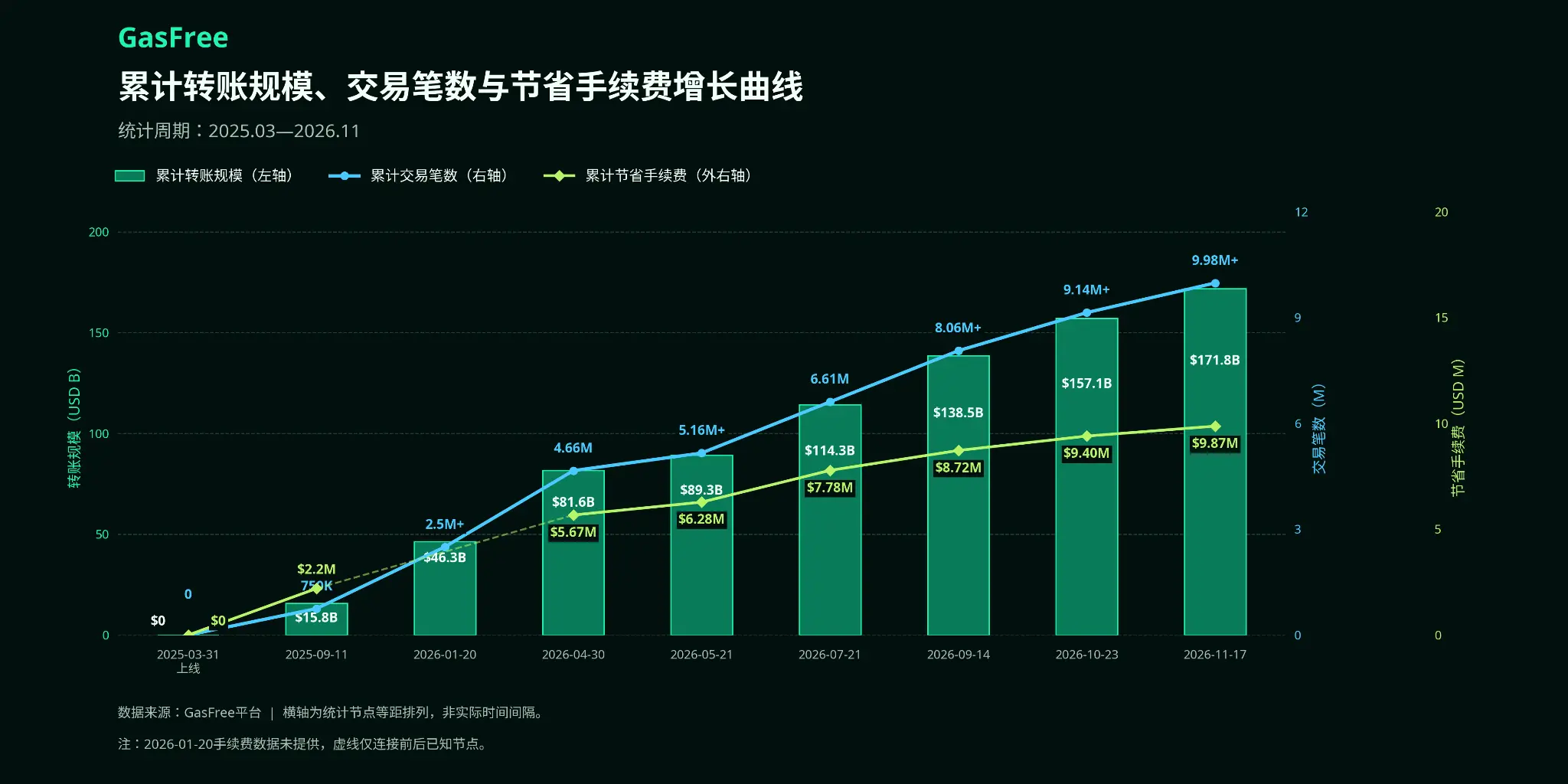
From the perspective of growth, GasFree’s cumulative transfer scale and number of transactions have achieved significant growth since 2026. Taking the cumulative transfer scale of US$46.3 billion in January 2026 as the base, it has increased by approximately 2.7 times as of November 17; the cumulative number of transactions during the same period has increased from 2.5 million to nearly 10 million, nearly 4 times the base. The simultaneous improvement of the two core indicators shows that GasFree's business growth comes not only from the expansion of capital circulation, but also from the continued increase in real transaction demand, showing the characteristics of healthy growth driven by both capital scale and transaction frequency.
It is worth mentioning that as of the latest data on November 19, 2026, GasFree has saved users nearly US$10 million in handling fees. This data reflects the actual role of the "Gas"-free transfer mechanism in reducing on-chain operating costs from the perspective of user value, and continues to bring user experience optimization and cost savings.
If the cumulative data reflects the overall development results of GasFree since its launch, then the monthly business performance further reveals the sustainability and structural characteristics of its growth. From April to October 2026, the monthly stablecoin transfer scale of GasFree has always remained above 10 billion US dollars, and increased from US$11.30 billion in April to US$15.89 billion in October, with a cumulative increase of approximately 40.6% in seven months. During the same period, the number of monthly transactions also increased from 725,000 in April to 934,000 in October, remaining above 700,000 every month; the cumulative number of service users increased from 287,000 in April to 524,000 in October, a net increase of 237,000 in seven months, an increase of more than 80%, providing a solid foundation for further expansion of transaction scale.
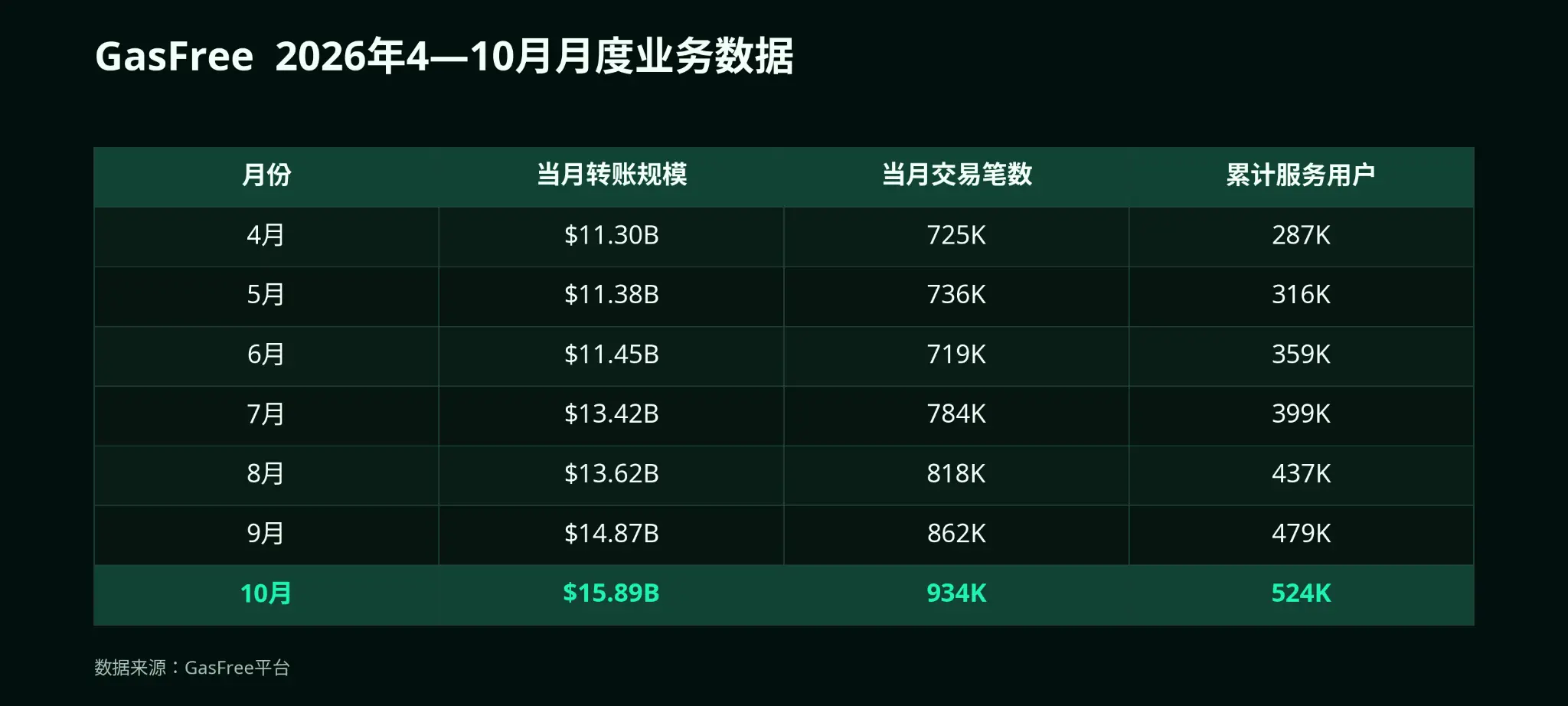
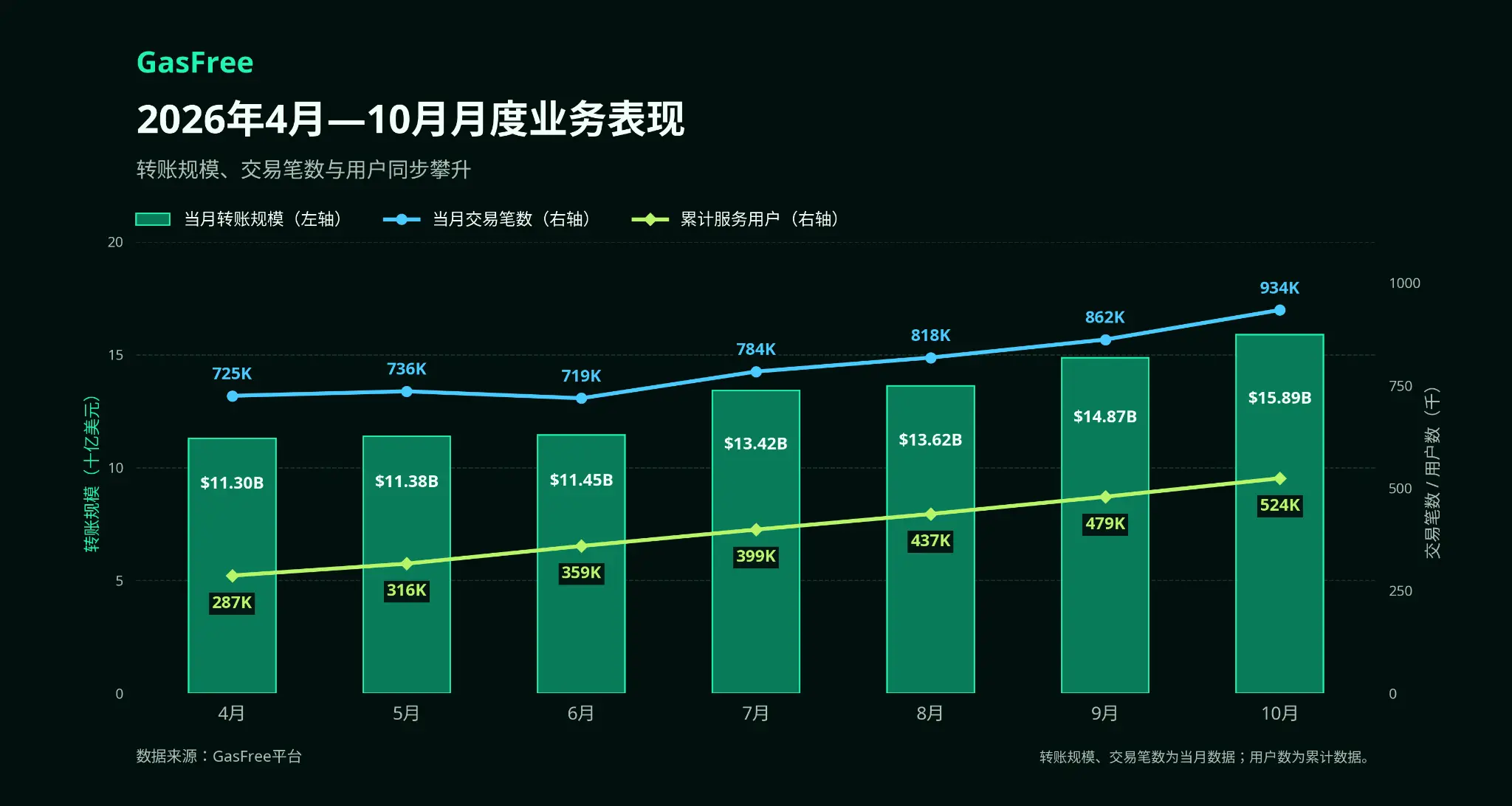
Continuously maintains a monthly transfer scale of tens of billions of dollars, indicating that GasFree has formed a relatively stable capital flow demand and has the ability to undertake larger-scale stablecoin trading activities; and the continued increase in monthly scale also shows that its growth is not a short-term pulse, but a structural expansion that gradually accumulates along the time dimension.
It can be seen from the monthly data that GasFree has formed a development trend that is mutually supportive of expanded user coverage, increased transaction activity, and increased capital flow scale. The continuous increase in the user base provides a broader basis for transaction demand; the increase in transaction frequency further promotes the expansion of monthly capital circulation. This multi-dimensional collaborative growth also makes GasFree's business performance no longer limited to a single fund size indicator, but gradually reflects the characteristics of large-scale applications.
From a zero start in the early days of launch in 2025, the cumulative transfer scale has exceeded 10 billion US dollars, exceeded 100 billion US dollars, and now exceeds 173 billion US dollars; service users have increased from 0 to more than 550,000, and cumulative transactions The number of transactions exceeds 10 million - in the past 20 months, GasFree has demonstrated with continued growth of real business data that the "Gas"-free transfer model not only has the basis for large-scale application, but also opens up real space for its extension to a wider range of stablecoin payment scenarios.
GasFree product features continue to innovate and upgrade: adding USDD assets to achieve multi-currency coverage and improving standardized API integration capabilities
While the user scale and transaction volume continue to grow, GasFree continues to deepen product capability building, and continues to iterate around the expansion of stablecoin asset types, upgrades to transfer fee mechanisms, and improvement of technology integration services. It has gradually formed an open technical service system based on the support of multiple stablecoins such as USDT, USDD, and supported by standardized APIs and developer tools, constantly improving product compatibility, ease of use, and ecological expansion capabilities.
In terms of asset support, GasFree’s stablecoin coverage capabilities have experienced the process of expanding from a single asset to a multi-asset matrix. In the initial stage of the platform's launch, GasFree focused on the USDT "Gas"-free transfer service that has the largest circulation and the most frequent usage in the world. In August 2026, GasFree officially added support for the TRON ecological decentralized stablecoin USDD, thereby achieving coverage of the two core stablecoins USDT and USDD, and the asset support structure was expanded from a single USDT to dual stablecoins in parallel.
Currently, users using GasFree to transfer USDD and USDT do not need to hold additional TRX. The handling fee can be automatically deducted directly from the transferred stablecoin assets, realizing "what you transfer is what you pay". This design enables new assets not to simply add currencies, but to complete asset support expansion without changing the user's operation path, reducing users' learning and usage costs, and also provides a reusable mechanism basis for the subsequent access of more stable currency assets and payment scenarios.
In terms of fee mechanism, GasFree completed the upgrade of the fee system in May 2026, further clarifying the charging standards for account activation and transfer services. Among them, the first-time activation fee for a USDT account is 1.5 USDT, and the fixed handling fee for each subsequent transfer is 1.5 USDT. After the USDD service is launched, in order to further reduce the user threshold, the first-time activation fee for a USDD account is 1 USDD, and the fixed handling fee for each subsequent transfer is only 0.5 USDD.
Users can choose either USDT or USDD to complete account activation. After activation, both types of stablecoins can be used. All transfer fees are fixed pricing: USDT 1.5 USDT per transaction, USDD 0.5 USDD per transaction, which has nothing to do with the transfer amount. This mechanism not only eliminates the need for users to hold native tokens in advance, but also eliminates the need to bear additional costs caused by price fluctuations of native tokens, making handling fee expectations clearer and more controllable.
From the perspective of actual transaction costs, GasFree’s on-chain transfer fees are more advantageous. Calculated based on the data on the TRON chain on November 17, 2026, the gas cost per transaction of transferring USDT on the traditional TRON chain is close to 3.2 USDT, while using GasFree only costs 1.5 USDT per transaction, which reduces the cost by more than 50%.
In terms of product expansion capabilities, GasFree continues to improve around two paths: developer ecosystem and asset service expansion: on the one hand, it reduces the threshold for third-party application integration through standardized APIs and developer tools; on the other hand, through a multi-token compatible architecture design, it reserves technical space for future new asset access and cross-ecological expansion. The two jointly promote the continuous penetration of "Gas"-free transfer capabilities into more assets and more Web3 scenarios.
On the third-party application access side, GasFree has launched the Developer Center in September 2025, which integrates SDK for the full ecological open wallet, DeFi application-specific API, and real-time energy and transaction fee analysis dashboard for service providers, lowering the access threshold for third-party applications. Through standardized API interfaces and development tool systems, wallets, DeFi applications and other Web3 service platforms can more easily integrate GasFree's "Gas" transaction capabilities.
In terms of new asset expansion and cross-ecology, the GasFree universal token architecture will support the access of more universal assets in the future. Its core functions are independent of the implementation of specific tokens. Token adaptation and the core logic of "Gas"-free transfers are decoupled from each other. There is no need to significantly transform the core protocol in the future. It only requires a few modifications to quickly support new TRC-20 and ERC-20 tokens with one click. Currently, GasFree core services are mainly deployed on the TRON network, and its underlying architecture has reserved complete technical space for subsequent cross-chain and cross-ecological expansion to Ethereum and the full range of EVM-compatible ecosystems.
Overall, GasFree currently uses a developer tool system to lower the integration threshold for third-party applications. In the future, it will use a multi-token compatible architecture to lower the threshold for new asset access and support cross-ecological expansion. The two paths form a synergy and jointly support the extension of its "Gas"-free transfer capabilities to more scenarios.
From expanding the scope of stablecoin support, to optimizing the fee system, to opening developer tools, GasFree is continuing to improve its underlying product capabilities and provide technical support for more wallets, DeFi applications and Web3 service platforms to access "Gas"-free transfer functions.
The GasFree ecological landscape is accelerating expansion: integrating dozens of mainstream wallets and payment platforms, and joining hands with Binance Web3 Wallet to launch the "Stablecoin Gas Payment" function
While transaction data continues to grow and product capabilities continue to improve, GasFree's ecological cooperation scope continues to expand: it has gradually extended from early official wallet integration to multi-wallet and multi-platform cooperation, promoting product capabilities to reach a wider user group, and gradually forming an ecological expansion model with technical capabilities as the core, supported by wallet, payment and exchange platform cooperation, and combining online and offline activities.
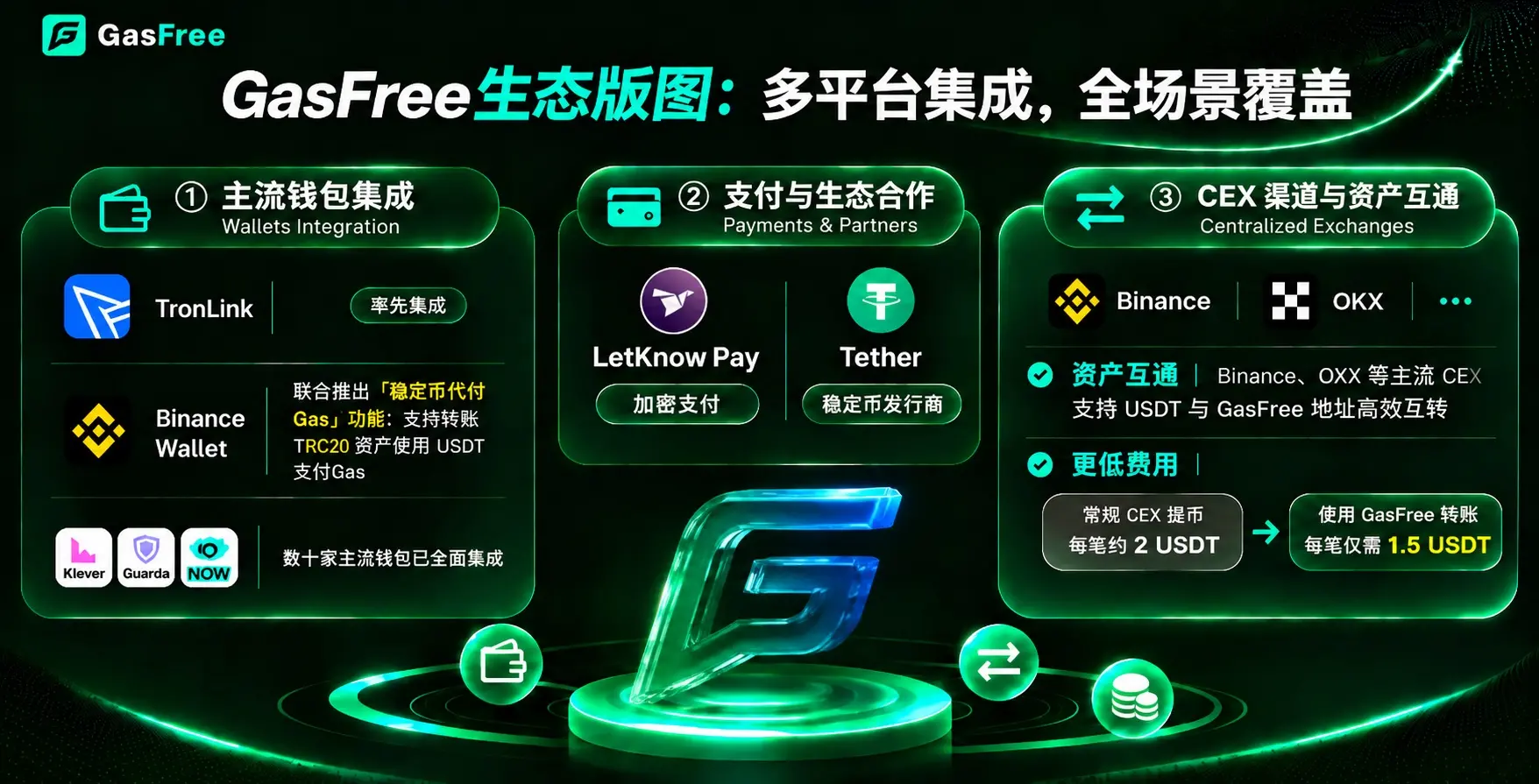
In terms of ecological cooperation, GasFree has gradually expanded from the early integration model based on TRON's official wallet TronLink to dozens of mainstream wallets such as Klever, Guarda, and NOW Wallet, as well as payment platforms such as LetKnow Pay and ecological partners such as Tether, and continues to promote technology access to more platforms. The scope of cooperation has been expanded from wallet integration to payment and ecological cooperation scenarios, making the "Gas"-free transfer capability closer to users' daily asset management and transfer portals.
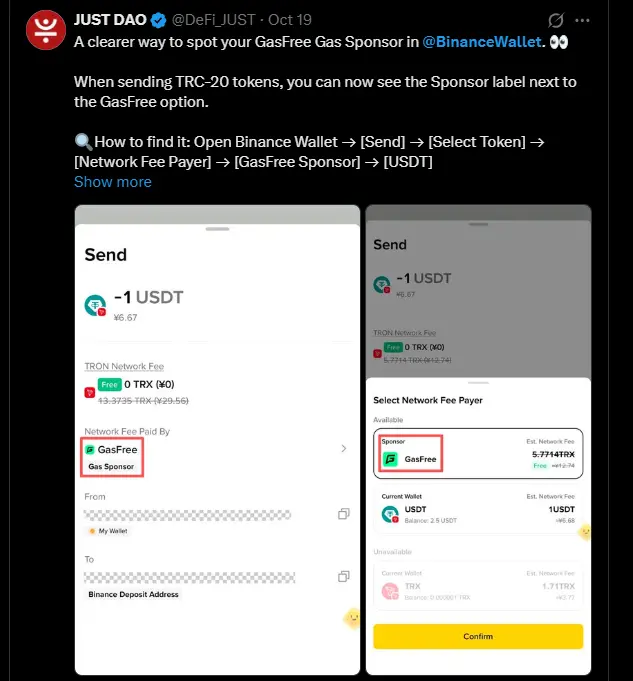
Among them, the cooperation with Binance Web3 wallet is an important milestone in the expansion of GasFree ecosystem. In September 2026, GasFree joined hands with Binance Web3 Wallet Binance Wallet to launch the "Stablecoin Gas Payment" function, which allows users to directly use USDT to deduct Gas fees without holding additional TRX when transferring USDT and related TRC-20 assets on the TRON network. At the same time, GasFree has launched special limited-time benefits for Binance wallet users: users can not only enjoy limited-time free asset transfer opportunities on the TRON chain, but also pay gas fees in USDT, with each transaction as low as 1 USDT, further lowering the threshold for users to experience "Gas" transfers. This cooperation not only reflects the recognition of GasFree’s technical capabilities by leading trading platforms, but also marks the further expansion of its “Gas”-free transfer capabilities from wallet integration within the TRON ecosystem to the third-party technology output of leading trading platforms, providing a new entrance to reach global user groups.
In terms of CEX channels, GasFree has achieved asset interoperability with a number of mainstream exchanges. Mainstream CEX platforms such as Binance, OKX, and HTX support users to directly withdraw USDT to the GasFree wallet address, or directly to the corresponding trading account. This access method shortens the path for users to transfer funds from the exchange to the chain, allowing users to complete asset withdrawals at a more familiar exchange entrance. It is worth mentioning that currently using GasFree to transfer has more cost advantages: now you can withdraw USDT to a TRON on-chain address through Binance and OKX, and each on-chain fee is about 2 USDT; using GasFree to transfer to other TRON addresses only costs 1.5 USDT.
In addition to wallet and platform cooperation, GasFree also expands brand influence and user awareness through online and offline activities. Online, whether it is the "JUST 6th Anniversary × GasFree Super Carnival Month" in May 2026 or the TRON ECO × BBW 2026 Thanksgiving Day Parade launched in November, there will be product experience, user interaction and other welfare activities for GasFree to promote more users to understand and use "Gas"-free transfer services. Offline, in the second half of 2026, GasFree will appear at IBW 2026 Istanbul Blockchain Week, WebX 2026 Tokyo Conference, GWDC 2026 Seoul, South Korea and Token2049 Singapore and other industry summits to strengthen communication with global Web3 industry and ecological partners and create more opportunities for subsequent platform cooperation and market expansion.
From integration with dozens of mainstream wallets, to access to Binance Web3 wallet, to payment platform integration, CEX asset interoperability, and online and offline activities, GasFree’s cooperation network and service reach continue to expand. Overall, its ecological expansion is not a single channel superimposition, but gradually unfolds around "wallet entrance - trading platform entrance - industry activity access": wallet integration expands daily use entrances, CEX interoperability shortens asset circulation paths, Binance Web3 wallet cooperation improves third-party platform output capabilities, online and offline activities simultaneously enhance user awareness and experience, and promote the expansion of products in the global market, jointly supporting the extension of "Gas"-free transfer capabilities to a wider range of users and scenarios.
From on-chain transfer tools to stablecoin payment infrastructure: GasFree’s cumulative revenue exceeds US$12 million, opening a new stage of commercial development
As the user scale, transaction volume and ecological access scope continue to expand, GasFree’s development achievements have officially extended from the product application level to a new stage of commercialization. The current GasFree has not only built a large-scale stablecoin transfer service capability that supports hundreds of billions of dollars in capital flows, but has also efficiently transformed massive real user needs into verifiable actual business income. It has completed a key leap from product scale growth to commercial value creation, and has officially entered a new development cycle of "verifying business models with actual income and supporting long-term development with ecological value return".
According to the "JST Repurchase and Destruction Mechanism Upgrade" announcement released by JUST Ecosystem on October 25, 2026, from the launch of GasFree in March 2025 to the end of the third quarter of 2026, the project The cumulative business income has reached 12.027 million US dollars; at the same time, all GasFree business income has been officially included in the repurchase and destruction fund pool of JUST ecological native governance token JST, becoming another important source of the JST value repurchase system. This node marks that GasFree's development logic has completely jumped out of the early stages of relying solely on product innovation and user growth to verify market demand, and has officially established a sustainable commercialization model supported by real cash flow, and its operating results have also been fully integrated into the overall value system of the JUST ecosystem.
Looking back on the complete development path, from its official launch at the end of March 2025 to November 2026, the cumulative stablecoin transfer scale exceeded 170 billion US dollars and the number of service users exceeded 550,000. GasFree has completed a closed-loop process from product innovation and market verification to large-scale application and commercialization in the past 20 months. The whole process spans: from the initial support for USDT gas-free transfers to the completion of full coverage of the two core stablecoins of USDT and USDD; from the early integration of small-scale ecological wallets to the realization of in-depth access to dozens of mainstream wallets and Binance Web3 wallets and payment ecology; from only providing transfer functions for end users to through Developer Center opens up full-stack standardized technical capabilities, and finally realizes that business income is officially included in the JST repurchase and destruction mechanism. GasFree has established a complete closed-loop product service system and sustainable commercial development framework.
From a macro perspective of the global crypto payment industry, the industry competition for stablecoin payment infrastructure has shifted from a single competition in asset transfer capabilities in the early days to a comprehensive competition in user experience, transaction efficiency, ecological breadth and business sustainability. As stablecoins accelerate their penetration into physical settlements and cross-border circulation, the market is no longer satisfied with basic products that can "complete transfers". The market is in urgent need of low-threshold, high-efficiency underlying infrastructure that can generate its own blood without relying on subsidies.
With nearly 20 months of data practice, GasFree has provided a practical sample with great reference value for industry development: it has innovatively eliminated the threshold for native token holdings with the mechanism of "transfer tokens to pay Gas directly", verified rigid demand with the continuously growing real transaction scale of hundreds of billions, expanded the service boundary with multi-platform ecological cooperation, and finally opened up the transmission link between product operation and ecological value through the deep linkage between actual business income and the JST repurchase and destruction mechanism. This complete path shows that it not only has a solid foundation for large-scale application, but can also form stable cash flow contributions in actual operations and can be integrated into the value growth system of the entire ecosystem.
More importantly, GasFree is rooted in TRON's hundreds of billions of US dollar stablecoin liquidity pool, with massive assets and high-frequency transfer infrastructure. With the collaborative improvement of products, ecology and business value, it is providing a clear and implementable industry model for stablecoin payment to move towards a new stage of "high efficiency, low threshold and sustainability".