
The capital market is currently experiencing three variations of "the de-anchoring of the US dollar - the surge of gold - the awakening of Bitcoin". The essence of this structural change is the generational change of the currency paradigm. As the economic historian Kindleberger pointed out in "Financial History of Western Europe": Changes in the monetary system often lag behind technological revolutions by 50-100 years.
The J-Curve dilemma faced by Bitcoin at the moment - subject to the valuation logic of technology stocks in the short term, and benefiting from the digital gold consensus in the long term - is just like the dormant period before gold broke through the gold standard in the 1970s. If we look at Kondratiev's long wave theory, we are standing at the historical intersection of the sixth wave of technological revolution (digital civilization) and the reconstruction of the monetary order. Bitcoin may play the role of gold in the industrial revolution in the 19th century 。
In the deep water area of the digital economy, whoever can build a stable infrastructure will have the ability to travel through cycles.
In the eyes of many people, the combination of Web3 and AI is still at the level of conceptual hype, and seems to just add a few more "hot words" to traditional technologies. But if we focus on those projects that have truly withstood the test of time and market, we will find that the interaction between so-called "decentralization" and "intelligent algorithms" is far more complex than imagined, and it does indeed show leapfrog innovation potential in specific scenarios. A key premise is that any AI requires real and diverse data to grow, and Web3's token mechanism and privacy protection means can give individuals and even groups new say in the flow and pricing of data.
In a sense, the coupling of Web3 and AI is not as simple as "moving the algorithm to the chain", but an attempt to use a new production relationship to coordinate data, computing power and income distribution.
As we all know, AI training models and applications require a large amount of computing resources. They prefer low-latency cloud environments and GPU computing power. The software stack also includes distributed computing platforms (Apache Spark/Hadoop). Spark distributes the workflows that need to be processed across large computing clusters and has built-in parallelism and fault-tolerant design. The natural decentralized design of the blockchain has made distributed nodes the norm, and the POW consensus mechanism created by BTC has established that miners need to compete in computing power (workload) to win the block results. This has a similar workflow to AI, which requires computing power to generate models/inference problems. As a result, traditional cloud server manufacturers began to expand new business models by renting out graphics cards and selling computing power like renting out servers. And imitating the idea of blockchain, AI computing power adopts a distributed system design, which can use idle GPU resources to reduce the computing power cost of startups.
Some people may say that since centralized computing power and supporting facilities are inseparable, what revolutionary value can Web3 and AI bring? The answer is often reflected in the subtle ways of "trust" and "distribution". In the past, platforms and giants were the absolute center of the data world, and individual users and small and medium-sized enterprises could only invest passively without the capital for peer-to-peer games; now, through the collaborative design of smart contracts and token economies, data contributors, model developers and ecological managers can participate in cooperation with clear agreements on the same network. Although these "new" relationships currently only operate in some relatively niche circles, it is precisely these local successes that provide examples that encourage more people to try to build collaborative networks on a larger scale and in more scenarios.
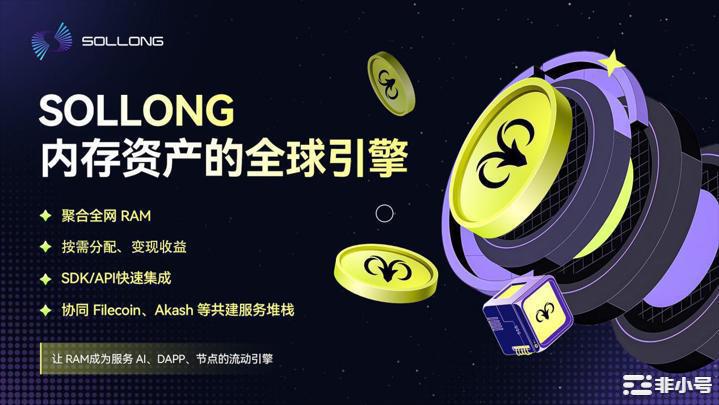
SOLLONG gave the answer
SOLLONG does not regard USDL as an "anchor" in the traditional sense, but as a value system supported by computing power. In the process of continuous stratification of the on-chain economy, the role of stablecoins is no longer just an "intermediary", but the foundation of the entire DeFi ecosystem.
USDL series assets, as the first stablecoin mechanism on the SOLLONG public chain, not only have anchoring income and high circulation characteristics, but will also be deeply empowered to multiple ecological levels such as strategic collaboration, liquidity mining, AI quantification, and cross-chain payments. It is not a passive mapping, but an active one; it is not a partial replacement, but a systematic intervention. In the future, USDL will become a bridge for the "circulation" of all computing power values, building a stable financial foundation native to the public chain in on-chain finance, digital payment, resource scheduling and other modules.