
Under the dome of Capitol Hill in Washington,WhenThe tip of Trump’s pen crossed "The last line of the GENIUS Act,At this moment, thousands of miles away in a mansion in Manhattan, a hedge fund manager is using USDT pays goods to Nigerian suppliers - it arrives in 0.1 seconds, with a handling fee of only US$0.3. These tiny ripples on the chain are converging into a huge wave that is reshaping the global financial order.
01 Two Heroes Fighting for Hegemony: The Warring States Era of Stablecoins
- USDT (market share 61.2%): holds US$120 billion in US Treasury bonds, exceeding the size of the German national reserves, effectively becoming the 19th largest holder of US bonds in the world. Its focus has shifted to the P2P remittance market, with a penetration rate as high as 43% in emerging countries
- USDC (market share 24.4%): Taking advantage of regulatory compliance, Dongfeng’s market value has doubled to US$61 billion. Its reserve assets are 100% cash and short-term treasury bonds. It holds top licenses such as FinCEN and EMI. It will promote IPO in 2025 and aim to become the “first stablecoin stock”
Ø Table: Stablecoin market structure and strategic positioning in 2025
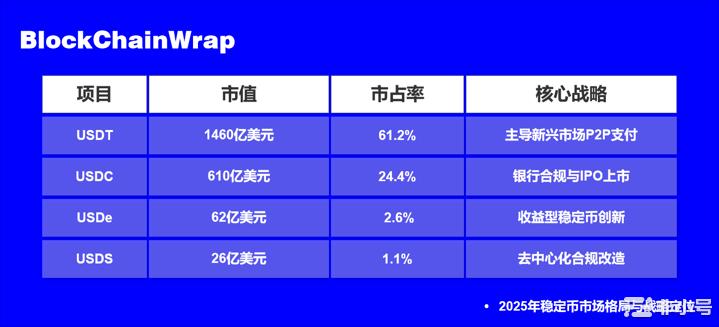
Decentralization is rising from the cracks. Ethena Labs’ USDe relied on its delta-neutral hedging strategy, and its market value surged 42 times from US$146 million to US$6.2 billion, becoming the third largest stablecoin in the market. The market value of USDS launched after MakerDAO changed its name to Sky exceeded US$2.6 billion, seizing the high ground of DeFi through compliance transformation.
02 Bill Revolution: How GENIUS recasts US dollar hegemony
The "GENIUS Act" passed on May 20, 2025, marks the official upgrade of stablecoins from a "regulatory gray area" to a US dollar digital strategic tool:
- Reserve Shackles: Mandatory Requirements 100% USD asset reserve (only cash, short-term debt within 93 days, currency funds), cutting off the path to algorithmic stablecoins
- Interest segregation: Issuers are prohibited from paying interest, user funds are bankrupt and segregated, terminatedTether’s arbitrage model of using reserves to invest in Bitcoin
- Geofirewall: Foreign stablecoins need to be registered in the United States and subject to supervision, and technology giants are not allowed to issue them without permission, specifically suppressing the cross-border expansion of China’s digital renminbi
Behind the bill is a naked calculation of US dollar hegemony. When Tether and other institutions allocate 90% of their reserves to short-term U.S. debt, objectively forming an invisible bond-buying power—stablecoin issuers may become one of the largest holders of U.S. debt by 2030, transfusing the US$36 trillion fiscal deficit. U.S. Treasury Secretary Bessent bluntly said: "We will use stablecoins to maintain the U.S. dollar's status as the world's reserve currency"。
03 Yield War: The life and death game of high-interest stablecoins
When The GENIUS bill blocks interest-bearing stablecoins, and a secret war on income innovation breaks out in a regulatory blind spot. Falcon Finance in Dubai, United Arab Emirates has become a dark horse:
its synthetic dollar protocolUSDf supports the use of BTC, ETH and other assets as collateral for casting, and the annualized return is as high as 14.3%
By integrationChainlink oracle and Pendle income platform build a delta neutral hedging matrix to maintain stability in volatile markets
The essence of this model is the art of regulatory arbitrage - Use the UAE's loose policies to circumvent the US ban, and then achieve "non-interest-bearing high returns" through on-chain portfolio strategies. Its TVL currently exceeds US$160 million, attracting a large number of institutional funds to flee the low-yield USDC.
04 Political Gambling: Trump’s Stablecoin Ambition
The Trump family’s tentacles have already penetrated deep into the hinterland of stable coins. What it supportsUSD1 (issued by World Liberty Financial) mysteriously rose before the bill was passed:
Launched in March 2025, the market value exceeded US$2 billion in May and ranked among the top seven in the world
Democratic Senator Warren directly denounced it as "Shadow Channel for Political Donations", suspected of circumventing traditional banking supervision and channeling funds to specific camps
A more subtle design is at the policy level. The "Bitcoin Strategic Reserve Act" will judicially confiscate 200,000 BTC are included in the permanent lock-up reserve, forming a dual-track system of "sovereign assets + private stablecoins" with the "GENIUS Act". This not only avoids the financial dispute of directly purchasing coins, but also increases the price of the currency by freezing 6% of the circulation, providing value support for the US dollar stable currency.
Geographical risks hang high like the sword of Damocles. The truth behind Tether’s holding of 120 billion U.S. debt is to tie the stable cornerstone of the crypto world to the powder keg of U.S. debt—if the credit of U.S. debt collapses, USDT will become the first domino. And when Hong Kong’s Stable Currency Ordinance allows some commercial paper reserves, the Eastern camp is building a differentiated regulatory framework, and this currency war has just begun.
Being a Mexican farmer USDT buys seeds. When Filipino programmers receive USDC salary, they will not realize that they have become the capillaries of the USD 2.0 system. The GENIUS Act is not the end, but the starting gun in the race to digitize sovereign currencies.