
Foreword
Since the collapse of TerraUSD (UST) in 2022, the market share of algorithmic stablecoins has continued to decline. As an algorithmic stablecoin, UST does not have any legal currency or asset collateral and relies solely on algorithms to maintain the peg to the US dollar. Once confidence collapses and mechanisms fail, a chain reaction will occur in the market. In comparison, fiat currency-anchored stablecoins (such as USDT, USDC, USD1) that use highly liquid assets such as the U.S. dollar and U.S. Treasury bonds as reserves have gradually become mainstream in the market. However, even for these stablecoins, compliance and transparency are still of concern. In response to this challenge, the United States has recently accelerated the implementation of the GENIUS Act, which aims to establish a comprehensive regulatory framework for the stablecoin market.
1. GENIUS Stablecoin Act
The Importance of the "GENIUS Act" to the Crypto Market
The core of the "GENIUS Act" includes key contents such as issuance qualification restrictions, reserve requirements, compliance obligations, user protection and international applicability. The bill clearly stipulates that issuers must fully support the stablecoins they issue with highly liquid assets of equivalent value to ensure that users can redeem them at any time. At the same time, in order to protect the interests of currency holders, if the issuing institution goes bankrupt, its assets should be used first to pay off user funds. In addition, issuers must also strictly comply with compliance obligations such as anti-money laundering (AML) and counter-terrorism financing (CFT) to prevent stablecoins from being used for illegal purposes. Overall, the GENIUS Act can strengthen the supervision of stablecoins and protect the rights and interests of users. However, in the short term, the bill raises the threshold for stablecoin issuers. Existing issuers need to change their asset reserve structures, information disclosure mechanisms, etc. as required. This transformation may bring higher costs and operational difficulties.
Core provisions of the bill
1. Licensing and regulatory structure
The bill stipulates that only three types of entities are allowed to issue payment stablecoins: first, subsidiaries of banks or credit unions; second, non-bank financial institutions approved by federal regulations (such as institutions regulated by the OCC); third, state-level issuers that have obtained state-level licenses and meet federal "substantial equivalence" standards. Supervision adopts a "two-tier system": issuers with a market value of more than $10 billion must accept federal supervision; those with smaller market values can be regulated by the state, but must meet basic federal requirements.
2. Reserve and asset segregation requirements
All stablecoins must be 100% reserve-backed and can only use highly liquid assets, such as cash, demand deposits, short-term U.S. Treasury bonds (≤93 days), short-term repurchase agreements (≤7 days, subject to central bank supervision) and central bank reserves. Customer assets must be strictly separated from operating funds, and re-pledge is prohibited, and can only be temporarily pledged for short-term liquidity purposes.
3. Transparency, auditing and accountability mechanisms
Issuers are required to disclose the composition of reserve assets every month and be audited by a certified public accounting firm. For issuers with a market capitalization of more than $50 billion, audit and compliance requirements are more stringent. The CEO and CFO of the issuer must sign a monthly compliance certification, and false statements will be criminally liable. Regulators will also set capital, liquidity and risk management standards.
4. Anti-money laundering and national security compliance
Stablecoin issuers are considered financial institutions under the Bank Secrecy Act and must establish anti-money laundering (AML) and sanctions compliance systems, including transaction monitoring, risk assessment, suspicious activity reporting, etc. Issuers are also required to keep records of transactions for review by regulators.
5. Restrictions on overseas issuers and large technology companies
Overseas stablecoin issuers that fail to comply with equivalent regulatory standards in the United States will be prohibited from providing services in the United States. If large technology companies (such as Meta, Amazon) are involved in the issuance of stable coins, they must meet strict financial compliance, user privacy and fair competition requirements to prevent monopoly and systemic risks.
6. Consumer Protection and Bankruptcy Priority
Stablecoin users have priority in repayment when the issuing institution goes bankrupt. To prevent conflicts of interest, the bill prohibits members of Congress and senior administrative officials from participating in stablecoin issuance during their term of office.
7. Clear legal classification and regulatory boundaries
The bill clearly states that payment stablecoins do not belong to securities or commodities, thereby excluding the regulatory authority of the SEC and CFTC, defining the legal boundaries of stablecoins, and avoiding repeated supervision.
Bill Progress
As of May 22, the Stablecoin "GENIUS Act" passed the debate motion with 69 votes in favor and 31 votes against, and entered the revision process. With the rapid advancement of stablecoin bills in the House of Representatives and the Senate, the two parties have reached a rare consensus on the regulation of crypto assets. The bill may be expected to complete the legislative process in Q4 of 2024.
2. Introduction to USD1
USD1 background
USD1 is a U.S. dollar stablecoin launched in March 2025 by World Liberty Financial Inc. (WLFI), a DeFi platform controlled by members of the former U.S. President Trump family. It aims to anchor each USD1 1:1 to the U.S. dollar and is fully supported by U.S. short-term Treasury bonds, U.S. dollar deposits and cash equivalents as reserves. The project emphasizes compliance and transparency, with reserve assets regularly audited by third-party accounting firms and hosted by digital asset custody giant BitGo. At the heart of the project are Zach Witkoff, one of WLFI’s co-founders, and Eric Trump, Trump’s son, who also serves as director of WLFI.
USD1 status
Recently, with the price of BTC breaking through the all-time high and the popularity of USD1 rising, its ecological cooperation projects have also attracted market attention. The prices of tokens from multiple partners including Buildon, Lista DAO, StakeStone, Haedal, Cookie, etc. have increased significantly, which has promoted the market's enthusiasm for the "WLFI+USD1" concept. As of mid-May 2025, the market value of the USD1 stablecoin has exceeded US$2.1 billion, becoming the seventh largest stablecoin. It has expanded rapidly since its launch in March, is deployed on Ethereum, BNB Chain, and has recently been launched on the Tron network. However, according to the official description of WLFI, USD1 is mainly aimed at institutional users. Therefore, the biggest progress USD1 has made in practical applications is that it was selected by Abu Dhabi investment institution MGX as the official stablecoin to invest US$2 billion in Binance, becoming its first major real-world application case.
USD1 ecological cooperation project
1.BUILDon
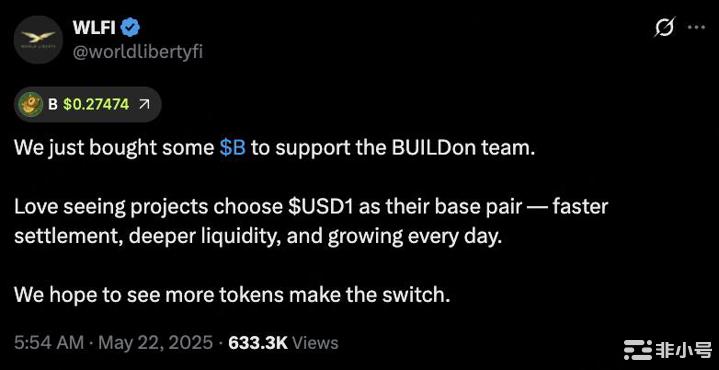
BUILDon is a MEME related to the mascot of BSC's construction culture. On May 17, the project officially announced the addition of the USD1 trading pair and has continued to tweet to interact with WLFI since then. On May 22, WLFI announced the purchase of BUILDon token B, and subsequently its price increased by more than 450%.
2.StakeStone
On May 9, StakeStone announced its cooperation with WLFI to provide USD1 users with fully connected liquidity infrastructure and cross-chain staking benefits. As USD1 was listed on Binance on May 22, the price of STO rose by more than 20% in a single day.

3.Lista
On May 7th, Lista officially announced a strategic cooperation with WLFI. The Lista DAO ecosystem will add USD1 to the treasury and also plans to add USD1/lisUSD LP and USD1 as CDP collateral. On May 22, as Binance announced the listing of USD1, the price of Lista increased by 37.9% in a single day.

In terms of other cooperation, it is currently cooperating with multiple DeFi protocols such as Venus Protocol, Aster, Meson Finance and Falcon Finance, and has supported USD1 for trading, mortgage or liquid assets. In terms of custody and liquidity services, BitGo is responsible for custody of reserve assets, and BitGo Prime provides institutional-level liquidity and trading services. DWF Labs deployed multiple DeFi liquidity pools for USD1 and subscribed for WLFI tokens for $25 million. In addition, in terms of encrypted wallets and consumption scenarios, TokenPocket, HOT Wallet, Pundi X and Umy have been connected to USD1 for Web3 scenarios such as payment, hotel reservations and merchant settlement.
USD1 and other competing products
There is no significant difference in mechanism design between USD1 and other mainstream stablecoins such as USDT and USDC. They all adopt a 1:1 US dollar asset reserve model, which is mainly supported by highly liquid assets such as U.S. Treasury bonds and cash, and is maintained through third-party custody and regular audits to ensure transparency and compliance. However, USD1’s unique advantage lies in the strong political branding behind it. The USD1 issued by WLFI, led by the Trump family, not only developed very rapidly in the early stage but was also used in the USD 2 billion investment transaction of Binance by Abu Dhabi investment institution MGX. This rapid growth is mainly due to the public influence and political resources of the Trump family, which has enhanced the market’s confidence in its compliance and credibility. However, it is worth noting that the price of the $TRUMP coin previously launched by Trump has fluctuated greatly, which has caused the market to question its stability and long-term value. This volatility could affect investor confidence in USD1, especially when considering the potential impact of political factors on the crypto asset market.
3. Future Development
The "GENIUS Act" is not only a regulatory framework for stablecoins, but also a strategic move by the United States to comprehensively strengthen the international dominance of the digital dollar by promoting the issuance of US dollar-anchored compliant stablecoins, attracting global capital flows to US debt, and restricting overseas issuance entities. These measures will help prevent incidents like TerraUSD from happening again and improve the security and stability of the entire crypto market. Against this background, stablecoin projects with strong compliance are expected to gain greater market recognition in the future. Stablecoin projects with strong endorsements such as USD1 are expected to occupy a more important position in the future crypto ecosystem as subsequent bills advance.
Risk reminder:
The information provided is for informational purposes only and should not be construed as a recommendation to buy, sell or hold any financial asset. All information is provided in good faith. However, we make no representations or warranties, express or implied, as to the accuracy, adequacy, validity, reliability, availability or completeness of such information.
All cryptocurrency investments (including gains) are highly speculative in nature and involve significant risk of loss. Past, hypothetical or simulated performance is not necessarily indicative of future results. Digital currencies may rise or fall in value, and buying, selling, holding or trading digital currencies may involve significant risks. You should carefully consider whether trading or holding digital currencies is suitable for you based on your personal investment objectives, financial situation and risk tolerance. BitMart does not provide any investment, legal or tax advice.