Ethereum, the king of public chains, is called the "world computer", but the competition pattern on the L1 track is far from finalized. Due to the high cost and low efficiency of Ethereum, many competing public chains have emerged one after another in recent years. Among them, Aptos, Sui, and Linera from the Meta chain have become the new hot spots and are enthusiastically sought after by capital and traffic. In addition to the "rich families", Abelian, who possesses two "killer weapons" of quantum resistance and privacy protection, should not be underestimated.
Abelian is the world's first post-quantum (anti-quantum) privacy-preserving L1 blockchain. It adopts NIST-standardized lattice-based cryptographic algorithms and has proven its security through cryptography. It aims to realize digital gold 2.0, create a quantum-resistant and privacy-protecting encryption ecosystem, and build L2 networks and post-quantum zero-knowledge bridges to support EVM equivalent blockchain networks and empower Web3 and DeFi applications.

Anti-quantum attack

In 2019, Google and IBM each built 53-qubit computers.
In 2021, Boston startup QuEra built a 256-qubit computer.
In 2022, IBM announced that it will build a 1000-qubit computer next year.
Additionally, PsiQuantum has raised $215 million from investors including Microsoft to build a 1 million qubit quantum computer…
Scientists at the University of Sussex in the United Kingdom estimate that a quantum system with 317 million qubits is enough to break the elliptic curve cryptography algorithm (ECC) that secures the Bitcoin blockchain in one hour. For a quantum computer with 1.9 billion qubits, it would only take 10 minutes to crack. As more and more of the world’s technology giants join the quantum computing arms race, this day is getting closer and closer to us.
By then, not only Bitcoin, but also Ethereum, Cardano, Solana, Ripple... almost all blockchain projects we are familiar with will be shrouded in the shadow of "quantum hegemony".
Quantum computers use quantum superposition and entanglement to create quantum bits (qubits). Unlike ordinary bits that are either 1 or 0, qubits can be 1 and 0 at the same time, giving quantum computers incomparable computing power that classical computers cannot match. This exponential increase in computing power, combined with algorithms such as Shor, can allow commonly used digital signature encryption technologies such as ECC and RSA to be broken within hours - it would take thousands of years for classical computers to crack, thus threatening the security of Bitcoin and other blockchain systems.
To this end, Ethereum founder Buterin has repeatedly emphasized the upgrade of Ethereum’s anti-quantum attack algorithm. In July 2021, Buterin mentioned in his online speech at the 2021 World Blockchain Hangzhou Conference that Ethereum will consider algorithm updates and resistance to quantum computing in the middle and later stages of the merger; in August 2022, Buterin once again emphasized at the 2022 South Korea Blockchain Week that quantum computing will be an important consideration in the future, and Ethereum needs to upgrade to protect itself from future quantum computing attacks. He pointed out that one of the key tasks of Ethereum in 2023 is to upgrade the anti-quantum attack algorithm. In addition, public chain projects such as Algorand have also released relevant arrangements for resisting quantum attacks, but so far there has been little progress.
In fact, it is extremely difficult to upgrade the anti-quantum attack algorithm based on the existing architecture. In contrast, Abelian is innately resistant to attacks by traditional computers and quantum computers, or it is designed to resist quantum attacks.
Abelian uses NIST-standardized lattice-based cryptographic algorithms to protect against quantum attacks.
NIST (National Institute of Standards and Technology) launched the post-quantum cryptography (PQcrypto) standardization project as early as 2015 and will publish its PQcrypto standard in 2024, when it will be adopted by the federal government.
Lattice-based cryptographic algorithms, hash-based, code-based, and multivariate quadratic equation encryption are currently the four main PQcrypto technology routes. In July 2022, NIST's PQcrypto standardization project selected 3 signatures and 4 encryption algorithms, of which 2 signatures (Dilithium and Falcon) are based on lattice.
It can be seen that Abelian’s cryptographic algorithm not only represents the cutting-edge technology trend of anti-quantum cryptography, but has also been proven to be cryptographically safe and reliable and is recognized by authoritative research institutions.
Introducing “Responsible Privacy”
Abelian is also a privacy-enhanced blockchain. Everything that happens on Abelian is encrypted, making it more secure and private than the Bitcoin network.

The United Nations Declaration of Human Rights states that privacy is a fundamental human right.
In the Web3 era, privacy protection is more urgent than ever and the challenges it faces are more severe. Public ledgers are an integral feature of cryptocurrencies and can be accessed by anyone without restrictions, which poses a threat to network users. Our wallet addresses and details of each transaction are publicly transparent and vulnerable to hackers. Therefore, privacy protection and privacy computing of smart contracts and off-chain data have become new imperatives.
So we see that more and more leading VCs and developers are turning their attention to the privacy track, and many privacy-focused projects have been born in both the protocol layer and the application layer. At the end of October 2022, Buterin stated in an interview with the media that Ethereum developers hope to achieve four key goals next year, including scalability, privacy, base layer censorship resistance and account abstraction, two of which are related to privacy protection.
Although the importance of privacy protection is self-evident, privacy coins have been widely criticized for their natural advantages in illegal transactions. For example, the U.S. Department of the Treasury banned the use of on-chain coin mixer Tornado Cash, and some privacy coins were delisted globally.
To this end, Abelian uses lattice-based linkable ring signatures, the basic technology of the well-known privacy coin project Monero, to hide transaction amounts and wallet addresses through commitment schemes and zero-knowledge proof systems. While achieving the goals of protecting privacy and ensuring asset security, Abelian creatively introduces "responsible privacy" and provides users with three privacy level options:
Basic Privacy: is similar to the pseudonymity used by Bitcoin.
Full Privacy: Hide transaction amounts and wallet addresses using a lattice-based linkable ring signature and commitment scheme.
Responsible and complete privacy: A tracking key will be generated such that transactions are fully private to others on the network, but have basic privacy to the authorized user with the generated key. This level of privacy may be suitable for businesses, especially industries with high compliance requirements such as financial services.
In this way, ABEL has unique value by balancing security and privacy protection with regulation and compliance.
Academic public chain
Speaking of blockchain academic projects, whether it is Algorand founded by MIT professor and Turing Award winner Silvio Micali, or Avalanche led by Professor Emin Gün Sirer, a well-known opinion leader in the encryption industry and a Turkish computer scientist at Cornell University, they have become phenomenal projects. As a public chain led by a group of lifelong cryptographers, mathematicians and computer scientists, Abelian can also be called academic.
Abelian is co-invented by linkable ring signature co-inventors, entrepreneurs, and world-renowned cryptographers and developers. The core members of the team have more than 20 years of experience in cryptography fields such as zero-knowledge proof systems and digital signatures, and have many years of development experience in well-known blockchain projects such as Bitcoin, Ethereum, R3 Corda, and Hyperledger Fabric.
- Dr. Duncan Wong, co-inventor of linkable ring signatures, former professor of Computer Science at City University of Hong Kong, author of more than 200 cryptography research publications
- Professor Huaxiong Wang, professor at Nanyang Technological University, is a top international cryptographer and mathematician who is proficient in the fields of lattice-based cryptography, threshold cryptography and secret sharing
- Professor Khoa Nguyen, professor of computer and information technology at the University of Wollongong, Australia, a famous cryptographer, has published papers in EUROCRYPT, PQCrypto, and CRYPTO
- Professor Guomin Yang, professor of computer and information systems at Singapore Management University, famous cryptologist, has published papers in CRYPTO and ASIACRYPT
In addition, Abelian has hired Professor Juan Garay, an academician of the International Association for Cryptozoological Research (IACR), an expert in the field of distributed systems and cryptographic systems, and Texas A&M University, as a consultant, forming a very strong academic lineup.
In 2018, the "Key Isolation and Privacy Preserving Signature Scheme Using Publicly Derived Public Keys" proposed by Professor Guomin Yang, Dr. Duncan Wong, Professor Khoa Nguyen, Professor Huaxiong Wang, etc. was published in IACR (International Association for Cryptozoological Research). In 2019, 2020, and 2021, it was successively approved by EuroS&P (IEEE Published and included in the European Security and Privacy Symposium), ESORICS (European Computer Security Research Symposium), and IEEE Transactions on Reliable and Secure Computing.
In 2019, "A Lattice-based Connectable Ring Signature Supporting Stealth Addresses" also proposed by Professor Khoa Nguyen, Professor Guomin Yang, Professor Huaxiong Wang, Dr. Duncan Wong, etc. was published in ESORICS.
In addition, Abelian sponsored the Hong Kong IEEE Blockchain Group Hackathon 2022, Australia's largest and oldest cryptography research conference ACISP 2022, Euro S&P 2023 IEEE European Security and Privacy Symposium, and the Netherlands ESORICS 2023 Symposium.
A series of research papers were published in authoritative international academic journals and participated in many global cryptography, security and privacy cutting-edge seminars, showing that after peer review by scientists, the Abelian anti-quantum encryption algorithm is the world's first fully secure algorithm and has been rigorously proven in mathematical adversarial mode.
Native token ABEL
ABEL is the native token of the Abelian ecosystem, with a total supply of 225.18 million, or 2^{51}–1 Neutrino (neutrino), where Neutrino is the smallest monetary unit in Abelian, 1 ABEL = 10^7 Neutrinos.
Abelian generates a block every 256 seconds (~4.27 minutes) and checks and adjusts the mining difficulty every 4000 blocks (~11.8 days). Every 400,000 blocks is an epoch (about 3.25 years). The block reward in the first epoch is 256 ABELs. The reward is halved in each subsequent epoch. The block reward in the last epoch is 0.5 ABELs. Among them, 20.58 million ABELs were pre-mined in the genesis block, accounting for 9.14% of the total ABEL supply. They are specifically used to support the decentralization of the Abelian network and promote the construction of a diverse and active Abelian community. That is:
- Era 1: Each block rewards 256 ABELs, 55% of ABEL will be mined in the first 3.25 years;
- Era 2: Each block rewards 128 ABELs, 77% of ABEL will be mined in the first 6.5 years;
- Era 3: Each block rewards 64 ABELs, and 89% of ABEL will be mined in the first 9.75 years;
- Era 4: Each block rewards 32 ABELs, and 94% of ABEL will be mined in the first 13 years;
- Era 5: Reward 16 ABELs per block;
- Era 6: 8 ABELs rewarded per block;
- Era 7: Reward 4 ABELs per block;
- Era 8: Reward 2 ABELs per block;
- Era 9: 1 ABEL reward per block;
- Era 10: 0.5 ABEL reward per block.
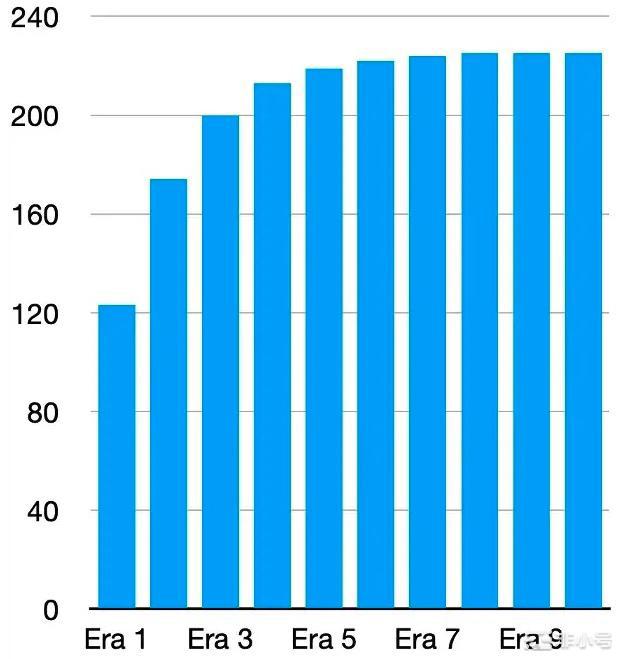
It will take a total of 10 epochs, or 32.5 years, to mine all the coins.
According to the project roadmap, ABEL will be listed on the world’s leading exchanges in 2023.
ABEL is positioned as digital gold 2.0. As a circulating token on the Abelian chain, ABEL will empower a quantum-resistant and privacy-protecting encryption ecosystem.
Four years to sharpen a sword
Just like star projects such as Polkadot and Avalanche Protocol, Abelian has gone through four years of research and development since the launch of the project in 2018. The mainnet will be online in March 2022, and will release a blockchain browser, CLI wallet, developer documentation, Abelian full node network and mining software.
Since July 2022, Abelian has raised $3 million in funding led by Draper Dragon, with other investors including high net worth individuals and family offices. The funds raised will be used for project technology development, reserve funds, marketing and support for Abelian ecological partners.

Draper Dragon is a cross-border venture capital fund established in 2006 that connects Silicon Valley and Asia. It is committed to finding early-stage companies that can disrupt and change the industry structure. It has invested in unicorn projects such as Coinbase (NASDAQ: COIN), MicroPort Medical (HK: 0853), Ledger, Yibao Pay and other unicorn projects.
As of October 2022, Abelian has attracted more than 3,000 miners around the world to participate in network maintenance. In the same month, Abelian started supporting GPU mining, and due to the continuous influx of computing power, the mining difficulty doubled every 10 days.
In November 2022, the pool.abelian.info mining pool was launched, with zero mainnet downtime, and the wallet and full-node core software versions were updated regularly every month. Development of smart contracts and Wrapped ABEL began during the same period, with the development network expected to be ready by January 2023.
In 2023, Abelian will make the network completely open source and plans to complete the upgrade from PoW to PoS within 36 months to achieve better scalability and environmental benefits. This means that Abelian’s scalability will be greatly improved while maintaining excellent security and decentralization.
According to the plan, Abelian will also create side chains and protocols (such as Lightning Network-like) to support EVM-type smart contracts, high scalability and interoperability, and empower DeFi, Web3 and Metaverse applications.

The development of the L2 network has begun in December 2022. Abelian L2 will be based on the Cosmos SDK, cleverly introduce the existing ecological power of Cosmos, and integrate the anti-quantum attack and privacy protection features of Abelian L1 to create the first technical solution in the entire network that is both efficient, decentralized and secure.
Recently, the Abelian Foundation has released a developer funding plan, which will provide financial support of US$5,000 – 50,000 to outstanding projects to attract global developers to join and create a post-quantum encryption ecosystem with Abelian.