
The Prediction Market Duopoly: A Strategic Analysis of Kalshi and Polymarket Author - Jonas, Rachel @Foresight Ventures Introduction - Next Financial Super App Niche Hides in Plain Sight Prediction markets represent a high-growth niche on a clear trajectory to rival the established global betting industry. By transforming real-world events into tradable assets, these platforms are unlocking a new form of financial speculation and information aggregation. The momentum behind this sector is best illustrated by its explosive growth metrics: Total Addressable Market (TAM): The market is benchmarked against the $300 Billion global betting industry, indicating a vast runway for growth. Projected 2025 Year-over-Year Growth: A staggering 400% growth rate is projected, with total transaction volume expected to surge from approximately 9 Billion in 2024 to 40 Billion in 2025. Projected 2025 Total Users: The user base is forecast to increase by 3-4x, growing from ~4 million in 2024 to 15 million in 2025. Primary Growth Engine: 70% of the market's volume is currently driven by sports betting, highlighting its crucial role in attracting mainstream users. This explosive growth is almost entirely captured by a duopoly: Kalshi and Polymarket. Together, they command 99% of the market. However, their divergent strategies in regulation, technology, and go-to-market execution signal a critical inflection point. This analysis dissects the competitive landscape defined by these two dominant forces, examining the strategic gambit that reshaped the market and the opportunities that lie ahead. A Tale of Two Platforms: The Regulated Titan vs. The Crypto-Native Visionary To understand the prediction market landscape, one must first appreciate the fundamental differences between its two leaders, Kalshi and Polymarket. Their contrasting philosophies are not merely operational details; they represent two distinct visions for the future of this asset class. Kalshi embodies a compliant, top-down approach designed for mainstream integration, while Polymarket champions a permissionless, bottom-up model rooted in crypto-native principles. This strategic divergence defines the current competitive dynamic and will shape the industry's evolution. Metric Kalshi (The Regulated Titan) Polymarket (The Crypto-Native Visionary) Platform Architecture Compliant, off-chain exchange with data accessible via API. Permissionless, fully on-chain platform where markets and positions are public. Regulatory Status Fully regulated by the CFTC with licenses in all 50 states. Pursuing US re-entry via acquisition (QCX LLC); previously banned. User Access & KYC Strict KYC required (SSN, bank account). No KYC; a crypto wallet is the only requirement. Funding Methods Fiat-friendly (Bank transfer, Debit Card, Wire) & USDC. Crypto-only (USDC on the Polygon network). Primary Market Focus Sports (~90% of volume), especially the NFL. Politics & Entertainment (formerly 80% during elections). Go-to-Market Strategy B2B2C, embedding in mainstream applications like Robinhood. B2C, relying on its crypto-native community and network effects. This high-level comparison reveals two fundamentally different playbooks. While Polymarket built an early lead through its crypto-native appeal, a single, pivotal event would soon demonstrate the overwhelming power of a different approach, dramatically altering the market's balance of power. The Gambit: How a Single Partnership Flipped the Market While Polymarket had established early and formidable dominance through the powerful network effects of the crypto ecosystem, its position was not unassailable. Kalshi, the regulated challenger, executed a single strategic partnership that proved mainstream distribution, backed by full regulatory compliance, could overwhelm a crypto-native moat. This move was not just a growth tactic; it was a market-altering gambit that validated an entirely different business model. The catalyst for this seismic shift was Kalshi's integration with the retail brokerage giant Robinhood . The partnership, which began on August 19th , started by embedding Kalshi's NFL prediction markets directly into the Robinhood app. This gave Kalshi direct access to Robinhood's massive user base of 27.4 million funded accounts , a demographic with a 60-70% overlap with Kalshi's target audience. The results were immediate and profound, triggering a complete reversal of market leadership and validating Kalshi's regulated, B2B2C strategy. Market Share Reversal: In a matter of months, Polymarket's dominant market share collapsed from ~95% to 32% , while Kalshi's share skyrocketed from just 8% to 66% . Volume Impact: Kalshi's annualized volume exploded from approximately $300 million to an estimated $40-50 billion , a staggering increase of nearly 200x. User Impact: Kalshi’s daily active users grew 20x to 75,000 , while Polymarket’s daily active user count correspondingly declined by 50% to 24,000 . This event was more than just growth; it was a strategic masterstroke. It proved that in the battle for the US market, compliant access to mainstream distribution channels could serve as a more powerful weapon than the permissionless network effects of the crypto world. This shift sets the stage for a deeper analysis of the distinct and durable business models each platform is now pursuing. Dissecting the Duopoly's Business Models and Strategies The dramatic shift in market share tells only part of the story. To understand the future of the prediction market, it is essential to look beyond the volume charts and dissect the distinct, long-term strategic moats and business models each platform is constructing. Kalshi is waging a regulated war on the legacy sports betting industry, while Polymarket is executing a pivot from a consumer-facing platform to an institutional-grade data provider. 3.1. Kalshi's Moat: A Dimensionality Reduction Attack on Sports Betting Kalshi's strategy is best understood as a "dimensionality reduction attack" on the legacy sports betting industry. Rather than competing with Polymarket on crypto-native terms, it is leveraging its unique regulatory status to outmaneuver and disrupt incumbents like DraftKings and FanDuel. This assault is built on two powerful pillars. Regulatory Arbitrage: The Nationwide Play. While traditional sports betting platforms are restricted by a patchwork of state-level laws, making them legal in only about 30 US states, Kalshi operates under a federal license from the Commodity Futures Trading Commission (CFTC). This makes it a federally regulated financial product, legal in all 50 states. This advantage unlocks massive, untapped markets like California and Texas, effectively bypassing state gambling restrictions and creating a nationwide competitive advantage. Superior Capital Efficiency: The User Value Proposition. Kalshi offers a fundamentally more transparent and capital-efficient product than its sports betting competitors. Incumbents often impose a significant "tax" on users, charging 25-30% on early cash-outs. Kalshi, by contrast, operates like a financial exchange, offering a superior product with no withdrawal penalties or extra fees . This clear value proposition attracts sophisticated players and erodes the user base of legacy systems. 3.2. Polymarket's Pivot: A B2C Feint for a B2B Endgame While Kalshi conquered the US retail market, Polymarket is strategically pivoting from a challenging B2C revenue model to a highly viable B2B Data-as-a-Service (DaaS) endgame. The clearest signal of this strategic shift is the $2 billion investment from Intercontinental Exchange (ICE) , the parent company of the New York Stock Exchange. This transforms Polymarket's speculative user activity into a quantifiable, saleable institutional asset. This new B2B strategy is built on three core components: The Asset: On-chain, real-time probability data generated by a global network of users, creating a powerful alternative data source. The Distributor: ICE plans to package this data, positioning itself as the global distributor for institutional clients. The Institutional Products: This raw data becomes the foundation for a new suite of institutional-grade financial products, including: Novel Sentiment Indicators: Real-time market probabilities offered to hedge funds and investment banks to track public sentiment. Enhanced Risk Modeling: Data to be used in macroeconomic forecasting and corporate risk assessment. New Financial Derivatives: ICE can issue derivatives based on Polymarket's data, creating "event-driven ETFs" that track outcomes like Fed interest rate decisions or election results. 3.3. Tale of the Tape: Financial and Operational Comparison The divergent strategies of Kalshi and Polymarket are clearly reflected in their financial and operational models. The following table provides a detailed comparison, synthesizing available data to highlight their fundamental differences. Metric Kalshi (The Regulated Titan) Polymarket (The Crypto-Native Visionary) Revenue Status Profitable. Over $200M in revenue in H1 2025. Pre-Revenue. No fees charged after 5 years of operation. Fee Model Transaction Fees. Charges an average of 0.8% of the contract value per trade (ranging from 0.7% to 3.5%). No Trading Fees. Evolved from a 2% cut of profits in its early AMM model to zero fees in its current order book model. Trading Mechanism Centralized Limit Order Book (CLOB). Off-chain order book with on-chain settlement. Liquidity Spend Aggressive. ~35,000 per day (annualized ~12.7M). Sustained. ~$5M per year to maintain core market liquidity. Outcome Resolution Centralized & Manual. An internal team resolves markets under CFTC supervision. Decentralized Oracle. Relies on the UMA Protocol for dispute resolution and outcome reporting. Ultimately, the contrast is stark: Kalshi operates as a traditional, revenue-focused exchange executing a proven playbook. Polymarket, conversely, prioritizes network growth and liquidity, funding operations from its treasury while building out its long-term institutional data strategy over immediate monetization. Three Hurdles on the Path to Mainstream Adoption Despite their individual successes and clear strategic paths, both Kalshi and Polymarket must overcome three fundamental, industry-wide challenges to evolve prediction markets from a niche product into a mature and widely adopted asset class. These hurdles relate to market structure, system integrity, and user accessibility. Liquidity Fragmentation The structure of prediction markets creates a significant capital efficiency problem. Every new market—whether on the outcome of an election or a football game—is an isolated, independent liquidity pool. This fragments capital across thousands of different events, limiting market depth and creating a persistent "cold start" problem for every new market that is launched. This inefficiency makes it difficult for platforms to offer a broad range of markets and can deter market makers who face high information asymmetry. Oracle Reliability The oracle—the mechanism that reports the real-world outcome of an event—is the market's lifeline. The integrity of the entire system hinges on its ability to resolve outcomes accurately and resist manipulation. Here, the duopoly's approaches present a clear trade-off. Kalshi’s centralized model is efficient but creates a single point of failure and risk of unfair rulings with limited recourse for users. Polymarket’s decentralized approach, using UMA, distributes trust but remains vulnerable to complex economic exploits. Its reliance on UMA for adjudication in markets worth hundreds of millions of dollars has been identified as a potential systemic risk that becomes more acute as the value at stake grows. User Experience (The Augur Lesson) The failure of early platforms like Augur provides a crucial lesson for the industry. Augur’s complex mechanics, reliance on a native token, and high Ethereum gas fees created an insurmountable barrier for mainstream users. To achieve mass adoption, the mandate is clear: the experience must be seamless and approximate a Web2 application. This includes simple onboarding, easy funding, and an intuitive interface that abstracts away Web3 complexity, a principle both Kalshi and Polymarket are actively pursuing. Overcoming these structural challenges is paramount. The platforms that solve them most effectively will be best positioned to capitalize on the strategic opportunities that lie ahead in the global competitive landscape.
The Strategic Playbook: Where the True Opportunity Lies
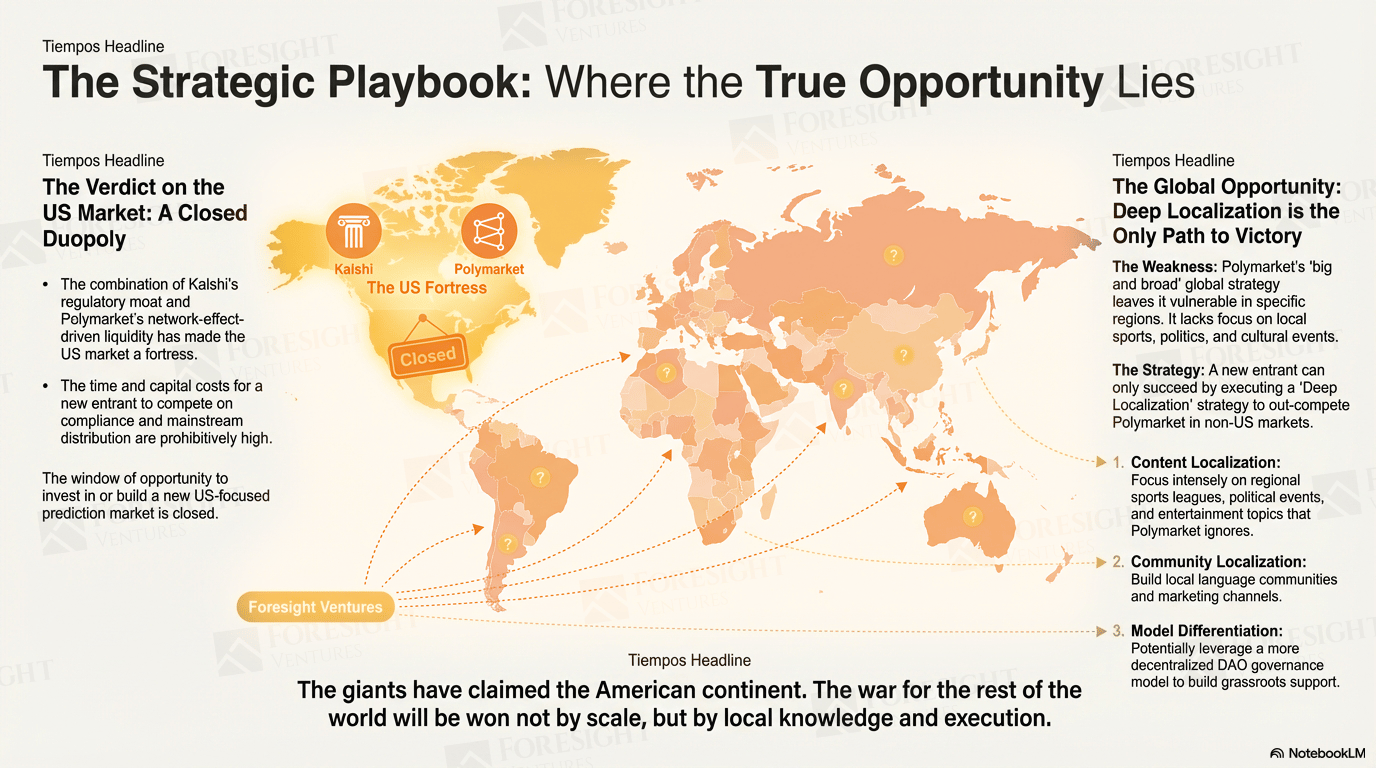
As the dust settles from the market share reversal, the strategic landscape is coming into sharp focus. While the two giants, Kalshi and Polymarket, have effectively claimed the US market through their respective moats of regulation and network effects, the war for the rest of the world has just begun. This next phase of competition will not be won by scale alone, but by local knowledge, nuanced execution, and a differentiated approach.
5.1. The Verdict on the US Market: A Closed Duopoly
For aspiring entrepreneurs and investors, the conclusion is clear: the window of opportunity to build a new, successful US-focused prediction market is effectively closed. The combination of Kalshi's formidable regulatory moat and Polymarket's deep, network-effect-driven liquidity has created a fortress that is prohibitively difficult for a new entrant to breach. The time and capital costs required to achieve regulatory compliance and overcome the cold-start liquidity problem are simply too high to justify the attempt.
5.2. The Global Opportunity: Deep Localization as the Path to Victory
While the US market is consolidated, Polymarket’s primary weakness on the global stage presents a clear opportunity for new challengers. Its current strategy is "big and broad," offering a generalized set of markets that often lacks focus on the specific sports, political events, and cultural moments that resonate within particular regions.
The counter-strategy for a new entrant to succeed in non-US markets is "Deep Localization." This approach focuses on out-competing the incumbent not on a global scale, but by winning decisively in specific, high-potential regions. The playbook for this strategy rests on three core pillars:
Content Localization: Intensely focus on creating markets for regional sports leagues, local political events, and culturally relevant entertainment topics that a global platform like Polymarket naturally ignores. This creates a superior, more engaging content offering for local users.
Community Localization: Build dedicated, local-language communities and marketing channels. This fosters a sense of ownership and grassroots support that a centralized, English-first platform cannot easily replicate.
Model Differentiation: Leverage a more decentralized governance model, such as a DAO (Decentralized Autonomous Organization), to empower local communities and build strong grassroots support. This "wild-card" approach can create a powerful competitive advantage against a more centrally managed platform.
The prediction market is at a clear inflection point. In the United States, the market has been consolidated by two giants with divergent but formidable strategies—one building a regulated financial exchange, the other an institutional data powerhouse. The future of that market is set. However, the global stage remains wide open, creating a compelling opportunity for nimble, localized challengers to build the next wave of successful prediction platforms.
About Foresight Ventures
Foresight Ventures is a top-tier crypto venture firm and one of the five most active investors globally in 2024. With our team in US and Asia, we are the first and only crypto VC truly bridging East and West. Our approach is research-driven and founder-focused: we back the infrastructure powering next-gen global payments — from stablecoins and on/off-ramps to real-world assets, while amplifying our portfolio through a strong media network. Our 150+ investments include Story, TON, Aptos, Morph, 0G Labs, Sentient AI, The Block, Foresight News, and many more.
For more information, please visit: Website | Twitter | LinkedIn
For media requests, please contact [email protected].