
Stablecoins made moving money free, so value shifted to float and clearing: a low-risk core incumbents own, and an underserved frontier they won’t serve.

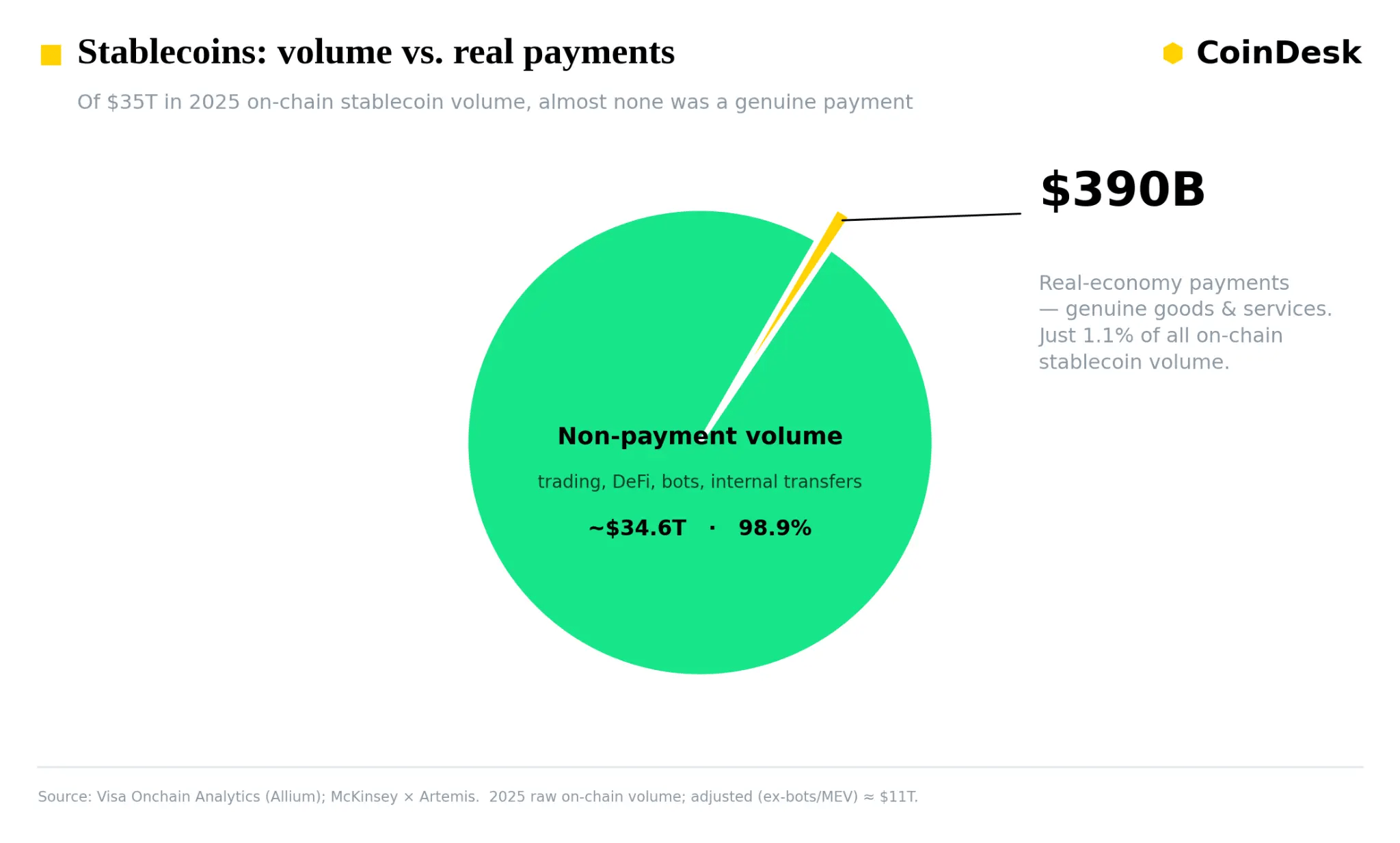
Stablecoins now settle at the scale of the card networks: roughly $35T moved on-chain in 2025, edging past the ~$25.5T in combined purchase volume that Visa and Mastercard handled. By volume the rail works - value settles globally, in seconds, around the clock, for a fraction of a cent.
Almost none of that volume is actually payment as McKinsey and Artemis estimate real-economy stablecoin payments at $390B in 2025 - about 0.02% of global payment flows - with B2B the largest share at ~$226B. Stablecoins have solved how to move money, not how to get paid for goods and services.
Cross-border payments still move through correspondent banking - chains of banks updating separate ledgers at different times, each hop adding delay and duplicated compliance checks. A decade of reform has barely changed it - the World Bank puts the average cross-border remittance cost at ~6.36%, rising to ~15% through banks and ~8.5% in Sub-Saharan Africa, and the FSB expects the G20’s 2027 cost and speed targets to be missed.
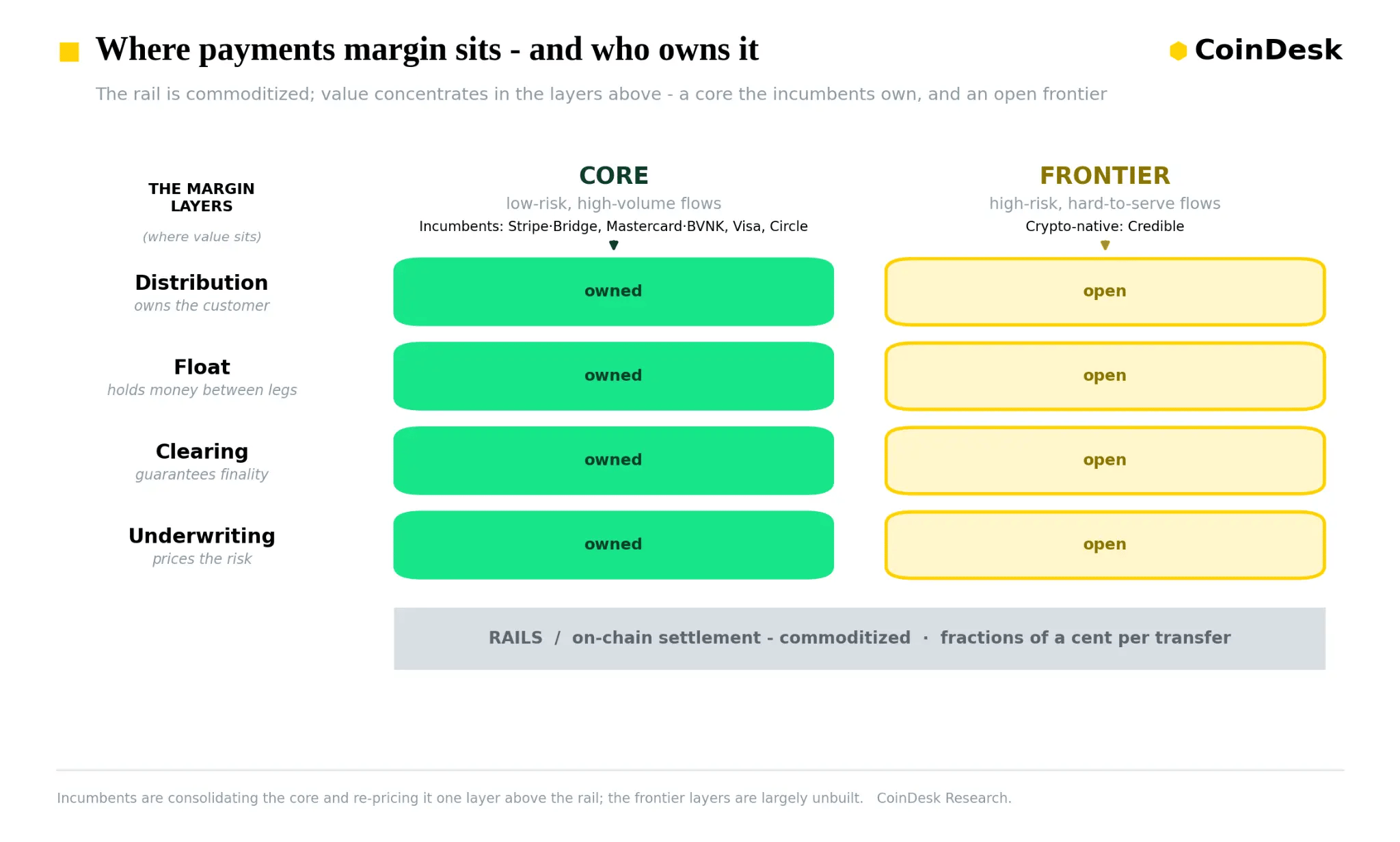
Stablecoins, in other words, made moving money cheap without making payments cheap. The friction moved off the rail and onto the layers around it - distribution (owning the customer), float (holding money between the legs of a payment), clearing (guaranteeing finality), and underwriting (pricing the risk). Those layers are where payments margin now sits, and they divide the market into two parts: a core the incumbents control, and a frontier they do not currently participate in.
The low-risk, high-volume core of payments is being absorbed by incumbents, and the margin is being taken one layer above the blockchain. Stripe, for example, charges a flat 1.5% to accept stablecoins - a rate that already covers FX, compliance, fraud and gas - even though the underlying rails settle for a fraction of a cent. That fee is collected at the regulated payment layer, not on-chain, on rails that were supposed to make payments nearly free.
The deals of the past eighteen months point the same way: the largest players are buying the orchestration and settlement layer, not issuing stablecoins. Stripe bought Bridge for ~$1.1B and is pursuing a national trust-bank charter; Mastercard agreed to buy BVNK for up to ~$1.8B.
Issuers are moving the same way, building their own rails so they stop paying the yield away. Circle paid Coinbase $907.9M in 2024 - most of its distribution bill - and launched its own chain, Arc, in September 2026; Stripe and Paradigm incubated Tempo, a payments L1 that raised $500M at ~$5B valuation.
The pattern is the same: the rail is free, but the layer of value above it is being locked up by incumbents.
The frontier is what the core leaves behind - the flows incumbents won’t touch because they are risky, fragmented, or expensive to underwrite. They are not small: global remittances move about $905B a year, and the creator economy and stablecoin-native fintechs are large and growing. They go unserved because they are hard to serve, not because the money isn’t there.
The card system refuses these flows by design as it prices risk by category rather than by transaction, so whole verticals are turned away instead of being underwritten case by case: high-chargeback categories, fraud-prone and high-velocity businesses, thin corridors no one has integrated, and anything classed as high-risk by default.
Processors keep prohibited-business lists, high-risk acquirers hold rolling reserves of 5–15% for months, and the rules keep tightening - in April 2026 Visa cut its merchant chargeback threshold from 2.2% to 1.5%, with an $8 fine per disputed transaction and no warning period.
Prediction markets illustrate the pattern well - high-opportunity industries get banked from the top down: one large operator clears the compliance bar, a tier-one provider takes its flow, and the door shuts behind it. Kalshi, the largest venue, is served; the long tail beneath it is not. The twelve-person team building a prediction market in São Paulo and the data vendor billing three exchanges from a small Chicago office cannot find a provider that wants their business, and that absence is the market.
Serving these flows requires three capabilities incumbents will not build for them:
Put together, these three capabilities are a business in their own right - and a handful of crypto-native firms are now building exactly that. Credible is the clearest example.
Credible is a US money-services business that orchestrates other providers’ payment rails through locally licensed partners. It sells to platforms such as remittance apps, creator platforms, neobanks and stablecoin fintechs, not to end users, and about 95% of its merchants are US companies paying into non-US markets. It is not a card network or a consumer app.
Its model is float: a customer pays through a local rail, a per-transaction risk model underwrites the receivable, and Credible’s pool advances the merchant immediately in USDC or USDT. The local rails settle afterwards on their usual cycle, often T+3, leaving Credible holding a 1-7 day receivable. It charges a blended take of about 20bps on volume; the margin sits in the float and underwriting, not the transfer.
Reported monthly volume for Credible climbed from about $23M in January 2026 to about $192M in September - pushing cumulative volume to roughly $1.48B, with about 76% of all volume settling on Solana. After strong continued onboarding, the team is strengthening the underlying infrastructure to keep transaction success rates high
Credible is running at about $192M a month, or roughly $2.3B in annualised volume, which at its ~20bps blended take implies about $4.6M in annualised gross revenue.
Credible’s core markets map the frontier: remittance apps, creator platforms, stablecoin fintechs, neobanks, payment aggregators, crypto wallets and money-transfer operators.
Each market can be read two ways - the total payment flow, and the stablecoin flow within it today. The gap between them is the addressable market for a player like Credible, and the approach is the same in every vertical: stablecoins carry a small share of the flow, and that share is growing fast. Consumer remittances are the most penetrated at 0.37%, B2B is the largest and fastest-growing, and card and creator flows are smaller but rising quickly - crypto-card spend at triple-digit rates.
What the table does not show is where the money is made. The processing fee is small: Stripe charges about 1.5%, and a venue like Kalshi keeps a fraction of a percent of notional. The margin sits a layer deeper - holding funds between the legs of a payment, guaranteeing settlement, and earning a yield on the capital fronted while the rails clear.
Credible operates at that layer: It takes ~20bps on volume, but because its pool fronts capital that turns over in days, that fee works out to a much higher yield on the capital deployed - out of which it pays liquidity providers 8-16%. The margin is the spread between the two.
Another potentially relevant call option vertical that exists at the moment is the agentic, machine-to-machine payments - always-on, sub-cent flows that card and ACH cannot serve economically. The rails exist (Coinbase’s x402, Google’s AP2, Stripe’s Machine Payments Protocol), but genuine commercial volume is still tiny - roughly $28K a day against headline figures in the hundreds of millions, much of the rest testing or wash activity.
Once moving money costs nothing, the value in payments moves to the layers around the movement - distribution, float, clearing, and underwriting. That shift splits the market.
The core - large, low-risk, regulated flows - is being absorbed by incumbents who are rebuilding their toll one layer above the rail, and it is not changing hands. The frontier - the hard, high-risk, thin-corridor flows those incumbents decline - is open, and the margin in it sits in the clearing and float layer that almost no one serves well.
That frontier is smaller than the core and harder to price, but it exists: a stablecoin payment base near $390B, growing about 60% a year inside multi-trillion-dollar flows. Credible is one worked example of a business built to capture it.
For an investor or operator, the exposure is not “stablecoins win payments.” It is narrower and more durable: whoever ends up owning float, clearing, and underwriting for the flows the incumbents won’t touch.