
The private ballot passed 106 to 1 as the advisory panel split 57 to 54. Gemini now runs Zakura, and NU7 reached testnet early ahead of a Nov. 5 mainnet.
Zcash holders made the call with no company in charge. Independent teams delivered the software
September demonstrated that Zcash's increasingly distributed governance model can make consequential decisions and get independent engineering groups to act on them.
Nearly 2.4 million ZEC took part in September’s coinholder vote on NU7, Zcash’s next network upgrade, roughly twice February’s 1.2 million and the largest such vote on record by voting weight. It came months after a counterfeiting flaw in Orchard, Zcash’s main privacy pool, forced an emergency response.
Holders chose by 106 to 1 to keep Zcash’s bitcoin-style halvings, which cut new coin issuance in half every four years, even as the community advisory panel divided 57 to 54 on the question. Five independent engineering groups then agreed to build the upgrade around the coinholder result.
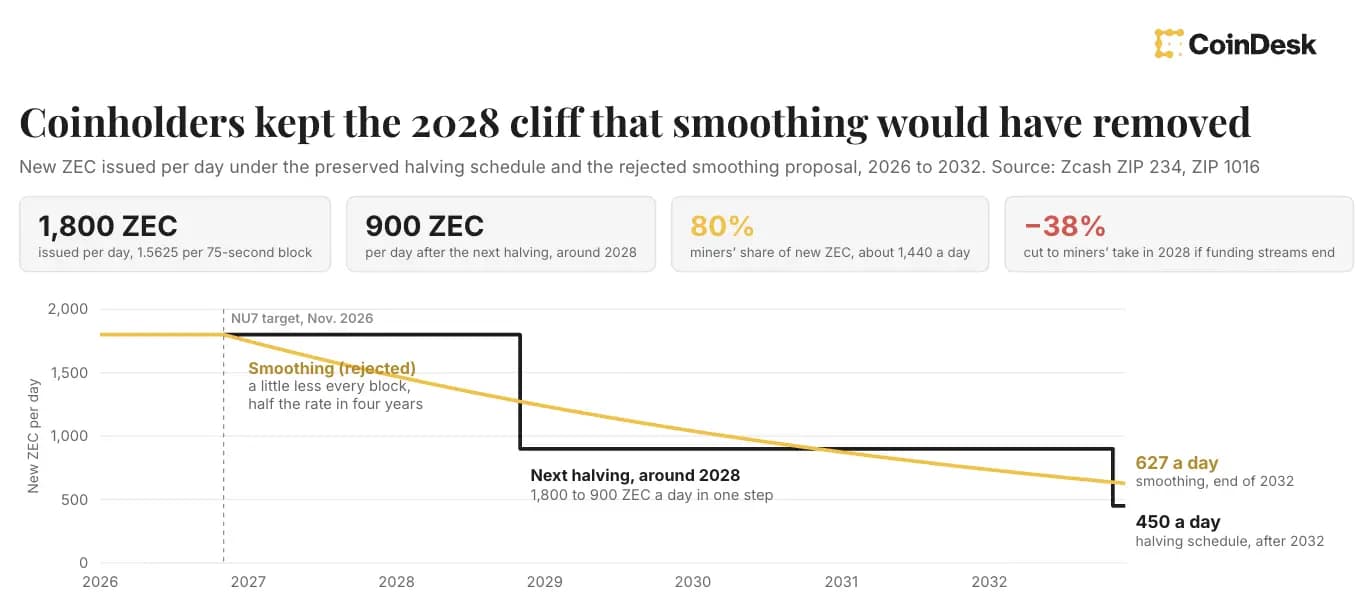
In November 2025, a network upgrade called NU6.1 began directing 12% of block rewards to coinholder-controlled grants and 8% to Zcash Community Grants. Two months later, Electric Coin Co.’s engineering team resigned, leaving no single company directing development.
September’s coinholder grants round approved $8.39 million for completed work, including $1.5 million to Taylor Hornby, who found the Orchard flaw, and $1 million to Project Tachyon. CoinDesk Research classified $7.2 million of the approved funding, or 86%, as protocol and security projects.
Our June research flagged Zcash’s reliance on a single implementation of its node software, the program exchanges and miners run to connect to the network, as a risk. By September, crypto exchange Gemini had moved its Zcash infrastructure onto Zakura, an independently developed alternative. Both Zakura and the Zcash Foundation’s Zebra supported NU7 when it went live on Zcash’s public test network on Oct. 4, two days early.
Wallet app Vizor’s gift-card links and support for Ledger hardware wallets made private ZEC easier to receive and safeguard. “It is meaningfully different to be a Zcash user today than literally six weeks ago,” Valar Group’s Dev Ojha said in a Sept. 19 discussion with GenZcash’s Arjun Khemani.
Jason McGee of Shielded Labs wrote on Sept. 18 that “no single group can push through changes on its own.” Coinholders expressed a preference, independent builders agreed to implement it, and miners, node operators and exchanges still have to adopt the software.
Nearly 2.4 million ZEC voted to keep Zcash’s halvings
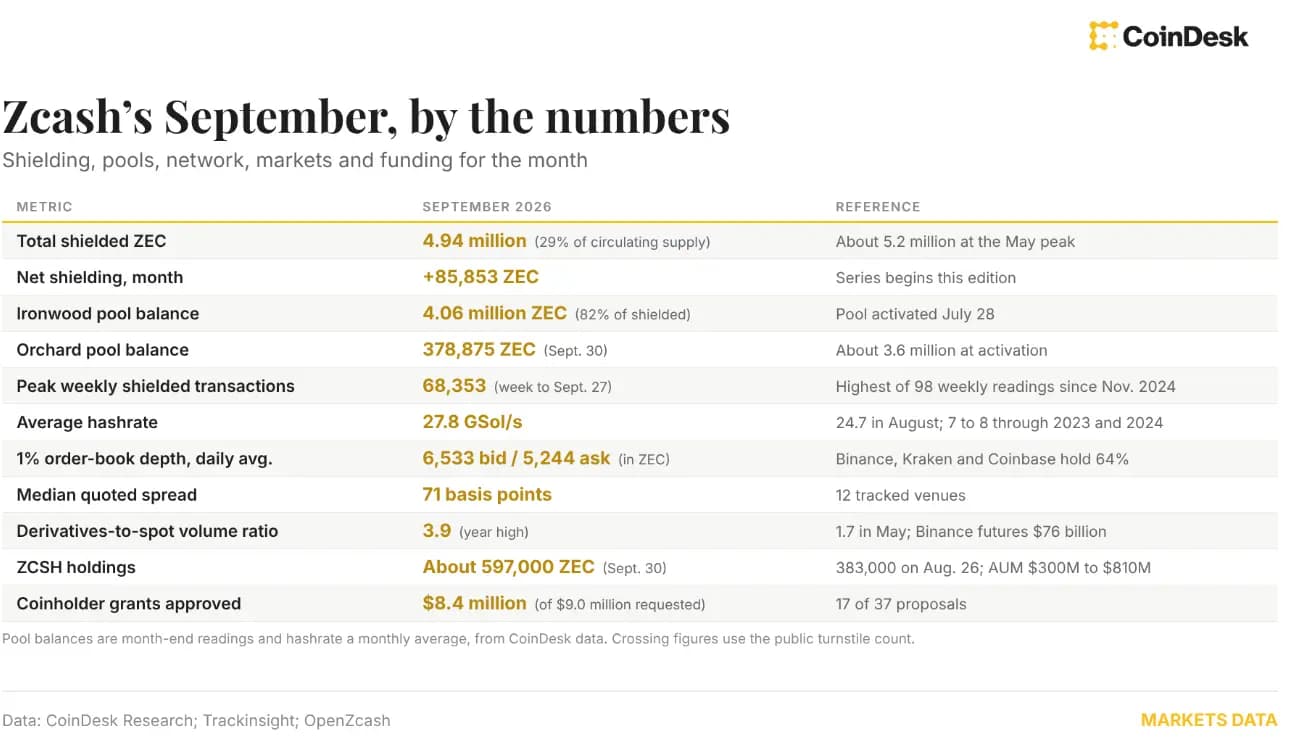
Coinholders voted overwhelmingly to keep cutting new ZEC issuance in half every four years, even as the community advisory panel split almost evenly. The teams building NU7 then adopted the holders’ answer.
Zcash holders rejected a proposal to smooth the network’s issuance decline. The Sept. 14 vote recorded 2,375,932 ZEC for keeping halvings and 22,385 ZEC for smoothing. At the next halving, expected around 2028, daily issuance is scheduled to fall from about 1,800 ZEC to about 900. Smoothing would have spread that decline over several years.
Voting ran on a separate encrypted blockchain built by Valar Group. About 3.6 million spendable ZEC in Ironwood, the privacy pool that replaced Orchard after the flaw, qualified based on balances recorded at a set block before voting opened. Roughly two-thirds of it took part. Observers could verify the totals without seeing individual answers or balances, with each ballot weighted by the ZEC behind it. The Zcash Open Development Lab (ZODL) built the poll into its wallet.
Holders also backed a February 2031 start for recycling transaction fees into future miner rewards, with 96.6% of participating ZEC supporting that date. The advisory panels favored starting sooner. Shielded Labs, Project Tachyon, ZODL, the Zcash Foundation and Valar Group agreed to pursue the coinholder preference.
Watch Valar Group’s Dev Ojha and GenZcash’s Arjun Khemani explain how the private vote worked.
The repaired pool became the electorate
Ironwood replaced the flawed Orchard pool within two months, and its spendable balances formed the electorate for the record coinholder vote.
Security researcher Taylor Hornby, auditing Orchard for Shielded Labs, found the flaw on May 29. An emergency change halted Orchard transactions on June 2, and a June 3 network upgrade restored transfers with the flawed proof code corrected. Because Orchard hides amounts, the public still cannot determine whether undetected counterfeiting occurred before the fix.
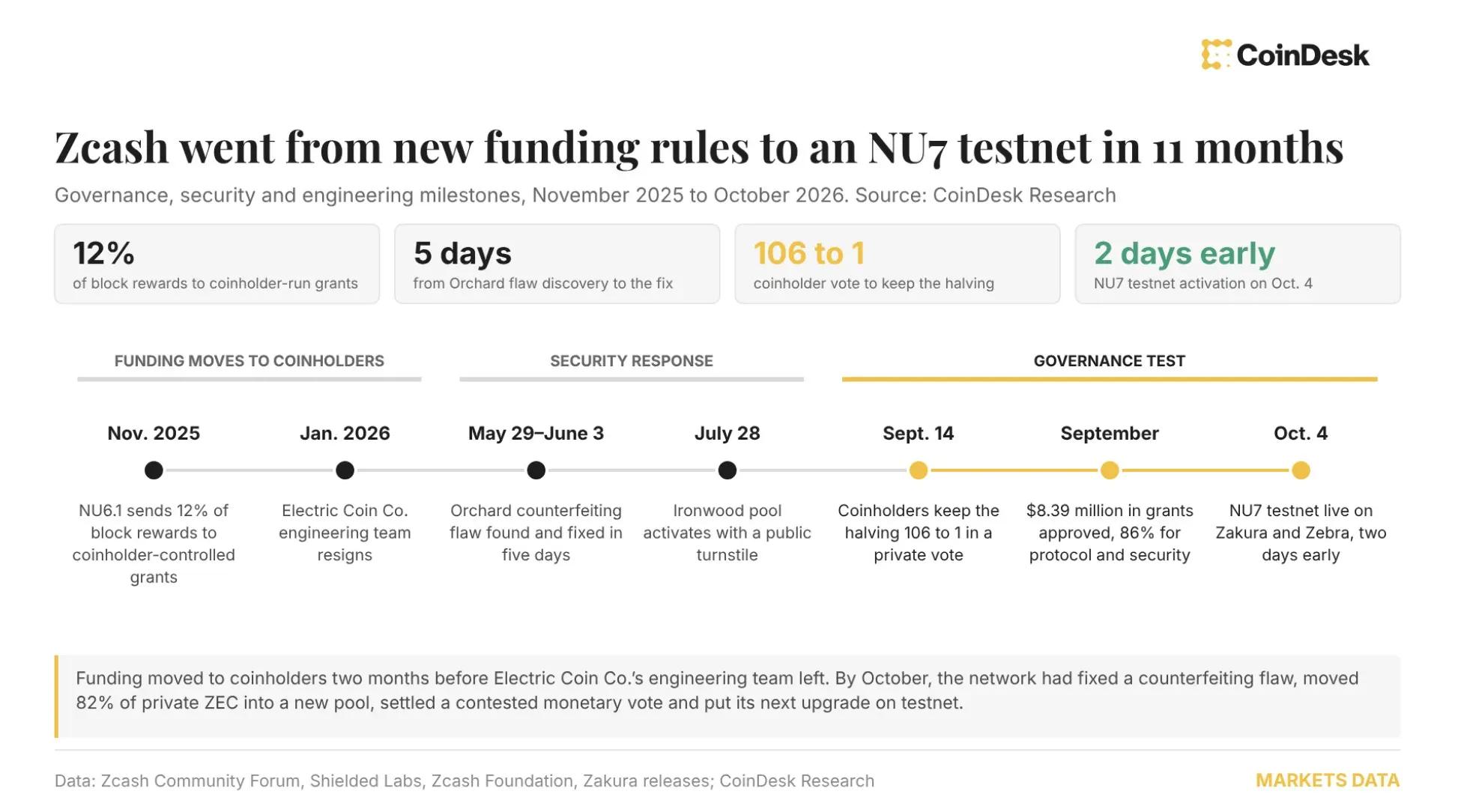
Ironwood activated on July 28 with a turnstile, a publicly counted exit from Orchard. No more value can leave the old pool than was recorded entering it. By September 30, Ironwood held 4.06 million ZEC, 82% of shielded balances.
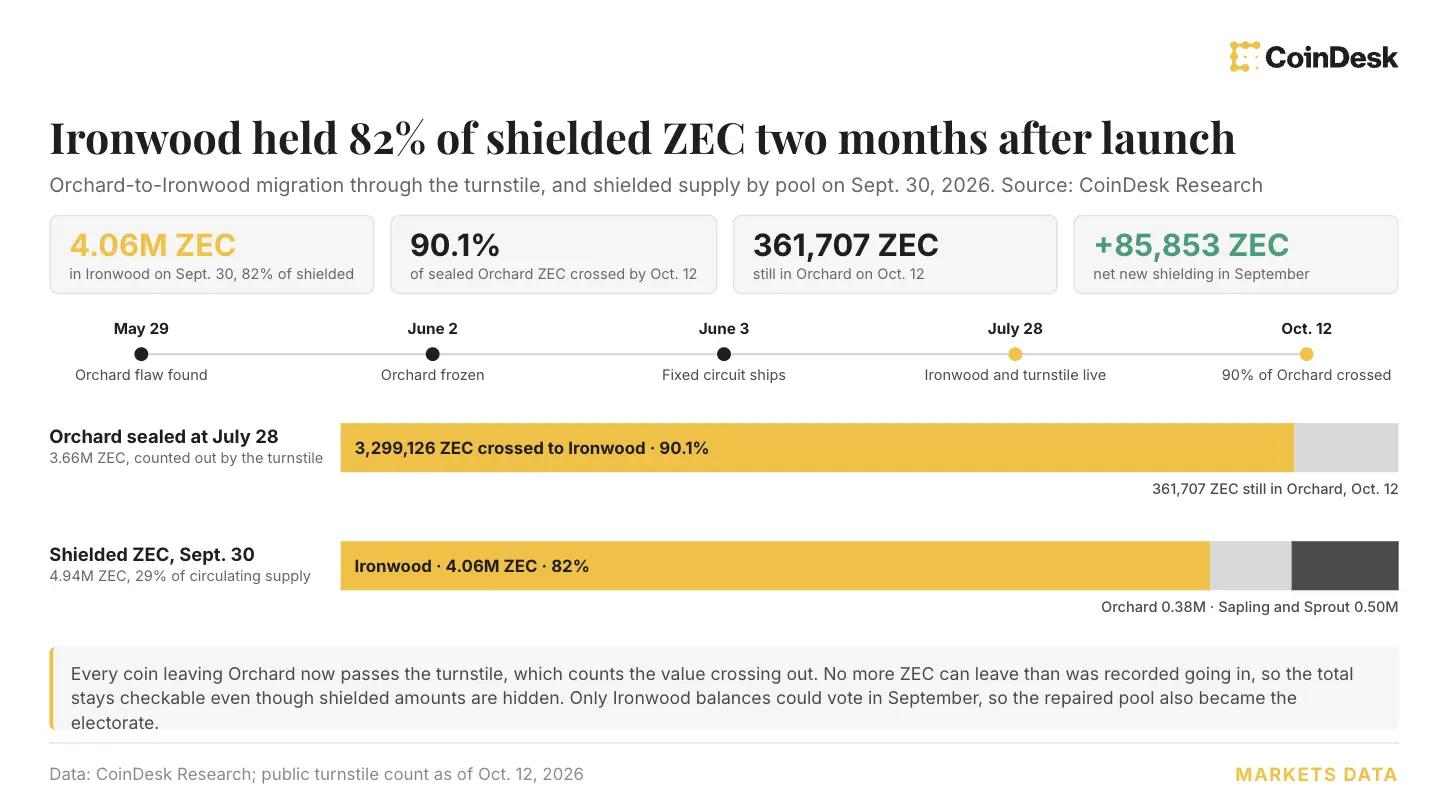
By Oct. 12, 90.1% of Orchard’s sealed balance had passed through the turnstile.
Two clients carried 25-second blocks onto testnet
NU7 aims to cut the time between blocks from 75 seconds to 25. An exchange that waits for three blocks before crediting a deposit could see that wait fall from nearly four minutes to just over one. The reward per block falls in step, keeping daily issuance on schedule. Activation on the live network, or mainnet, remained targeted for Nov. 5, pending an Oct. 20 readiness review.
NU7 also disables v4 transactions, the format needed to spend coins from Sprout, Zcash’s original shielded pool. The proposal behind the change, ZIP 2003, warns that coins left there may become unspendable unless a later upgrade restores access. The coins would not be burned.
Zakura’s developers, a joint team from Valar Group and Project Tachyon, tested 25-second blocks across 80 nodes in 11 regions with blocks filled by 2 MB of shielded transactions. Just over 3% of blocks were orphaned, roughly twice the rate under 75-second blocks. An orphaned block loses a race with a competing block and is discarded, so its miner forfeits the reward.
Gemini, which deployed Zakura, said the node software catches up with the latest block in just over six hours, compared with close to a day for Zebra in its deployment. Both independently developed clients supported the Oct. 4 NU7 testnet. Zakura’s Sept. 10 release also cut the time an iPhone 17 takes to create a private payment from 3 seconds to 142 milliseconds, about 21 times faster.
Watch Zakura’s September recap.
Watch Dev Ojha’s TOKEN2049 summary.
Wallets changed the first payment
Vizor introduced ZEC gift cards shared through links or QR codes. Someone can now receive a gift before installing the app. Vizor also added support for Ledger hardware wallets, while Ledger Wallet Desktop began supporting Ironwood on Sept. 23. ZODL improved voting, synchronization and recovery, and added export of viewing keys, which let a holder show an auditor their transactions without handing over control of funds.
Zebra recalled two releases after testing exposed a node-crash bug
Zebra recalled versions 6.4.0 and 6.4.1 after fuzz testing, which bombards software with random inputs, found that a badly formed transaction from another node could crash it. Version 6.4.2 fixed the crash on Sept. 25, with no funds or consensus rules affected.
Project Tachyon checked Ironwood’s math by machine
Project Tachyon, the scaling research team led by cryptographer Sean Bowe, worked with security firms zkSecurity and Formal Land to mathematically verify the cryptographic proof system used for Ironwood. Its published grant account describes more than 2,700 theorems checked in Lean, software that verifies mathematical proofs line by line. The proofs cover specific circuit and protocol properties under stated assumptions. The response to the Orchard flaw left behind proofs any Zcash team can inspect and reuse. Coinholders approved $1 million for the work in the Q3 grants round.
Holders approved 93% of the funding requested while accepting fewer than half the proposals. The dollars went mainly to protocol and security work.
The third-quarter retroactive round, which pays for work already completed, approved 17 of 37 requests, or 46% of applications, while accepting about 93% of the dollars sought. Winning requests totaled $8.39 million. Large technical awards accounted for most of the total. CoinDesk Research classified $7.2 million, or 86%, as protocol and security work.
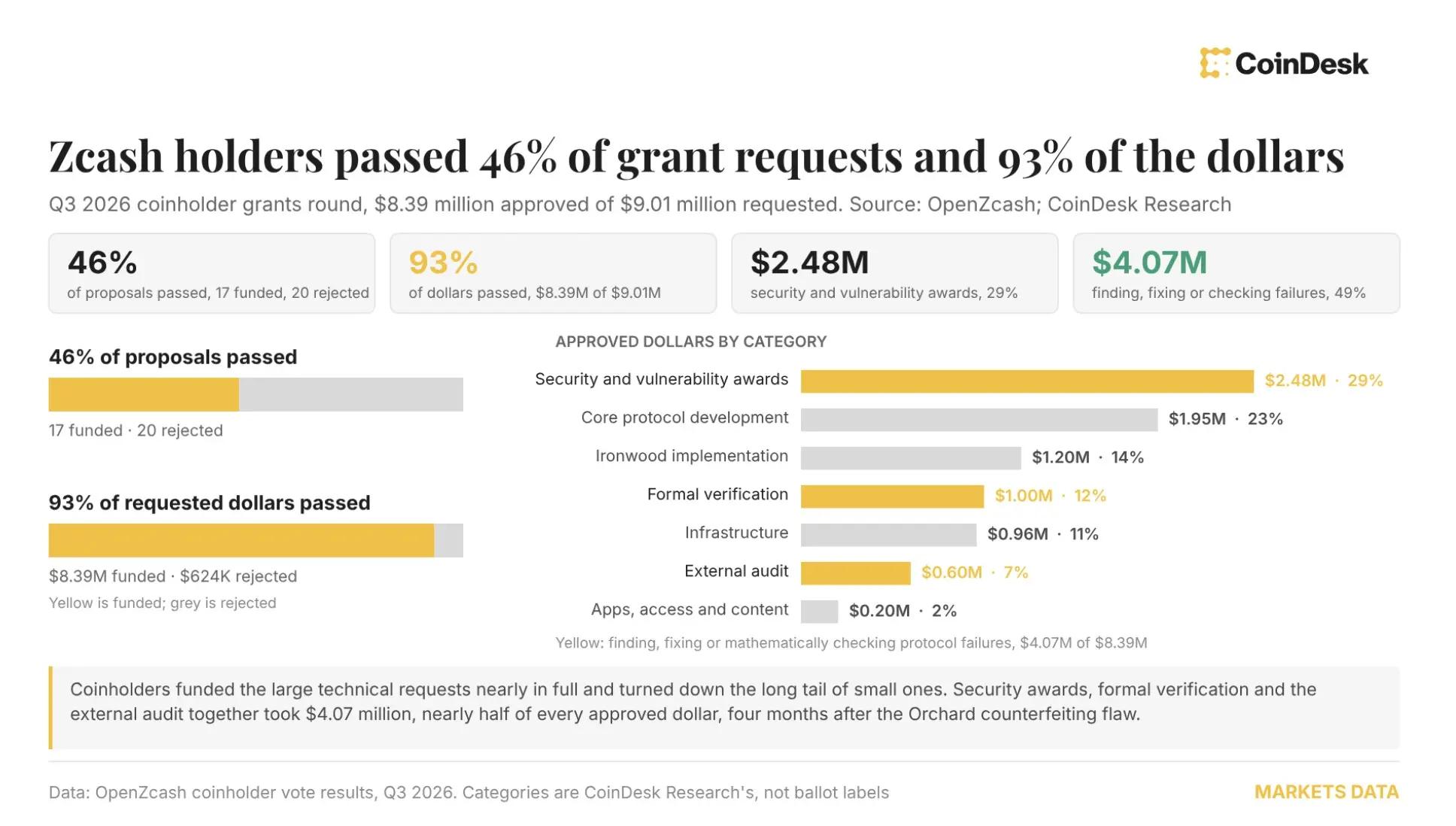
Much of the money went to the people who found and fixed the Orchard flaw. Taylor Hornby was awarded $1.5 million, a $750,000 bug bounty plus a matching bonus nominated by Jason McGee.
Project Tachyon was awarded $1 million for verifying Ironwood’s proofs, its $738,942 request topped up by a $261,058 bonus that McGee nominated in a personal capacity without Tachyon asking. McGee argued the team had priced its emergency work at the bottom of the market rate and sought nothing for the two-month delay to its own roadmap. ZODL won $1.95 million for core protocol work completed in the first half, and Valar Group won about $1.8 million for Ironwood integration and external audits.
Both bonuses passed with more than 99% of voting ZEC. Bug bounties and vulnerability rewards took about $2.5 million of the round, more than ZODL’s core development grant. Rounds like this draw on the 12% of block rewards that NU6.1 placed under coinholder control.
September showed holders will pay for major security work once it is delivered. Maxime Desalle’s Sept. 9 call to wind down Zcash’s development fund sparked the month’s funding debate. Shielded Labs replied on Sept. 15 that the community should first agree on what the fund should pay for and how large it should be. The debate centered on whether periodic votes give independent teams enough certainty to hire and plan ahead.
More ZEC entered privacy after the repair
Total shielded ZEC recovered toward May’s high. The 85,853 ZEC of net shielding in September was separate from the much larger movement of existing coins into Ironwood.
September closed with 4.94 million ZEC in shielded pools, 29% of circulating supply, after 85,853 ZEC of net new shielding. The total was back within about 240,000 ZEC of May’s 5.18 million peak. The intervening drop followed discovery and disclosure of the Orchard flaw, with a low near 4.28 million on July 27.
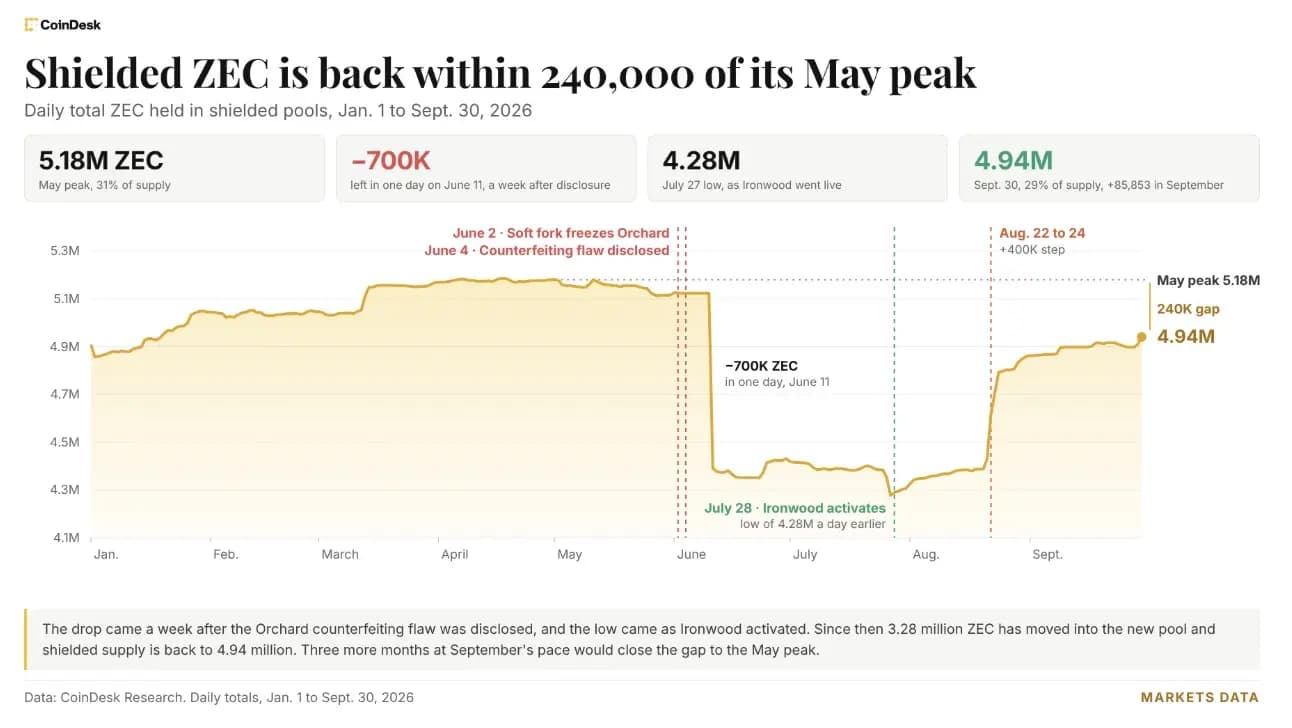
An Orchard-to-Ironwood transfer changes which pool holds the coins without changing the total amount shielded. Net shielding instead counts value moving from transparent addresses, where balances are public, into private pools, less withdrawals. Private activity rose as well. Shielded transactions reached 68,353 in the week to Sept. 27, the highest weekly count since tracking began in November 2024.
Mining capacity also climbed. September’s average hashrate, the computing power securing the network, reached about 27.8 GSol/s, up 13% from August’s 24.7. More hashing power raises the cost of attacking the chain.
Futures turnover outpaces spot trading nearly four to one
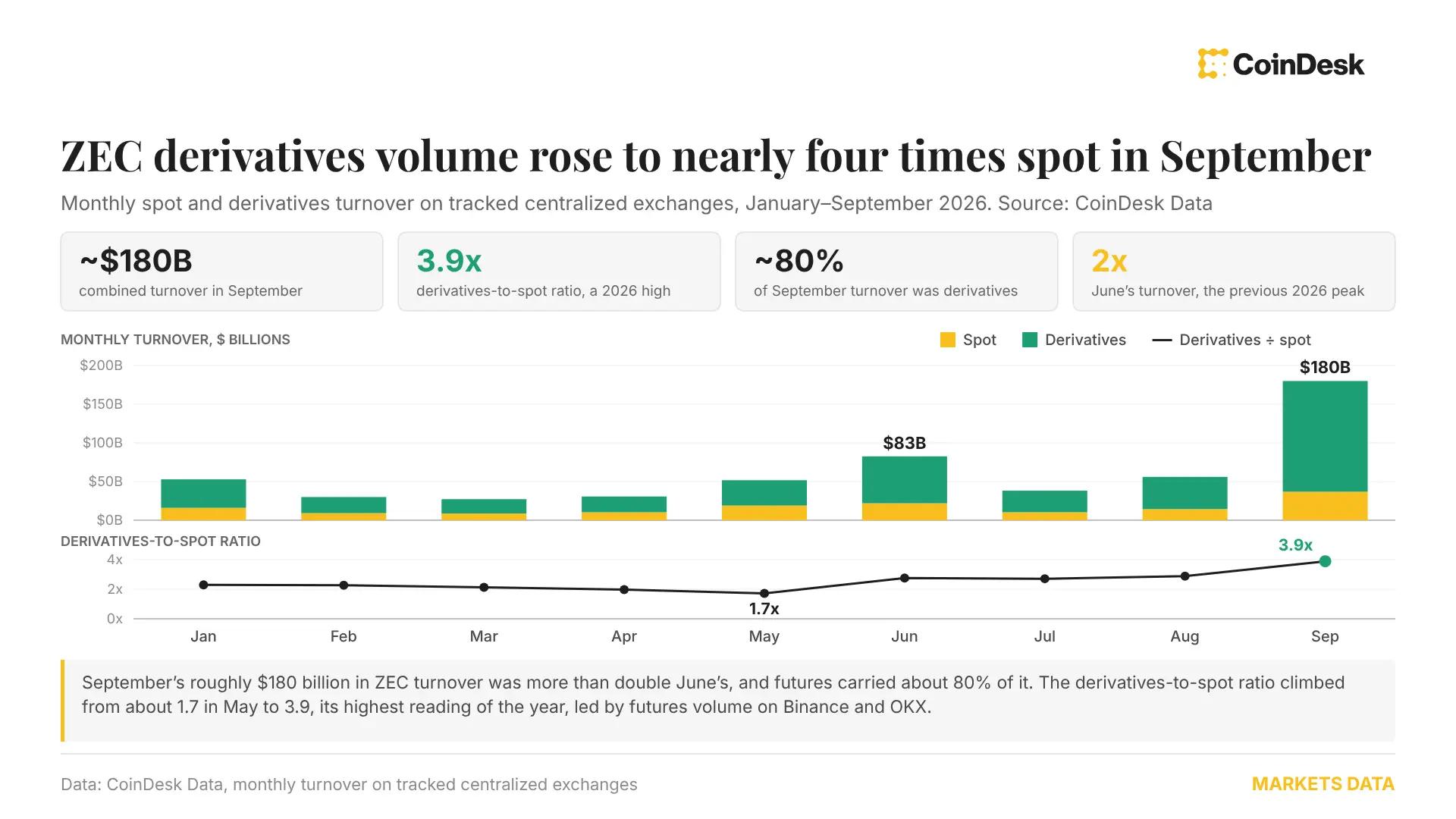
CoinDesk Research’s tracked venues showed an estimated $180 billion in combined spot and derivatives turnover in September, compared with about $80 billion in June. The derivatives-to-spot ratio reached 3.9, meaning nearly $4 traded in futures and other derivatives for every $1 of ZEC bought or sold outright. Binance accounted for about $76 billion in ZEC futures turnover, OKX about $43 billion and the onchain venue Hyperliquid nearly $15 billion.
Binance, Kraken and Coinbase supplied roughly 64% of the resting buy and sell orders within 1% of the market price on the tracked exchanges. That near-price depth sets how much ZEC can trade before the price moves. Near-market spot liquidity remained concentrated even as futures trading surged.
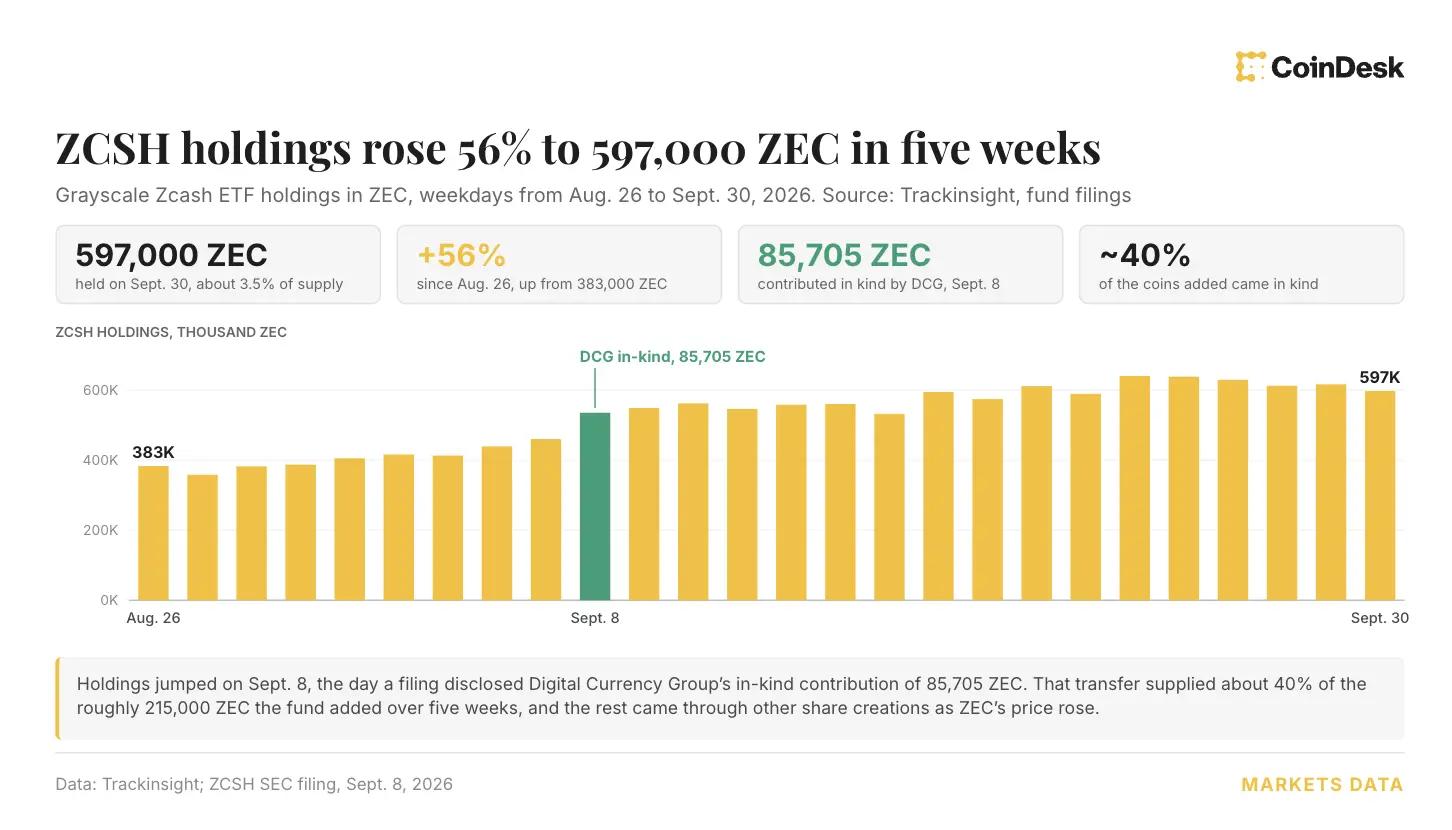
Grayscale’s ZEC fund grew 56% in five weeks
Grayscale’s Zcash fund, which trades under the ticker ZCSH, held about 597,000 ZEC at Sept. 30, up from roughly 383,000 on Aug. 26. That was about 3.5% of circulating supply. A contribution of 85,705 ZEC from Grayscale parent Digital Currency Group supplied about 40% of the five-week increase, according to a Sept. 8 filing. DCG delivered the coins directly from its own holdings. On Sept. 29, Grayscale added crypto bank Anchorage Digital as a second custodian for the fund, with Coinbase remaining primary custodian.
About 100,000 ZEC also circulated on Solana in September as wrapped tokens, each backed by ZEC held in reserve, giving holders another venue to trade.
The private vote and testnet showed that separate teams could agree and ship. NU7’s mainnet operation, continued private usage and predictable funding will test whether September’s momentum persist into October.