
Anvil is a shared on-chain collateral layer built on a programmable letter of credit: reserve assets as a guarantee -no loan, no interest, keep custody & yield.

Credit is the base layer of the modern economy and its largest single market - on the order of $250 trillion of obligations outstanding. Access to its lowest-cost form; secured credit lent against collateral; is determined by one variable: the operational cost of making a loan secure.
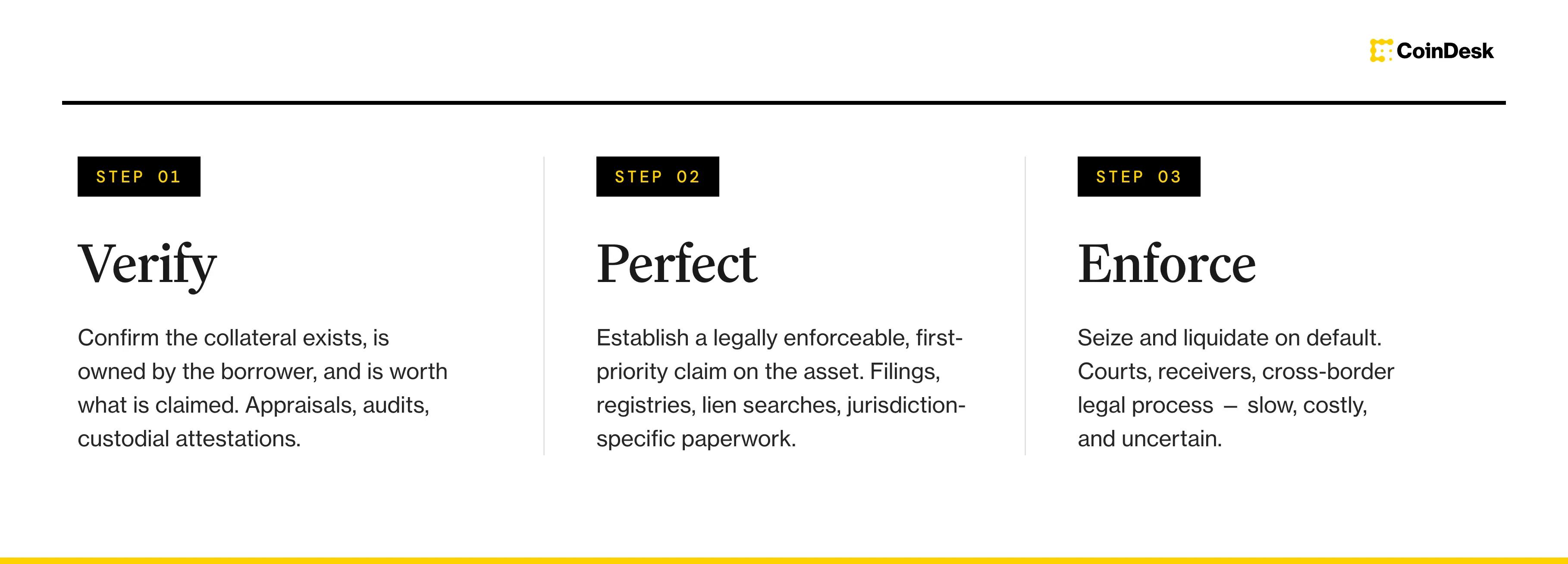
Converting a loan from unsecured to secured requires three operations:
None of these is conceptually difficult but all three are expensive and largely fixed per transaction regardless of deal size. That single fact determines who gets secured credit: only borrowers whose assets are standardised and liquid enough - Treasuries, large mortgages, blue-chip equity portfolios - and whose transaction size is large enough to justify the overhead. Everyone below that threshold is rationed out.
Letters of credit, the most collateral-intensive payment instrument in trade, cover just 12.5% of world trade by value. The Asian Development Bank (ADB) estimates $2.5 trillion in annual trade-finance demand goes unmet - largely because smaller transactions and SMEs cannot justify the operational cost. Banks reject around half of SME trade-finance applications against 7% for multinationals; the reason given is not borrower weakness but the friction of assessment itself.
In consumer credit, TransUnion describes the US market as K-shaped: the super-prime tier expands as established borrowers refinance on improving terms, while lower-rated borrowers carry rising debt-service burdens on shrinking credit lines.
The Moody's Baa - 10-year Treasury spread; a measure of how much extra yield investors demand to hold corporate debt over risk-free government bonds - sat around 1.6% in mid-2026, in the 5th percentile of its range since 2000. In other words, credit for established borrowers is as cheap as it has been at almost any point in the past 25 years. The problem is not a shortage of credit. It is that access to cheap credit is determined by operational cost, and that cost excludes most borrowers from the lowest-cost tier.
For borrowers excluded from secured credit, the alternatives are expensive by design: Buy Now, Pay Later - projected to exceed $1 trillion in market size by 2030 - charges high fees precisely because it extends unsecured credit to borrowers traditional lenders won't touch, pricing default risk into every transaction.
The pawn shop is the offline version of the same trade-off: bring what you own, receive a fraction of its value, pay a premium to access it. Both exist because no low-cost mechanism exists to secure a claim against the assets ordinary borrowers actually hold.
The same constraint applies to digital assets as there are now over 560 million crypto holders globally, with combined holdings worth billions - but almost none of that wealth is recognised in conventional credit models.
A holder of ETH, wstETH or tokenised Treasuries cannot walk into a bank and borrow against it. The assets exist, the value exists, but the verify-perfect-enforce machinery does not accommodate them. By renowned economist de Soto's definition, this is dead capital: assets owned but unable to be pledged, because no low-cost mechanism exists to secure a claim against them. He estimated the global stock of such assets at more than $9T (2015)- and that was before digital assets existed as an established category.
No single mechanism existed that could verify, perfect and enforce a claim against any asset, in any context, without a new registry per country.
That mechanism has since emerged within crypto as smart-contract collateral management solved all three steps automatically, at scale, and without intermediaries - but has operated only broadly on crypto-native assets.
On-chain lending protocols do all three in code as the chain already records who owns the collateral, so ownership is verified instantly; reserving it in a smart contract is itself the claim, with no paperwork to file; and if the borrower defaults, the contract leaves the position open for anyone to liquidate .
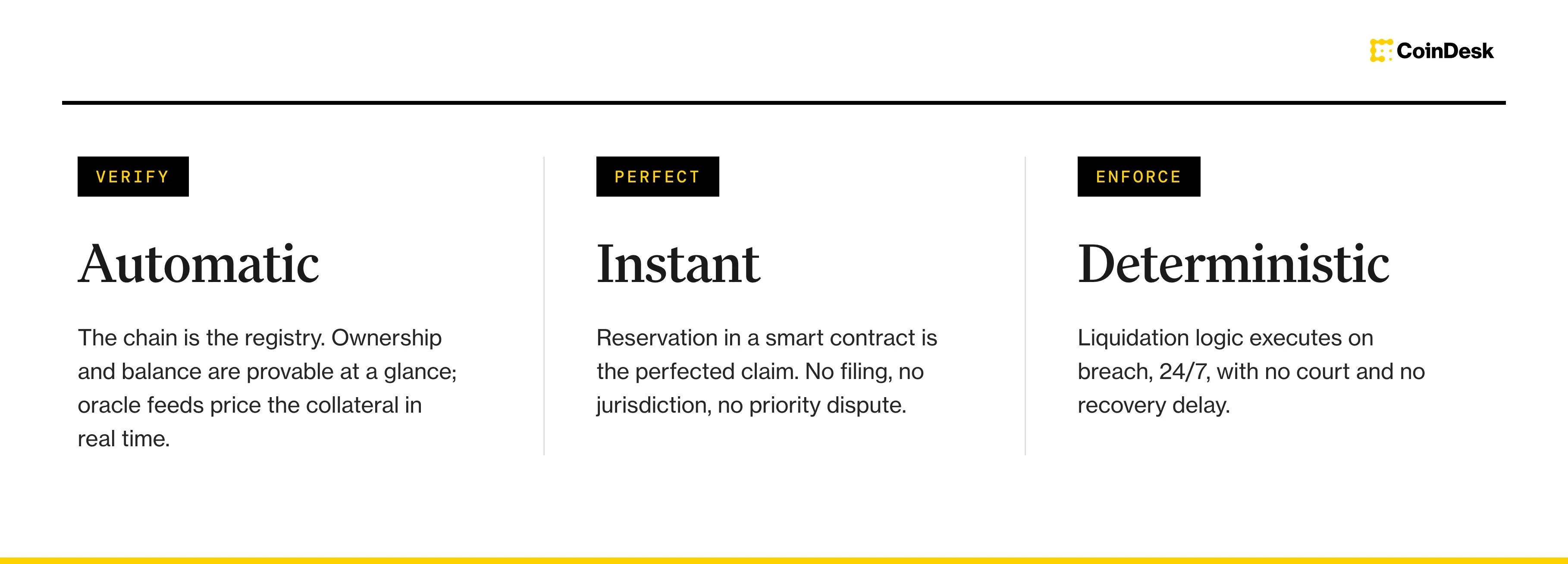
Active loans across all chains stand at $25B today, up from under $1B in 2020 - six years of live operation across significant collateral volumes, including through major market stress events. The implication is direct: the operational cost of secured credit is not fixed. It is a function of the infrastructure performing those three steps. Replace that infrastructure with code and the cost approaches zero.
In-spite of this, digital assets carry real trade-offs - slower to onboard, harder to use, less familiar than a bank account. DeFi built this capability as a lending product - the borrower deposits collateral, takes on debt, pays interest, and risks liquidation. Access therefore still requires holding capital upfront. The mechanism is cheaper but the access condition is unchanged: you need to already hold assets to participate.
The asset universe has also been limited to crypto-native tokens, though this is changing. Tokenised RWA market cap stands at $26B: $15B in bonds, with equities, commodities and private credit expanding the base. But plugging a wider asset universe into the same lending model does not resolve the access problem. A tokenised Treasury holder who posts collateral on Aave still takes on debt, pays interest, and risks liquidation.
What DeFi's cost reduction has not produced is a way to pledge collateral without becoming a debtor. That is the gap Anvil addresses, on both counts. It separates the guarantee from debt: collateral backs a claim rather than a loan, with no interest and the creator keeping custody and yield. And it is a general primitive rather than a protocol-specific feature - from one reserved pool of collateral, a creator can issue unlimited letters of credit, to any beneficiary and redeemable anywhere, instead of being confined to a single application's vault, rules, and liquidation engine.
Anvil is not a lending protocol i.e. it is a programmable, fully-collateralised payment guarantee - the on-chain equivalent of a cashier's cheque, backed by any eligible asset.
A letter of credit is one of the oldest instruments in commerce. In its traditional form, a buyer’s bank issues a written guarantee to a seller: if the buyer fails to pay, the bank will.
Traditional LOCs work, but they are slow and expensive to issue as a bank must assess risk, negotiate with counterparties, and manually verify documentation - a process that can take days, involves multiple intermediaries, and generates fees at every step. For smaller transactions or counterparties outside established banking networks, those costs often make the instrument uneconomic.
Anvil reproduces the economic function of a letter of credit in smart contract code, removing the intermediary and compressing the issuance process to a single on-chain transaction.
The mechanics are straightforward: a creator deposits collateral into the vault, issues a guarantee to a named beneficiary, and the beneficiary redeems on demand. No loan is taken out. No interest accrues. The creator retains custody of the collateral - and any yield it generates - until the moment the LOC is redeemed.
The collateral cannot be lent out from beneath the beneficiary as from the beneficiary's perspective, only the guaranteed credit value matters; the underlying collateral is abstracted away.
Anvil is early-stage - TVL currently stands at approximately $10M on Ethereum, having peaked at 36,000 ETH ($109M) in July 2025. The protocol is bootstrapped and fully open-source, audited by OpenZeppelin and Trail of Bits, and covered by two Immunefi bug bounty programmes.
Protocol governance is managed through the ANVL token, which has a circulating supply of 80 billion tokens against a total supply of 100 billion.
In June 2026, Anvil was accepted into the Ethereum Security Subsidy Program, a joint initiative of the Ethereum Foundation, Nethermind and Chainlink, reflecting the protocol's focus on security as a foundational requirement rather than an afterthought.
How this Differs from DeFi Lending
A borrow/lend protocol - Aave, Compound, Morpho - moves capital: the borrower takes out a loan, pays variable interest, and risks forced liquidation if the collateral value falls. The borrower is a debtor; the lender is a creditor; the protocol intermediates between them.
An Anvil LOC reserves capital rather than moving it - the creator is not a borrower, they are issuing a guarantee. The beneficiary is not a lender - they hold a claim they can exercise on demand. There is no interest rate and no pool of other depositors whose funds are at risk.
All collateral sits in a central Vault contract that maintains a hard separation between available and reserved balances. The moment a LOC is issued, the relevant balance is locked into a reservation that cannot be withdrawn, transferred or reused while the LOC is active.
The LOC contract manages the guarantee and supports two formats depending on whether the collateral and the asset the beneficiary receives are the same token or different ones.
In the simpler case, they match - a creator deposits USDC and the beneficiary receives USDC on redemption. In the cross-asset case, they differ - a creator might deposit WETH to back a USDC-denominated guarantee. Here the contract monitors the collateral ratio in real time; if it approaches the threshold, the collateral can be converted into the credited asset. As with a standard liquidation engine, this conversion is permissionless - any third party can execute it.
For larger-scale use cases - exchange credit lines, trade-finance programmes - multiple accounts can contribute collateral into a shared pool rather than issuing individual LOCs. Withdrawals from the pool require advance notice, giving beneficiaries certainty that the collateral will not be pulled mid-commitment.
The protocol currently charges no fees - no creation, interest, amendment or withdrawal charges. Any future fee change requires a governance vote.
In May 2026, Anvil launched its first institutional product at Consensus 2026 - enterprise-grade support for on-chain LOCs via institutional beneficiary helper contracts. The product reflects a core observation from the team: bringing institutional finance on-chain is not primarily a technology problem, it is an operational one.
Traditional corporate finance operates through role-based access - finance redeems, operations routes funds, support views status - and the institutional contracts replicate that structure on-chain.
Multiple LOCs can be managed in bulk, funds route directly to permissioned addresses without sitting in the contract, and passthrough metadata links on-chain events to internal systems such as invoice or customer IDs. For large institutions, commodity traders and logistics providers, this closes the gap between DeFi tooling and existing operational workflows.
Anvil's on-chain letter of credit is not limited to crypto: it addresses a requirement common across the economy - proving a counterparty will meet an obligation. It is a general substitute for the instruments built for that purpose - escrow, security deposits, prepayment, surety and performance bonds, standby letters of credit, exchange margin - each of which locks up capital to prove the same thing. A LOC consolidates them into one mechanism: reserve collateral already held, issue a verifiable guarantee, redeem only if the condition is met.
All of this presumes that the party issuing the guarantee must hold eligible on-chain collateral to reserve against. That prerequisite is what currently bounds the reach beyond crypto - and what the tokenisation of real-world assets progressively loosens, as each newly tokenised asset class brings a new set of parties able to pledge.
Real world applications include:
Because Anvil reduces the operational cost of proving a commitment, it does not compete for a defined market share. Its opportunity is the aggregate of the applications above, each of which currently locks capital, prepays, or pays a third party to stand behind an obligation - and those applications are illustrative, not exhaustive. Any transaction that today requires one party to prove it is good for an obligation is a candidate, so the addressable set expands as more of that activity moves on-chain.
The table below gives a sector anchor for each application - and highlights how big the potential Anvil opportunity set is in dollar terms.
Confining Anvil's addressable market to crypto-native use cases understates it; as the table shows, the applications draw on markets that are individually large - the $2.5T annual trade-finance gap, ~$560B in buy now pay later (BNPL) market size, ~$640B in global gambling revenue, and a subscription economy of comparable scale - and most sit outside crypto entirely. Any capital the economy immobilises to prove a commitment that may never be called - every security deposit, authorisation hold, surety bond, prepaid margin balance, and locked bid - is a use case the primitive can serve.
The operational cost of verify, perfect and enforce is what restricts access to secured credit - not borrower creditworthiness, not asset quality. DeFi proved that cost can be driven toward zero, but built a lending instrument that preserved the same access condition. Anvil's LOC primitive is designed to address that constraint directly.
Several conditions that the thesis requires are already moving: the collateral base is expanding as tokenised RWA market cap stands at $26B today, up from near-zero three years ago, with the asset class broadening beyond bonds into equities and private credit. The LOC primitive requires eligible on-chain collateral to operate against - that constraint is easing.
Regulatory clarity is improving as SEC's January 2026 joint statement confirmed tokenised securities sit under existing federal securities law. The UK's Electronic Trade Documents Act (2023) provides legal recognition for digital trade instruments in one of the world's largest trade finance jurisdictions. Neither directly addresses on-chain guarantees, but both reduce the ambient legal uncertainty that slows institutional adoption.
Secured credit is the lowest-cost form of borrowing and among the least accessible. The mechanism that makes it expensive is operational, not fundamental - and a version that drives that cost toward zero has already been demonstrated within crypto. The question is whether an on-chain guarantee instrument can extend that cost reduction beyond the crypto-native population to the broader set of borrowers and counterparties the traditional system currently prices out.