Introduction
TLDR
1 Plasma
A. Tech Stack
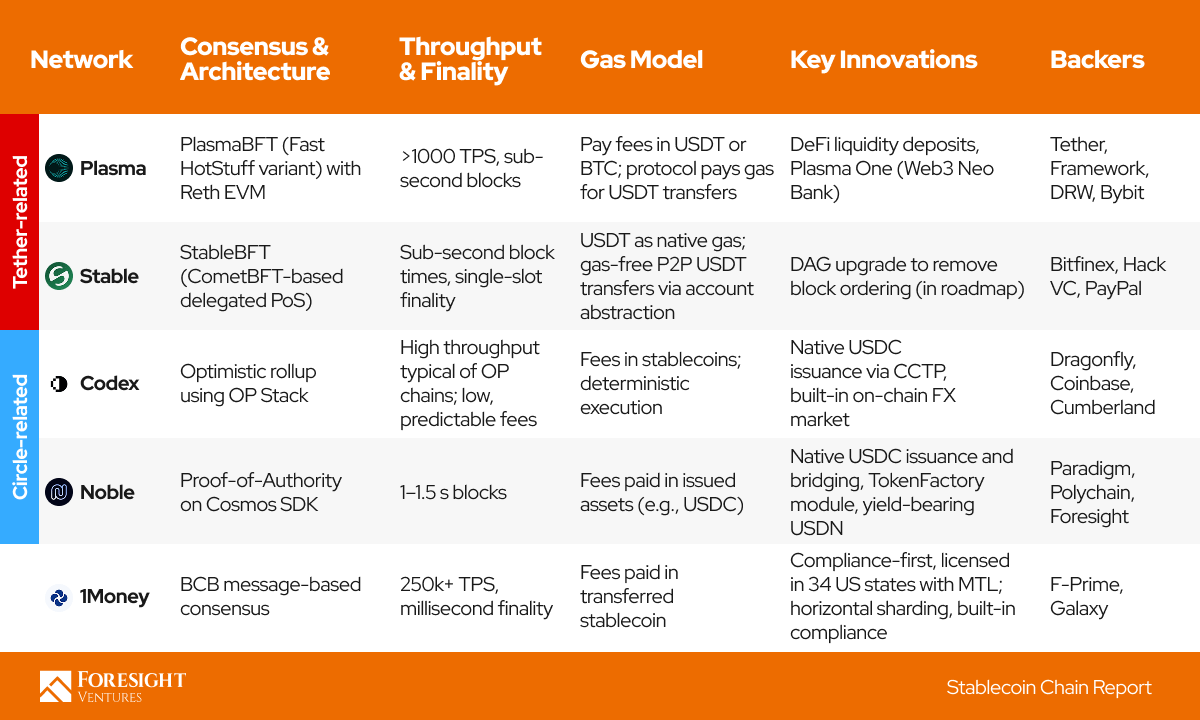
Plasma is a high‑performance Layer 1 designed for stablecoin settlement. It uses PlasmaBFT, a pipelined variant of the Fast HotStuff algorithm, coupled with the Reth execution engine for Ethereum‑Virtual‑Machine (EVM) compatibility. This combination delivers 1000+ transactions per second (TPS) and sub‑second block times, while supporting more than 15 different stablecoins. A protocol‑managed paymaster sponsors gas fees for USDT transfers, enabling zero‑fee transactions. Users can also pay fees in other stablecoins (e.g., USDT or bridged BTC), avoiding volatile native tokens. The chain integrates a trust‑minimised Bitcoin bridge, allowing BTC to interact with its EVM environment and enabling hybrid applications.
B. GTM
In September 2025, the team also rolled out Plasma One—a stablecoin-native neobank with a Visa-licensed card issued by Signify Holdings—supporting zero-fee USDT transfers, spend-while-you-earn balances, and up to 4% cashback.
C. Traction
Plasma has generated strong market heat. Its official account on X gained more than 130,000 followers in its first year. The deposit campaign and high‑profile investors (Founders Fund, Framework and Bitfinex) fuelled community interest. Testnet campaigns have involved wallet providers such as Gate, and partnerships with payment companies like Yellow Card are promoting real‑world remittance pilots. Plasma claims to have processed over US$1 billion in cross‑chain stablecoin deposits during its testnet, and roughly US$2 billion of liquidity is expected at mainnet launch.
D. Development Progress
Plasma’s testnet demonstrated support for over 1000 TPS, sub‑second block times and second‑level transaction finality. The network plans to aggregate more than fifteen stablecoins at launch and has integrated with node services such as QuickNode and Tenderly. Official documentation describes an EVM‑compatible chain with support for custom gas tokens, confidential transactions and an optional paymaster that sponsors USDT gas fees. Although zero‑fee transfers for USDT are available, other tokens still incur minimal fees, and high‑frequency trading may exceed the system’s current capacity. Developers can deploy smart contracts via Reth, and improvements to throughput and privacy are ongoing.
2. Stable
A. Tech Stack
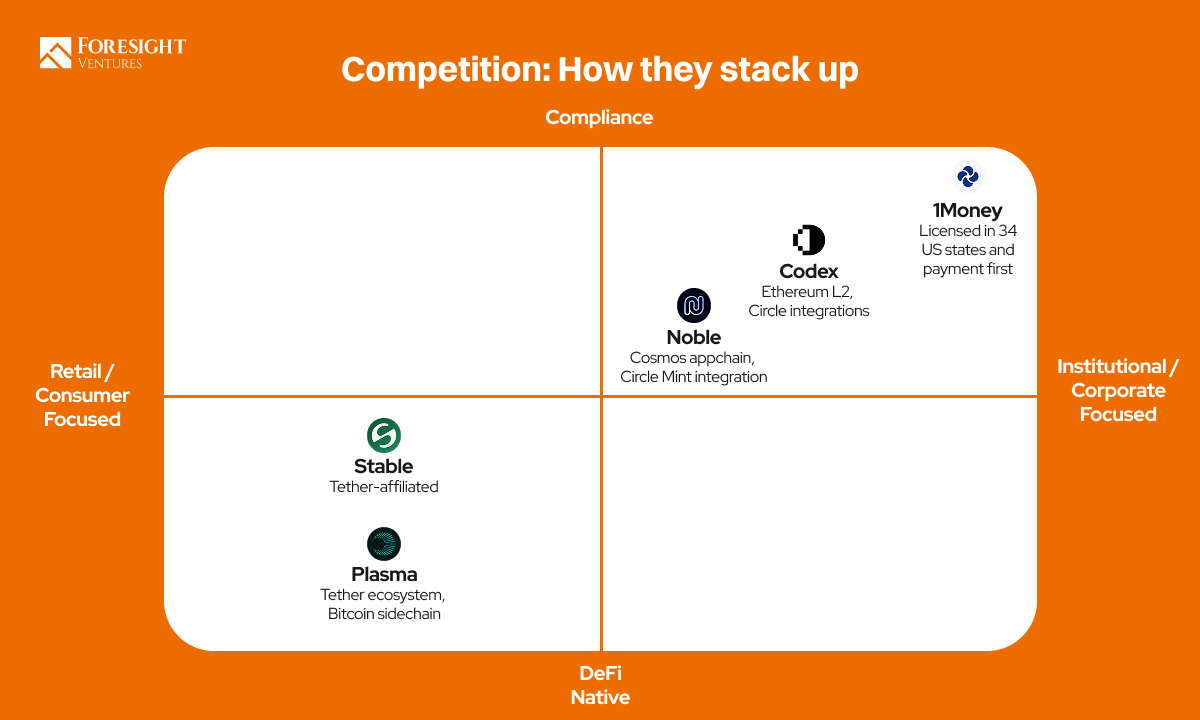
Stable is a Tether/Bitfinex‑backed Layer 1 designed for USDT‑native payments. Its consensus mechanism, StableBFT, is a delegated proof‑of‑stake variant built on CometBFT (a Tendermint fork). StableBFT provides sub‑second block times and single‑slot finality, and the network is fully EVM‑compatible. A planned Autobahn DAG upgrade will further reduce latency by eliminating block ordering. Stable uses gasUSDT as its gas token; through account‑abstraction and a paymaster/bundler system, users can pay fees directly in USDT and even execute peer‑to‑peer USDT transfers without gas fees. For non‑USDT transactions, the bundler converts gas to gasUSDT behind the scenes.
B. GTM
Stable leverages Tether and Bitfinex’s network to attract users and institutions. It announced a US$28 million seed round in mid‑2025 from investors including Hack VC, Franklin Templeton, Bybit and KuCoin. The public messaging emphasises a three‑phase roadmap: (1) build the core network and USDT gas model; (2) release a cross‑currency aggregator and reserved block space for enterprise clients; and (3) optimise speed, provide developer tools and enrich the application ecosystem. By positioning itself as “USDT‑exclusive,” Stable aims to capture the vast liquidity that currently flows on Tron and Ethereum.
C. Traction
Stable’s social following quickly exceeded 160,000 followers, reflecting strong retail interest. Executives from Tether and Bitfinex, including Paolo Ardoino, frequently promote the project. Community discussion recognises the importance of a regulated stablecoin chain but is also waiting for empirical testnet data. Because stable emphasises compliance, it is well positioned to court institutional users once performance and security are demonstrated.
D. Development Progress
Stable launched its internal testnet in mid‑2025. The network claims to support thousands of TPS and sub‑second finality, and it will offer gas‑free USDT transfers via account abstraction. Unlike Plasma, which sponsors only USDT gas, Stable uses USDT as the gas token itself. Detailed performance metrics are not yet publicly available because the mainnet is scheduled for late 2025 or early 2026. The team has outlined plans to release a transfer aggregator that automatically handles cross‑chain swaps and routes, allowing a user to send USDT on one chain and the recipient to receive USDC on another without manual bridging. For now, market participants expect the testnet to confirm the promised throughput and reliability.
3 Codex
A. Tech Stack
Codex is an Ethereum Layer 2 built on the Optimism OP Stack and hosted by Conduit. It is designed as a stablecoin‑only network for B2B and enterprise settlements rather than a general‑purpose DeFi chain. Codex leverages optimistic rollup technology to inherit Ethereum’s security while providing predictable low fees and stable performance. Its design supports native USDC issuance via Circle’s Cross‑Chain Transfer Protocol (CCTP) and offers built‑in foreign‑exchange and custody modules. Fees are denominated in stablecoins, and deterministic execution ensures that high‑frequency transactions complete reliably.
B. GTM
Codex targets enterprise cross‑border payments and other high‑volume use cases. The team emphasises compliance and collaborates with custodians like Fireblocks and wallet‑as‑a‑service providers like Dfns. Strategic investors include Coinbase, Circle Ventures and Cumberland. In July 2025, Circle deployed native USDC on Codex, making it one of the youngest networks to support CCTP‑enabled minting. The project works closely with payment service providers, FX brokers and on‑/off‑ramp partners to reduce friction for institutional users. Its marketing deliberately avoids retail hype and focuses on building trust with regulated financial institutions.
C. Traction
Because Codex does not offer a retail token sale or airdrop, its public community is small (around 7,000 followers on X). However, industry professionals view its partnerships with Circle and Coinbase as endorsements of its compliance stance. Media articles emphasise that Codex positions itself as an “institutional‑grade stablecoin channel” rather than a speculative chain.
D. Development Progress
Codex launched its mainnet on 24 June 2025, supporting native USDC issuance and cross‑chain settlement. The OP Stack architecture allows the network to handle high‑frequency transactions at minimal cost; typical gas fees are a fraction of a cent. Codex emphasises features like on‑chain atomic swaps and compliance checks that ensure KYC/AML processes are completed during transactions. Circle’s CCTP integration enables users to mint and redeem USDC directly on Codex, while ongoing work on Codex Avenue promises instant FX settlement for multiple fiat‑backed stablecoins. Current circulating USDC on Codex is modest (about US$1.7 million), reflecting the early stage of the network, and there is no widely tracked TVL data because the network focuses on payments rather than DeFi liquidity.
4 Noble
A. Tech Stack
Noble is a Cosmos SDK–based application chain purpose‑built for on‑chain asset issuance. It adopts a Proof‑of‑Authority (PoA) consensus mechanism using CometBFT. The validator set is permissioned and controlled by a committee; misbehaving validators are “tombstoned,” meaning their signing keys are permanently disabled. Blocks are produced roughly every 1–1.5 seconds. Noble supports the Inter‑Blockchain Communication (IBC) protocol, allowing tokens issued on Noble to flow freely to other Cosmos chains. The chain offers features such as a TokenFactory module for minting and burning assets and integrates Circle’s CCTP for seamless USDC conversions. There is no native gas token; fees are paid in the issued assets (e.g., USDC), and the chain is designed to be a neutral issuance hub.
B. GTM
Noble markets itself as the “stablecoin issuance chain” for the Cosmos ecosystem. Its first major partnership was with Circle, which in April 2023 enabled the native issuance of USDC on Noble. The chain then distributes USDC across nearly 50 Cosmos chains via IBC packet forwarding. To increase user retention, Noble collaborated with the M^0 protocol to launch USDN, a yield‑bearing stablecoin backed by short‑term U.S. Treasury bills. Users can convert USDC into USDN and choose between a Points Vault (sacrificing yield to earn points for future incentives) and a Boosted Vault (earning baseline Treasury yield plus extra yield forfeited by points participants). As of mid‑2025, the boosted vault had been discontinued but the points vault continues to distribute yield.
C. Traction
Noble’s official X account has around 30,000 followers, comprised largely of Cosmos ecosystem participants. Market sentiment is positive: native USDC issuance solved a long‑standing liquidity gap in Cosmos, and the introduction of USDN brought U.S. Treasury yields on‑chain. Some concerns remain regarding centralisation and reliance on off‑chain custodians, but the team actively engages with the community to explain security measures. The chain processed over US$5 billion in USDC transfers in its first year, demonstrating robust demand.
D. Development Progress
Noble launched its mainnet in Q2 2023 and has undergone multiple upgrades. Besides USDC, Noble supports other stablecoins such as OUSD (Ondo) and EURe (Monerium). It plans to issue additional real‑world asset tokens and decentralised stablecoins. According to DeFiLlama, the total market capitalisation of stablecoins on Noble is about US$408 million, with USDC accounting for ~82% and USDN ~16% of supply. USDN’s yield, derived from T‑bills, is roughly 4.08% annually. Fees on Noble average around US$0.01 per transaction, and cross‑chain transfers via IBC add negligible latency. Notably, there is no native support for USDT; USDT must be converted to USDC before entering the Cosmos ecosystem via Noble.
5 1Money
A. Tech Stack
1Money is a Layer 1 network founded by former Binance US CEO Brian Shroder. It is built on a messaging‑based consensus protocol called Byzantine Consistent Broadcast (BCB). Rather than producing blocks, 1Money processes each transaction individually. Senders sign a payment message; validators verify it and countersign. Once a quorum of signatures is gathered, a certificate is generated and the transaction becomes final, achieving instant determinism. The protocol enables horizontal node‑level sharding—adding nodes or hardware increases throughput linearly—and uses a built‑in governance system for updating validator sets and fee schedules. A Substack review of 1Money reports that the network currently supports over 250,000 TPS and can scale almost indefinitely through node‑level parallelism.
B. GTM
1Money focuses on mainstream payment users and emphasises simplicity. Unlike other blockchains, it has no native gas token, no staking and no governance voting, thereby removing complexity for merchants. Transaction fees are paid directly in the transferred stablecoin at fixed amounts, and partnerships with payment processors may subsidise these fees. The project raised over US$20 million in seed funding, with investors including Fidelity’s F‑Prime, Galaxy Digital, Kraken, KuCoin and BitGo. 1Money also operates 1Money Global, offering stablecoin debit cards and USD account infrastructure, positioning the network as a bridge between traditional finance and Web3.
C. Traction
1Money’s community is still small (approximately 7,000 followers on X), reflecting its early stage. Because the project has not conducted token sales or airdrop campaigns, retail speculation is limited. Nonetheless, the involvement of high‑profile executives and compliance experts (such as former U.S. FinCEN Director Ken Blanco and former OFAC Director Michael Mosier) lends credibility. Press releases on PYMNTS and Stabledash emphasise that 1Money can process 250,000+ TPS and provide near‑instant confirmations.
D. Development Progress
1Money launched its public testnet and developer portal on 6 August 2025. Early tests demonstrate that payments process within milliseconds and achieve instant finality thanks to the BCB consensus. The network is currently optimising the stability of BCB based on testnet feedback and preparing for security audits. The mainnet is slated for Q4 2025. Because 1Money does not support smart contracts, developer integration revolves around APIs and SDKs rather than on‑chain programmability. The key performance metrics emphasised in marketing materials—250,000 TPS, <1 s confirmation and gas‑free transfers—still need to be validated once the mainnet is live.
Conclusion